Professionally, I’m a retired professor of accounting and former chair of the School of Accounting at the University of South Carolina’s Moore School of Business. My academic work explored how people make decisions in complex systems, especially when information is imperfect or overwhelming. I’ve published in a fair number of journals that few people read voluntarily, and I spent decades thinking about how technology shapes human behavior.
These days, my time is divided between managing a small flock of chickens, herding goats, chatting on amateur radio (KO4LMP), and living just on the edge of the grid—literally and metaphorically. I’m a father to five daughters, a grandfather to 17, and a great-grandfather to three. Somewhere along the way, I realized that what I enjoy most is simply talking about the world we live in—and how to make sense of it.
Professionally, I’m a retired professor of accounting and former chair of the School of Accounting at the University of South Carolina’s Moore School of Business. My academic work explored how people make decisions in complex systems, especially when information is imperfect or overwhelming. I’ve published in a fair number of journals that few people read voluntarily, and I spent decades thinking about how technology shapes human behavior.
These days, my time is divided between managing a small flock of chickens, herding goats, chatting on amateur radio (KO4LMP), and living just on the edge of the grid—literally and metaphorically. I’m a father to five daughters, a grandfather to 17, and a great-grandfather to three. Somewhere along the way, I realized that what I enjoy most is simply talking about the world we live in—and how to make sense of it.
This is part of a series where I use AI to identify a variety of plants, animals, insects, rocks, diseases, et cetera, with the hopes of illustrating just how useful and interactive AI can be.
ChatGPT said:
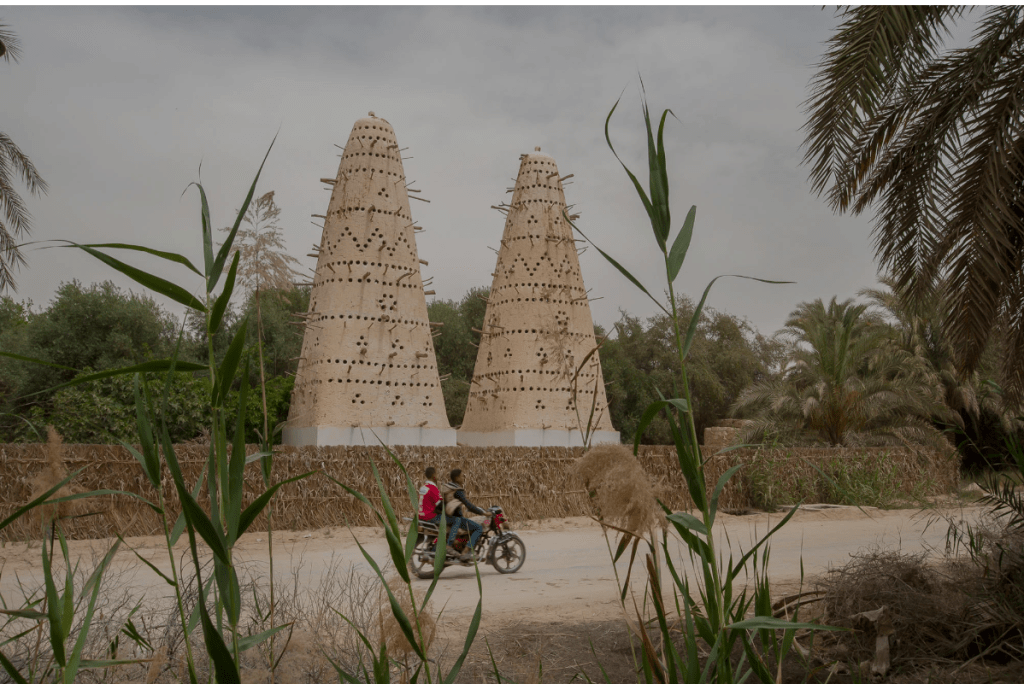
These look very much like traditional pigeon towers (dovecotes), common in parts of North Africa and the Middle East, especially Egypt.
Why I think they’re pigeon towers
Conical shape is characteristic of many traditional dovecotes.
The hundreds of small round holes are entrance holes for pigeons.
The wooden pegs sticking out provide perches for birds before they enter.
They are built from mud brick or plastered earth, materials commonly used in hot, dry climates.
The pigeons served several purposes:
Fertilizer: Pigeon droppings were a valuable, nitrogen-rich fertilizer for crops.
Food: Squabs (young pigeons) were raised for meat.
Occasionally communication: Though these large towers were primarily for breeding rather than housing messenger pigeons.
The surrounding date palms also fit well with an oasis environment, which points toward places like:
Egypt (especially the Nile Valley or oases such as Fayoum or Siwa)
Parts of Tunisia
Morocco
Less commonly, similar structures can be found elsewhere across North Africa.
I’m about 90–95% confident these are pigeon towers rather than beehives or grain silos. Beehives generally have much smaller openings and lack the external perches.
Can you please create for me a best estimate of which temples of The Church of Jesus Christ of Latter-day Saints will be in operation by January 2028?
ChatGPT said:
Worked for 56s
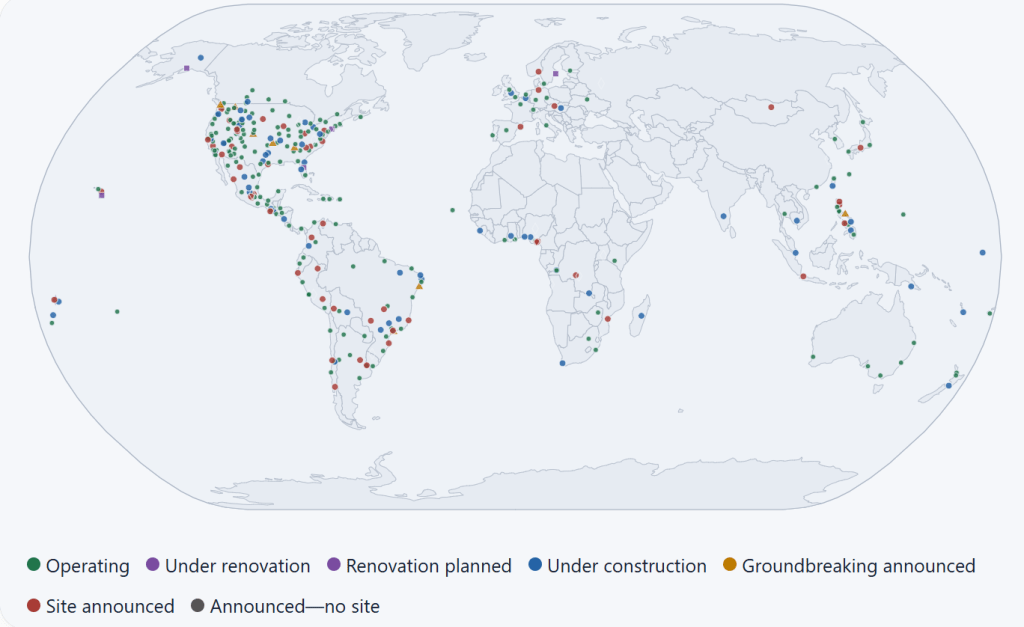
Best estimate as of July 31, 2026
The Church’s official figures currently show:
209 temples in operation
6 closed for renovation on the Church’s count; the detailed construction tracker counts eight major renovation projects because Anchorage remains open during construction and San Diego is approaching rededication
61 new temples under construction
105 announced temples, including eight with scheduled groundbreakings and 53 with officially announced sites
385 temples altogether
My central estimate is that about 265 temples will be operating on January 1, 2028, with a reasonable range of 258–272.
That estimate consists approximately of:
Component
Estimate operating Jan. 1, 2028
Operating now
209
New temples presently under construction
44–50
Renovated temples returned to service
6–8
Temples whose groundbreakings are scheduled in 2026
1–4
Estimated total
260–271; central estimate 265
The Church cautions that construction and dedication schedules can be delayed.
1. Temples currently in operation
The official Church list contains 209 operating temples as of July 27, 2026. On that list, an operating temple is identifiable by a dedication date rather than “Construction,” “Announced,” “Renovation,” or “Opening Soon.”
Because reproducing all 209 names would obscure the more useful forward-looking portion of the report, the Church’s official Temple List is the definitive Category 1 list. It includes each temple’s location and dedication date.
One wrinkle is Anchorage Alaska: it remains open while exterior renovation work continues, so I include it among operating temples rather than treating it as closed.
2. Ground broken, groundbreaking announced, or renovation underway/planned
A. New temples under construction — 61
Virtually certain to operate before January 2028
These are already scheduled for dedication or are at the open-house/final-completion stage:
Belo Horizonte Brazil
Cleveland Ohio
Phnom Penh Cambodia
Miraflores Guatemala City Guatemala
Ephraim Utah
Managua Nicaragua
Montpelier Idaho
Cody Wyoming
Wichita Kansas
San Luis Potosí Mexico
Modesto California
Torreón Mexico
Pago Pago American Samoa
Smithfield Utah
Fort Worth Texas
Knoxville Tennessee
Port Moresby Papua New Guinea
Neiafu Tonga
The first twelve are already preparing for dedication or public open houses in 2026; the following six are at or near major construction completion.
Strong probability of operation before January 2028
Port Vila Vanuatu
Freetown Sierra Leone
Santa Cruz Bolivia
Querétaro Mexico
Ribeirão Preto Brazil
Londrina Brazil
Cagayan de Oro Philippines
Santiago West Chile
Austin Texas
Kaohsiung Taiwan
Grand Rapids Michigan
Cali Colombia
Natal Brazil
Lubumbashi Democratic Republic of the Congo
Teton River Idaho
Lethbridge Alberta
Vancouver Washington
Tarawa Kiribati
Winchester Virginia
These generally have exterior cladding, windows, landscaping or interior finish work underway.
Possible by January 2028, but schedule risk is material
Birmingham England
Budapest Hungary
Lone Mountain Nevada
Wellington New Zealand
Tampa Florida
Tacloban City Philippines
Antananarivo Madagascar
Jacksonville Florida
Fairbanks Alaska
João Pessoa Brazil
Cape Town South Africa
Missoula Montana
Fairview Texas
Kumasi Ghana
Benin City Nigeria
Heber Valley Utah
Singapore
Most are between foundation work and structural framing. Fairbanks and Tarawa use modular construction, which may allow faster completion than their present appearance suggests.
Unlikely to operate by January 2028
Bengaluru India — construction temporarily halted
Lagos Nigeria — groundbreaking held May 10, 2025, but no substantial construction status reported
Brazzaville Republic of the Congo — groundbreaking held August 23, 2025
Brussels Belgium — groundbreaking held November 22, 2025
Huehuetenango Guatemala — groundbreaking held March 14, 2026
Teresina Brazil — groundbreaking held April 18, 2026
Springfield Missouri — groundbreaking held June 6, 2026
These could advance rapidly, but January 2028 would require relatively short construction periods.
B. Groundbreakings already scheduled — 8
Santos Brazil — August 1, 2026
Naga Philippines — August 8, 2026; preliminary site work underway
Huntsville Alabama — August 15, 2026; zoning board recommended approval
Tulsa Oklahoma — August 22, 2026
Victoria British Columbia — August 22, 2026; zoning bylaw approved
Coeur d’Alene Idaho — August 29, 2026; site staked and preliminary work anticipated
Colorado Springs Colorado — September 12, 2026; heavy equipment already on site
Maceió Brazil — October 10, 2026
January 2028 judgment: I would not count any as certain. Naga, Coeur d’Alene and Colorado Springs appear to have the best chance, especially should modular or standardized construction be used. One to four of this group may be dedicated before January 2028.
C. Temples under major renovation — 8
San Diego California — preparing for rededication; certain to reopen in 2026
Salt Lake — open house begins April 5, 2027; certain to operate during 2027
Kona Hawaii — advanced exterior and grounds work; likely by 2027
Anchorage Alaska — remains open during renovation
Manhattan New York — exterior and interior renovation progressing; likely by 2027
Stockholm Sweden — exterior work progressing; likely by 2027
Orlando Florida — interior and grounds renovation progressing; likely by 2027
Provo Utah Rock Canyon — exterior enclosure and landscaping underway; likely by 2027
D. Renovation announced but not yet begun
Apia Samoa — scheduled to close December 23, 2026. Because that leaves only about twelve months before January 2028, I regard reopening by the target date as possible but less likely than not.
3. Announced temples with an officially identified site
The detailed tracker reports 53 temples with officially announced sites, in addition to the eight scheduled groundbreakings above.
São Paulo East Brazil — site announced; planning and approvals; official name not finalized
Mexico City Benemérito Mexico — site and rendering released
Barcelona Spain — site cleared; seeking government approvals
Vitória Brazil — former buildings demolished and site cleared
Oslo Norway — site and rendering released
Charlotte North Carolina — replacement site announced March 23, 2026
Bakersfield California — seeking height-related zoning modification; environmental study conducted
La Paz Bolivia — site and rendering released
Sunnyvale California — site and rendering released
Vienna Austria — site and rendering released; groundwater investigation performed
Harrisburg Pennsylvania — site and rendering released
Viña del Mar Chile — existing meetinghouse closed for demolition
Toluca Mexico — site and rendering released
Cuernavaca Mexico — site cleared; rendering released
Cusco Peru — site announced
Iquitos Peru — site announced
Jakarta Indonesia — site and rendering released
Osaka Japan — earthwork underway; rendering released
Savai’i Samoa — site and rendering released
Kananga Democratic Republic of the Congo — site announced
West Jordan Utah — preliminary site-plan approval being sought
Lehi Utah — retaining walls, storm drains and excavation underway
Cincinnati Ohio — preliminary site preparation underway
Des Moines Iowa — seeking local approvals
Tacoma Washington — traffic-impact analysis published
Buenos Aires City Center Argentina — injunction overturned; preparing building-permit application
Florianópolis Brazil — fencing and ground preparation underway
Culiacán Mexico — site and rendering released
Tuguegarao City Philippines — site and rendering released
Retalhuleu Guatemala — site and rendering released
Eket Nigeria — site announced
Chihuahua Mexico — site and rendering released
Ulaanbaatar Mongolia — site and rendering released
Fort Bend Texas — access-road extension underway
Piura Peru — site and rendering released
Calabar Nigeria — site and rendering released
Yuma Arizona — site and rendering released
Beira Mozambique — site announced
Spanish Fork Utah — design well underway; soil and groundwater testing completed
Kahului Hawaii — site announced
Flagstaff Arizona — site announced
Puerto Montt Chile — site announced
Norfolk Virginia — site and rendering released
Santiago Philippines — site and rendering released
Iloilo Philippines — site and rendering released
Rapid City South Dakota — site and rendering released
Rosario Argentina — site announced
Caldwell Idaho — site announced
Greenville South Carolina — site and rendering released
Hamburg Germany — site announced
Goiânia Brazil — site announced
Medellín Colombia — site announced
Campo Grande Brazil — site announced
Chances of operating by January 2028
I would place only a few of these in the plausible category:
Lehi Utah — best prospect because excavation and infrastructure work are already underway.
Osaka Japan
Florianópolis Brazil
Cincinnati Ohio
Spanish Fork Utah
Fort Bend Texas
Even these would need groundbreakings soon and comparatively rapid construction. I have included zero to two from this entire site-announced group in my central January 2028 estimate.
4. Announced temples without an officially located site
I count 44 in this category:
Russia
Shanghai People’s Republic of China
Dubai United Arab Emirates
Monrovia Liberia
Busan Korea
Chiclayo Peru
Pachuca Mexico
Tula Mexico
Laoag Philippines
Mbuji-Mayi Democratic Republic of the Congo
Luanda Angola
Cape Coast Ghana
Huancayo Peru
Roanoke Virginia
Cancún Mexico
Brisbane Australia South
Edinburgh Scotland
Maracaibo Venezuela
Uturoa French Polynesia
Honolulu Hawaii
Juchitán de Zaragoza Mexico
Santa Ana El Salvador
Santiago Dominican Republic
Dublin Ireland
Milan Italy
Abuja Nigeria
Kampala Uganda
Maputo Mozambique
Queen Creek Arizona
El Paso Texas
Milwaukee Wisconsin
Summit New Jersey
Price Utah
Reynosa Mexico
Chorrillos Peru
Rivera Uruguay
Porto Portugal
Uyo Nigeria
San Jose del Monte Philippines
Nouméa New Caledonia
Liverpool Australia
Portland Maine
Marysville Washington
Otavalo Ecuador
I would expect none of these to be operating by January 1, 2028. Even if a site were announced during late 2026, the normal sequence of design, approvals, groundbreaking, construction, open house and dedication makes that target very unlikely.
Bottom line
My best single-number estimate is:
Approximately 265 operating temples on January 1, 2028.
The most conservative defensible figure is about 258; an unusually rapid construction and dedication schedule might produce 270–272. The largest uncertainty is not the temples already near completion—it is how many of the middle-stage construction projects, particularly in Africa, Latin America, Asia and the Pacific, can be completed and dedicated during 2027.
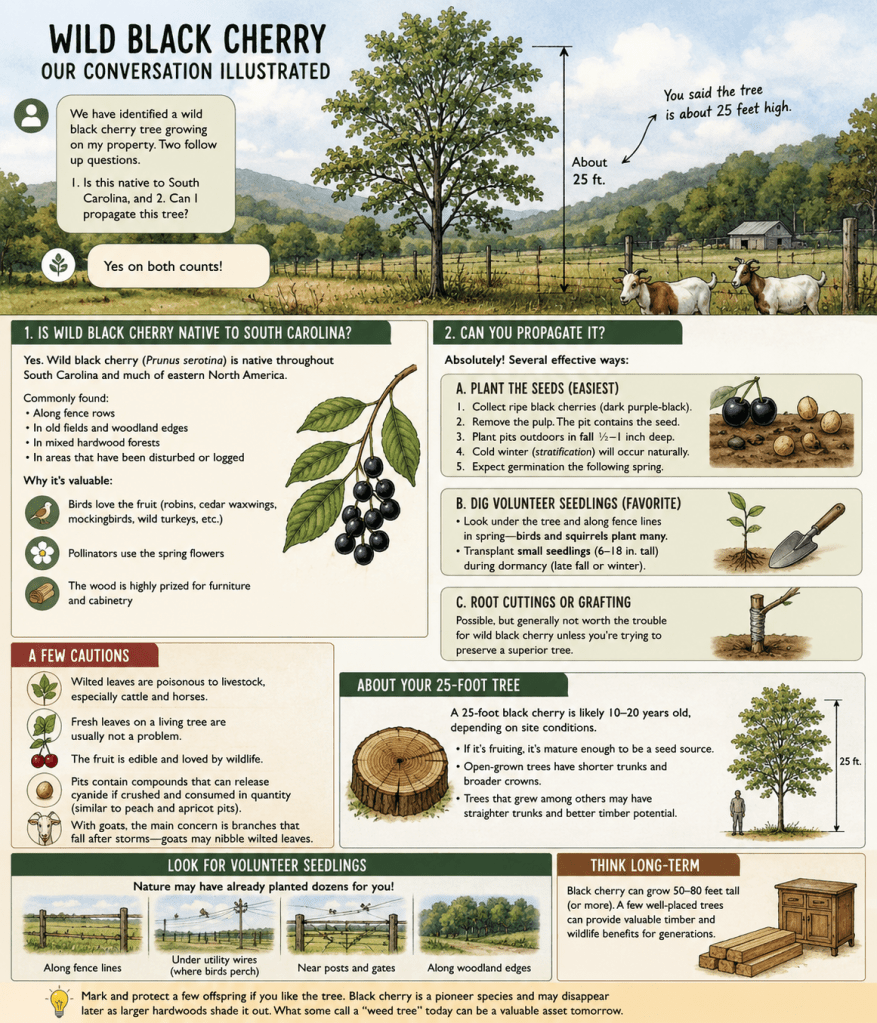
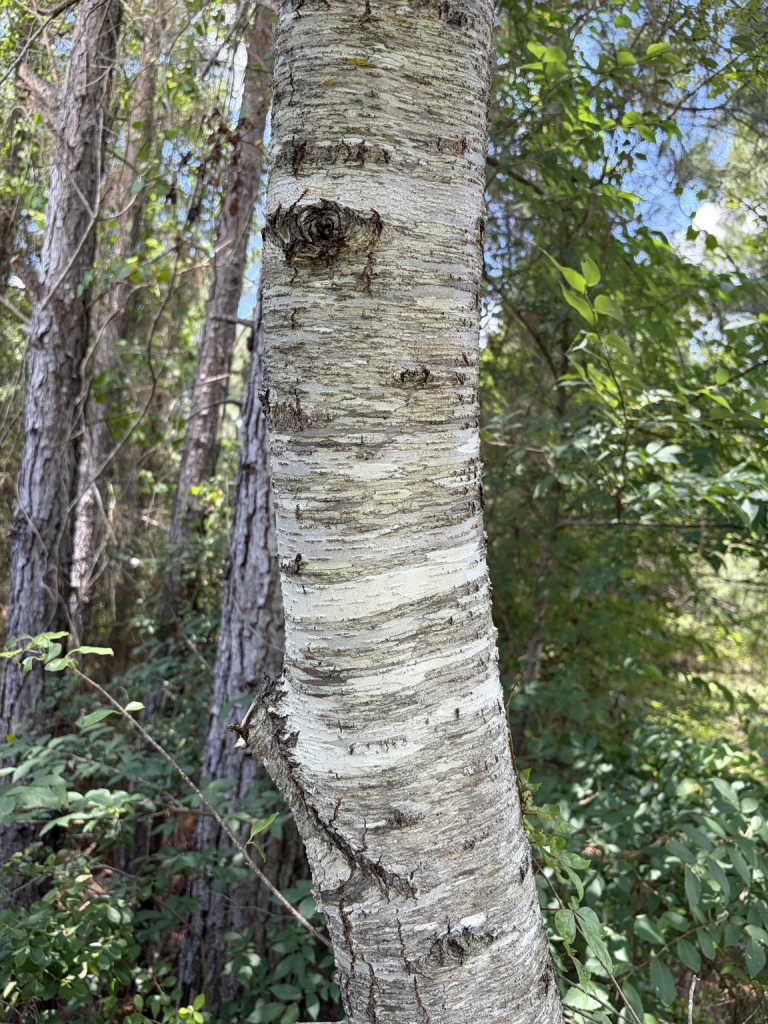
We have identified a wild black cherry tree growing on my property. Two follow up questions. 1. Is this native to South Carolina, and 2. Can I propagate this tree?
ChatGPT said:
Yes on both counts.
1. Is wild black cherry native to South Carolina?
Yes. The species you likely identified is Black Cherry, which is native throughout South Carolina and much of eastern North America.
Black cherry is commonly found:
Along fence rows
In old fields and woodland edges
In mixed hardwood forests
In areas that have been disturbed or logged
It is considered a valuable native tree because:
Birds love the fruit (robins, cedar waxwings, mockingbirds, wild turkeys, etc.)
Pollinators use the spring flowers
The wood is highly prized for furniture and cabinetry
If your tree is producing fruit, wildlife almost certainly planted it for you by dropping a seed years ago.
2. Can you propagate it?
Absolutely. There are several ways.
Method A: Plant the seeds (easiest)
This is how nature does it.
Collect ripe black cherries when they turn dark purple-black.
Remove the pulp from around the pit.
The pit contains the seed.
Plant the pits outdoors in fall about ½–1 inch deep.
Black cherry seeds normally require a cold winter period (called stratification) before they will sprout. Planting them in the fall lets nature handle this.
Expect germination the following spring.
Warning: Don’t let the fruit ferment in a bucket for long. The pits are easier to clean when the fruit is fresh.
Method B: Dig volunteer seedlings
This is my favorite method.
Look beneath the tree and around nearby fence lines next spring. Birds and squirrels often create dozens of volunteer seedlings.
Small seedlings 6–18 inches tall transplant fairly well when dug during dormancy (late fall or winter).
Advantages:
Faster than starting from seed
Already adapted to your property
No stratification required
Method C: Root cuttings or grafting
Possible, but generally not worth the trouble for a wild black cherry unless you’re trying to preserve a particular tree with especially large fruit or excellent timber characteristics.
A few cautions
Black cherry has some interesting characteristics:
Wilted leaves are poisonous to livestock, especially cattle and horses.
Fresh leaves on a living tree are usually not a problem.
The fruit itself is edible.
The pits contain compounds that can release cyanide if crushed and consumed in quantity (similar to peach and apricot pits), so don’t eat the pits.
Since you have goats, the main concern would be branches that fall after storms. Goats are curious and may nibble wilted leaves.
If you’re thinking long-term timber
Black cherry can become a beautiful tree 50–80 feet tall, occasionally larger. If you have open areas on your 125-acre property, a few carefully placed seedlings could eventually produce valuable lumber while also feeding wildlife.
When I was young, they told us that all white berries were poison and all black berries were edible. Red berries were sometimes poison and sometimes edible. Are these berries from a tree on my farm edible?
Note: This is part of a series where I use AI to identify a variety of plants, animals, insects, rocks, diseases, et cetera, with the hopes of illustrating just how useful and interactive AI can be. ChatGPT has a + button next to its entry field with options to upload pictures or use the camera. Easy-peasy.
ChatGPT said:
I would not rely on the old rule. It has many exceptions. For example, some white berries are edible, some black berries are poisonous, and some red berries are perfectly safe.
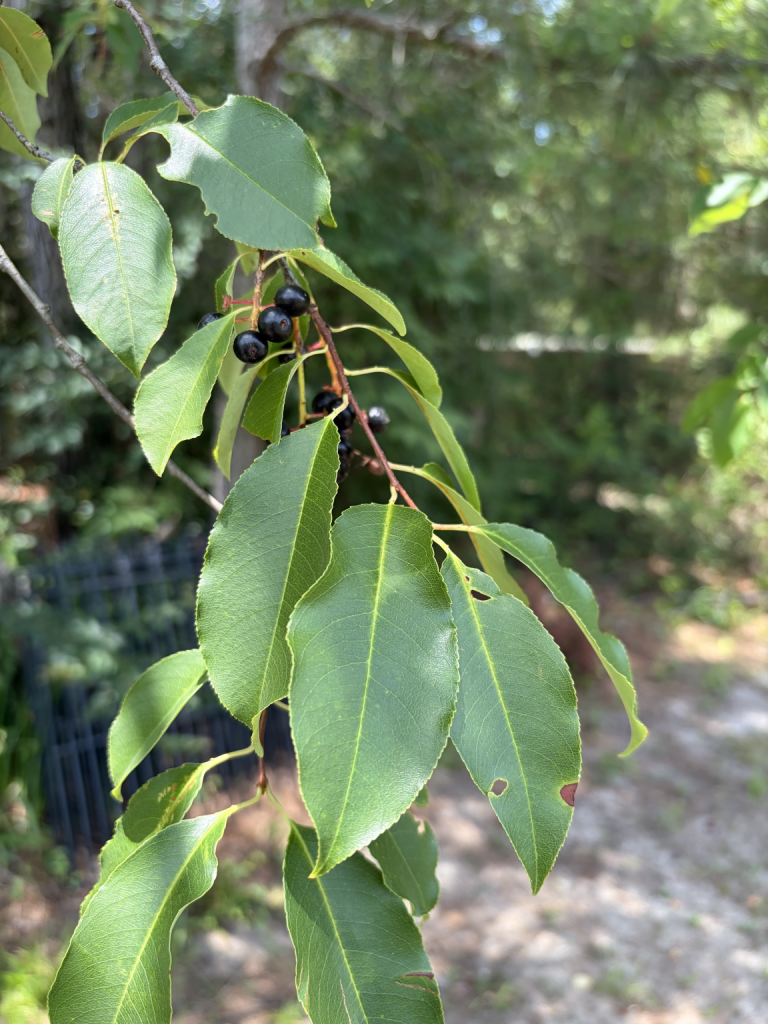
Looking at your photo, this appears very likely to be a black cherry tree (Black Cherry):
Long, alternate, finely serrated leaves.
Small black fruits hanging in elongated clusters (racemes).
Reddish fruit stems.
If it is black cherry, then:
The ripe black fruit is edible and has been used for jelly, wine, and preserves.
The fruit is usually somewhat bitter compared to cultivated cherries.
The pits (seeds) should not be eaten, as they contain compounds that can release cyanide when crushed.
Wilted leaves and twigs can be poisonous to livestock.
That said, I can’t safely guarantee identification from a single photo. Before eating any, I’d want to see:
A close-up of the bark on the trunk.
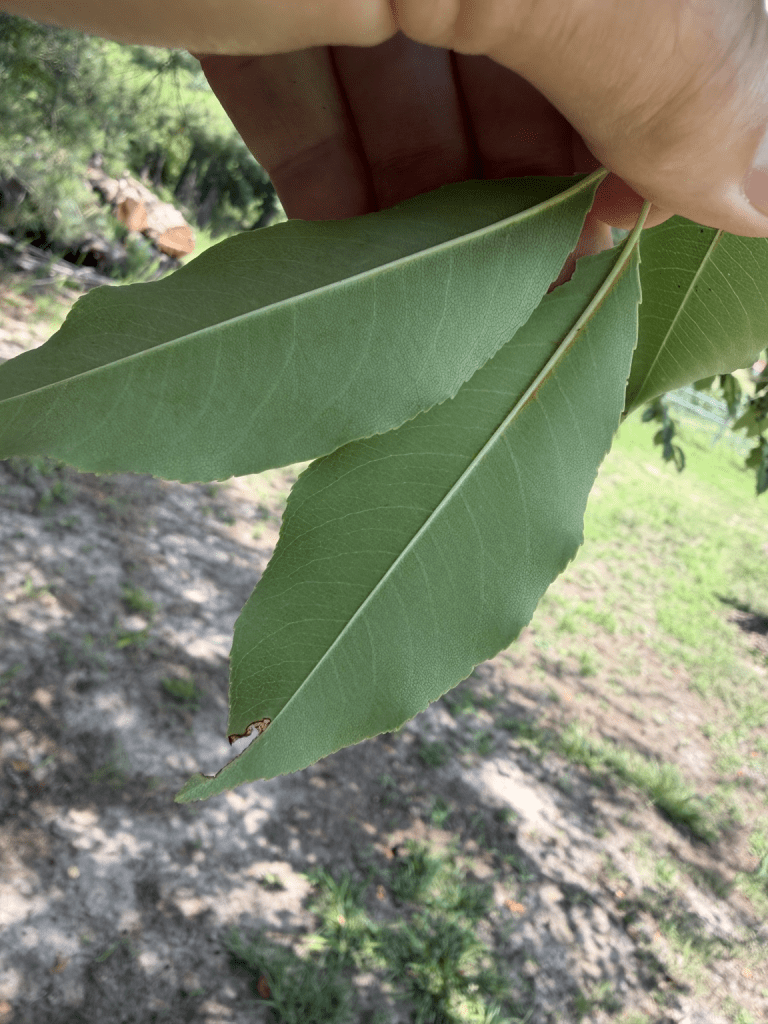
A close-up of a leaf showing both upper and lower surfaces.
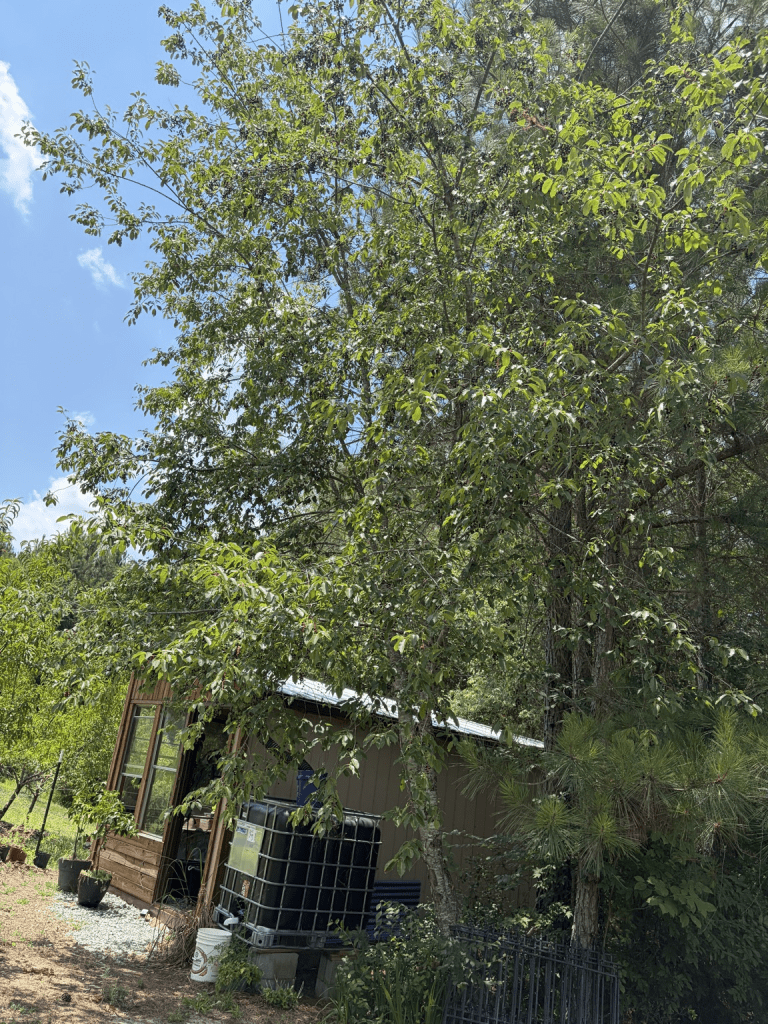
A photo of the entire tree.
If you upload those, I can tell you with much greater confidence whether this is black cherry or one of the similar-looking species.
With the additional photos, I’m considerably more confident that this is a cherry, most likely a wild cherry in the genus Prunus. The evidence:
The bark has the distinctive horizontal lenticels (the horizontal stripes) that cherries are famous for.
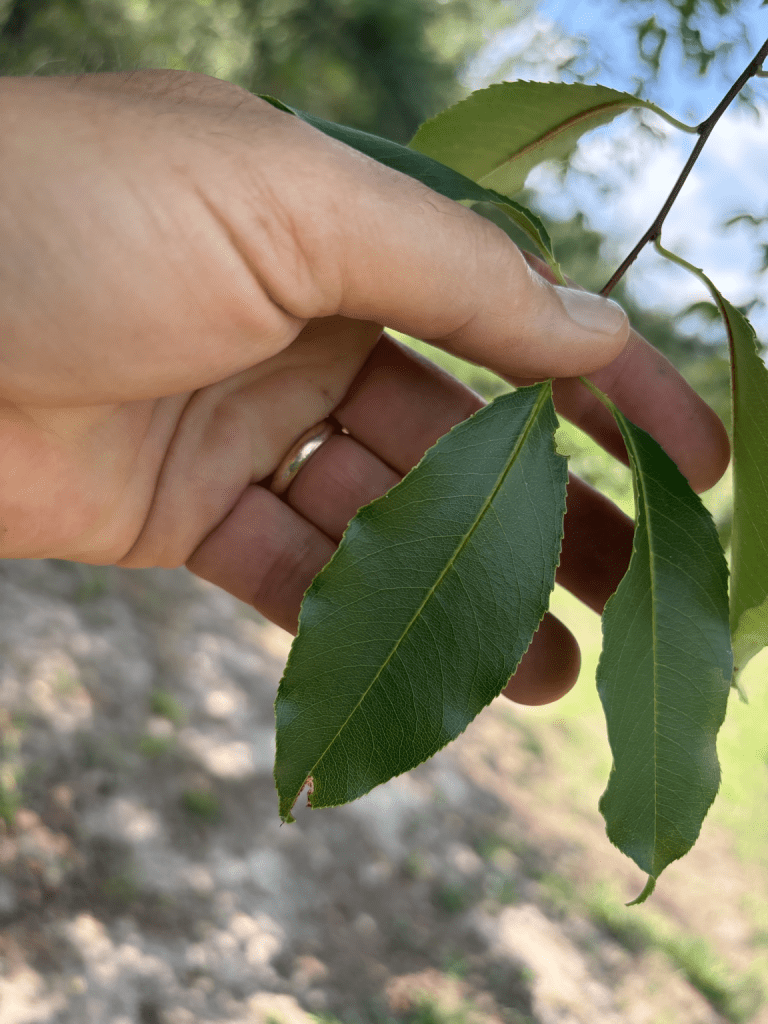
The leaves are alternate, simple, finely serrated, and have the typical cherry shape.
The fruit hangs in elongated clusters rather than singly.
The fruit ripens from red to black.
The two most likely candidates in South Carolina are:
Black Cherry
Carolina Laurelcherry
Based on the fruit clusters and leaf shape, I’m leaning toward Black Cherry.
Are the berries edible?
If it is Black Cherry, then yes, the ripe black fruits are edible. They’re small, with a relatively large pit and a flavor ranging from sweet to somewhat astringent depending on the tree.
Important cautions
Eat only the fleshy part.
Do not chew or crush the pits.
Do not make tea from wilted leaves.
Livestock should not browse wilted cherry leaves.
What I would do if I were standing beside you
I would still want one more confirmation step before eating them:
Pick a ripe fruit.
Cut or squeeze it open.
Photograph:
the whole fruit,
the inside,
the pit.
A cherry should have one hard stone (pit) in the center, very much like a tiny cultivated cherry.
If you send that photo, I can probably get from “pretty sure” to “very sure.”
By the way, your childhood rule would have worked surprisingly often around farms because many edible fruits (blackberries, dewberries, cherries, elderberries when cooked, etc.) are dark when ripe. But nature provided enough exceptions that I wouldn’t trust it with anything going into my mouth today.
That latest photo actually increases my confidence that this is a wild cherry.
What I can see:
Dark purple-black skin.
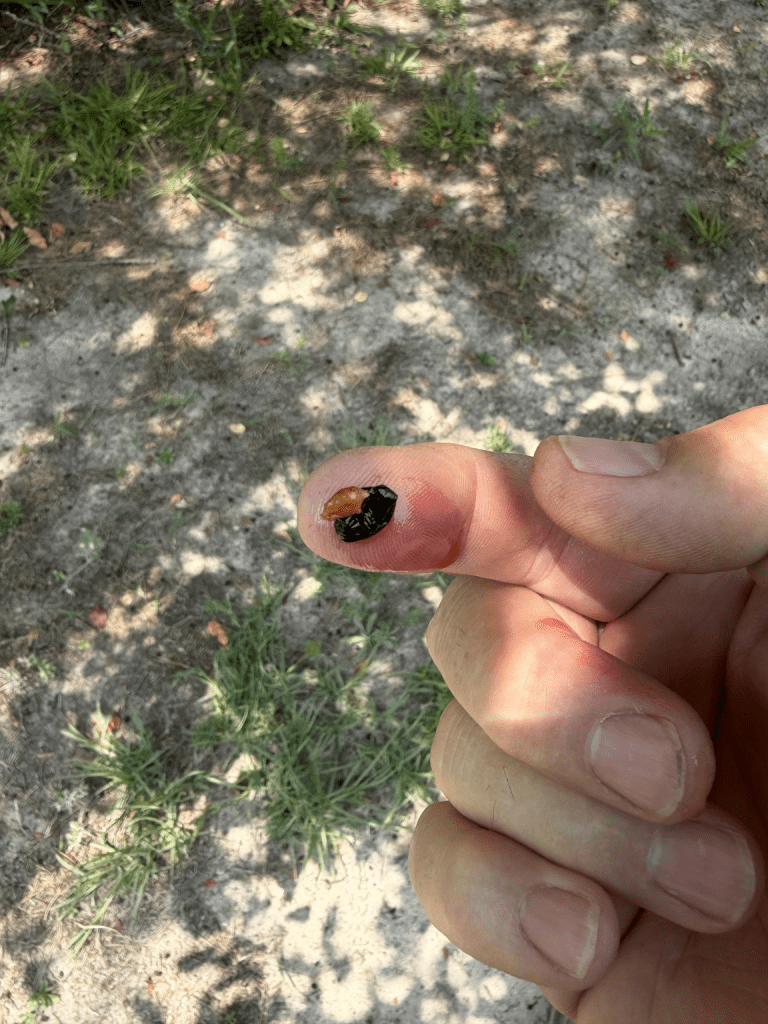
Purple-red juice staining your finger.
A single tan seed-like structure in the center.
The fruit appears to have a relatively thin layer of flesh around the seed, which is typical of wild black cherries.
One thing puzzles me slightly: the seed visible in the photo doesn’t look quite as hard and stone-like as I would expect from a mature black cherry pit. That may simply be because the fruit is very ripe and crushed, or because we’re seeing part of the seed coat rather than the entire pit.
Based on all four sets of photos together:
Cherry-like bark ✔️
Cherry-like leaves ✔️
Cherry-like fruit clusters ✔️
Cherry-like fruit flesh ✔️
I would put the odds very strongly in favor of this being a wild cherry, most likely Black Cherry.
However, because identification from photos can never be 100%, I still can’t tell you with certainty to eat it. If I were identifying it in person, the final confirmation would be to crack open an intact fruit and verify that there is a single hard pit inside.
A couple of questions:
Does the fruit taste sweet, bitter, or astringent?
Is there a single hard stone in the center that feels like a miniature cherry pit?
If the answer to #2 is yes, I think we’ve essentially solved the mystery.
And as a side note, your old childhood rule would have failed on one notorious example: Pokeweed produces very dark purple-black berries that are definitely not something I’d recommend eating. That’s one reason botanists get nervous about color-based rules. 😊
It tasted like a slightly bitter cherry
That description is exactly what I would expect from a wild black cherry.
Putting all the clues together:
✅ Tree form matches a cherry. ✅ Bark has the characteristic horizontal cherry lenticels. ✅ Leaves match black cherry. ✅ Fruit hangs in long clusters. ✅ Fruit is black when ripe. ✅ Flesh is dark purple and stains. ✅ Taste is “slightly bitter cherry.”
At this point I’d be surprised if it were anything other than Black Cherry.
The fruit of black cherry is edible, although most wild trees produce fruit that is smaller and more bitter than grocery-store cherries. Some individual trees are quite good, others are mostly useful for jelly, syrup, wine, or jam.
A few notes:
Eat the flesh, but don’t chew the pits.
The pits, leaves, and wilted twigs contain compounds that can release cyanide.
Birds absolutely love black cherries and often strip a tree quickly once the fruit ripens.
Black cherry is also one of the most valuable hardwood trees in eastern forests. Cabinet makers prize the wood.
One interesting thing from your photos: the bark is unusually light-colored compared with many mature black cherries. That’s probably because the tree is relatively young. As they age, black cherry trunks typically become much darker and develop rough, flaky bark that some people describe as looking like burnt potato chips.
So if you asked me, “Would I tell my grandson this is a black cherry tree?” the answer would be yes.
As for the old farm rule, I’d revise it to:
“Most black berries are edible, but enough are not that you should identify the plant first.”
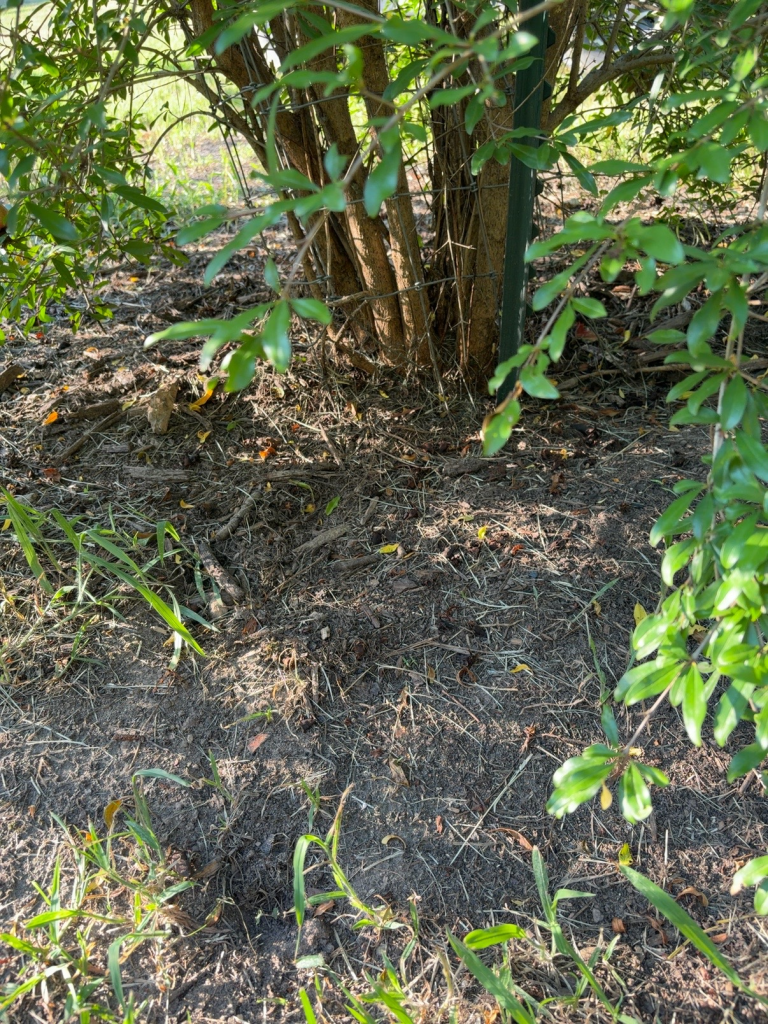
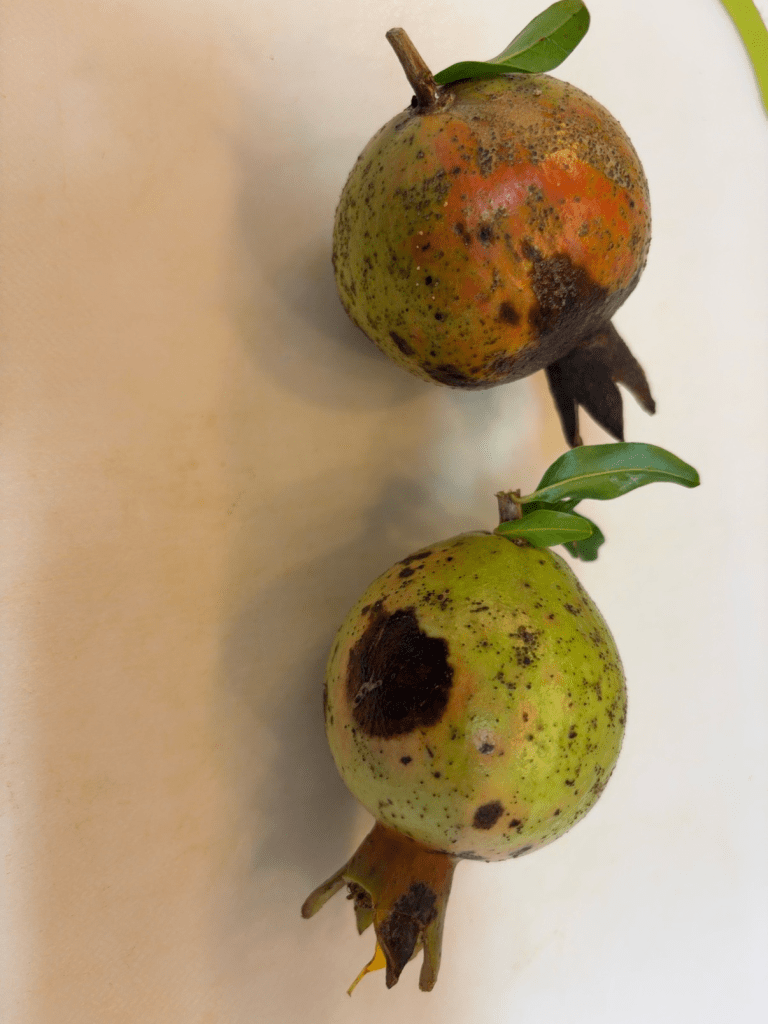
This is my first year with significant pomegranate fruit, but some appear to have a fungus. What’s going on here? I’m familiar with pomegranate bushes in California over 50 years ago and don’t remember this problem.
Note: This is part of a series where I use AI to identify a variety of plants, animals, insects, rocks, diseases, et cetera, with the hopes of illustrating just how useful and interactive AI can be. ChatGPT has a + button next to its entry field with options to upload pictures or use the camera. Easy-peasy.
An audible version of this post can be found on YouTube below followed by more images that I sent to AI.
ChatGPT said:
Brad, these photos are actually quite helpful. The pattern tells a story.
My first impression is that this is not a typical leaf fungus spreading randomly over the plant, but rather a fruit disease, most likely one of these:
Anthracnose (most likely)
Alternaria fruit rot (black heart) (possible)
Bacterial blight (less likely from these photos)
Why I think anthracnose is the leading candidate
The fruit shows:
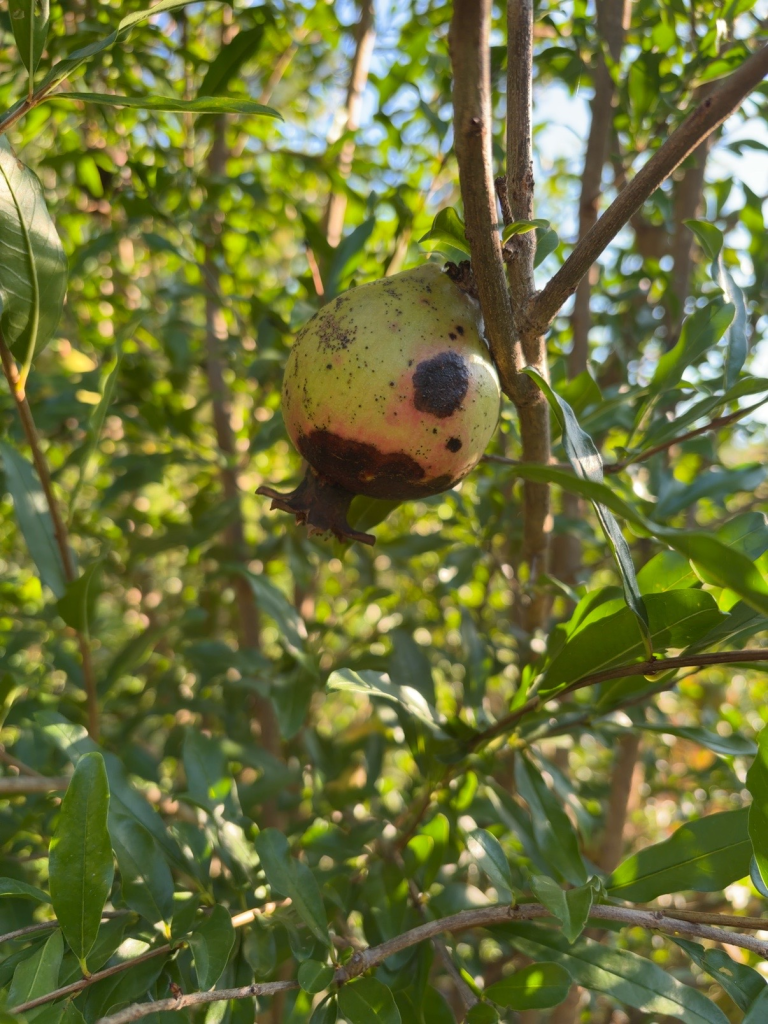
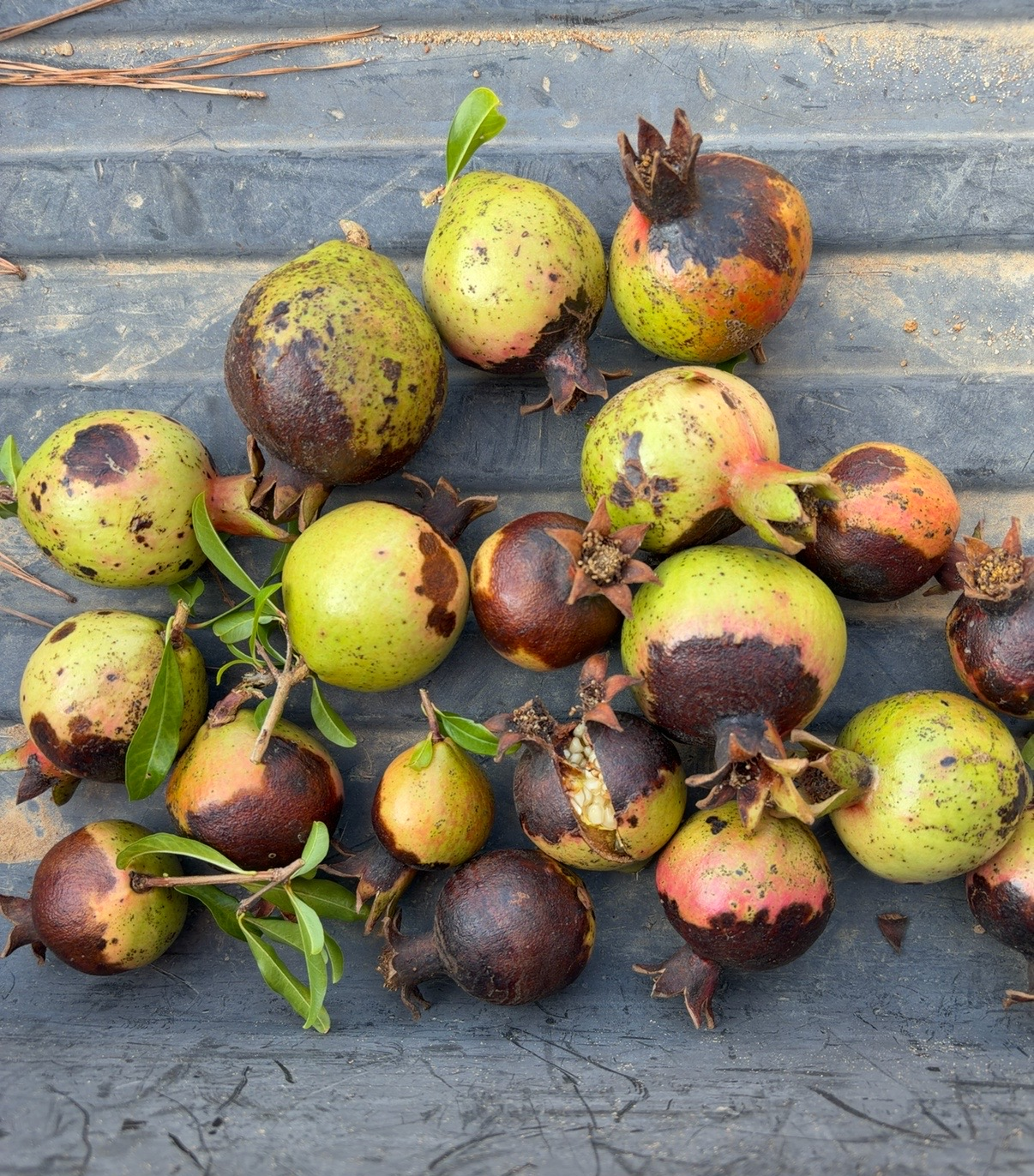
Large black, sunken patches
Numerous small black specks surrounding the larger lesions
Lesions beginning on the surface while the fruit is still green
Many fruits affected simultaneously
Those are classic anthracnose symptoms. The fungus infects flowers or very young fruit, then often becomes obvious as the fruit enlarges.
What makes me think it isn’t simply sunburn
Sunburn usually:
occurs only on the southwest side of exposed fruit
produces tan or brown leathery patches
doesn’t create all those tiny black pepper-like spots
Your fruit has numerous small spots and expanding dark lesions, which points much more toward disease.
California versus South Carolina
This is probably the biggest reason you’re seeing something now.
California’s pomegranate climate is almost ideal:
long hot summers
very low humidity
little summer rainfall
South Carolina gives the fungus exactly what it wants:
warm temperatures
high humidity
afternoon thunderstorms
leaves and fruit staying wet for hours
Many fruit diseases that barely exist in California become annual problems in the Southeast.
The good news
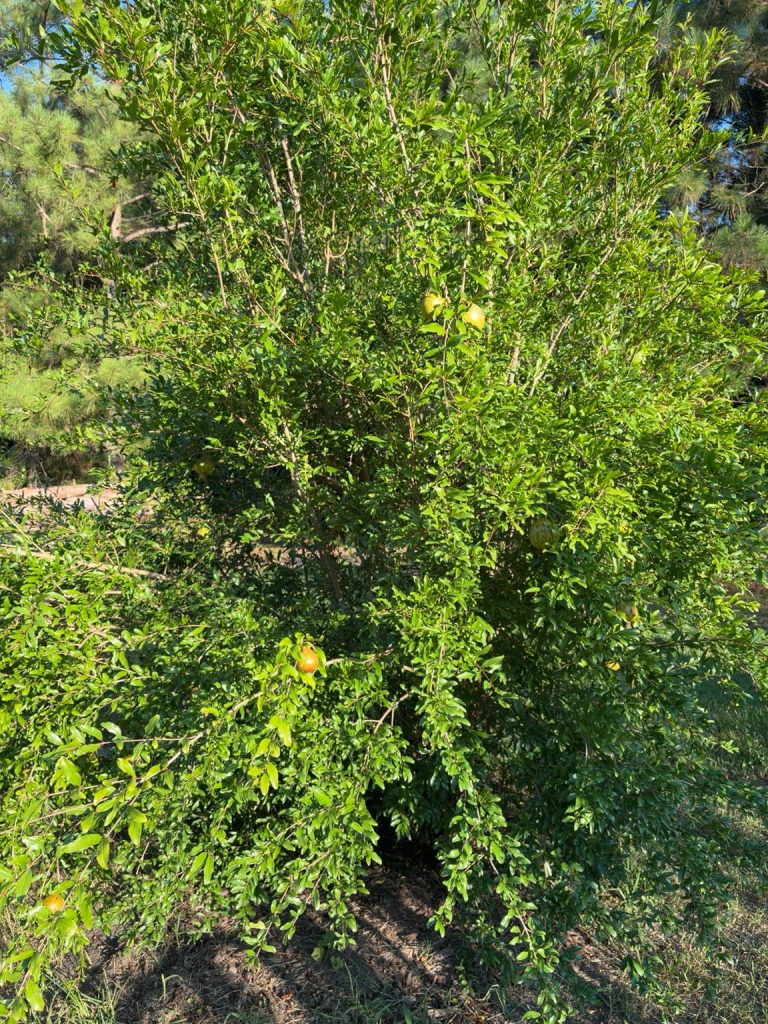
Your bush itself actually looks vigorous.
From the whole-plant photo I notice:
dense healthy foliage
good color
lots of fruit
no obvious dieback
That suggests the plant is healthy—the disease is primarily attacking the fruit.
What I would do
For this season:
Remove badly infected fruit from the bush.
Pick up fallen fruit promptly.
Don’t compost infected fruit unless your compost gets very hot.
Improve airflow by thinning some of the crowded interior branches this winter.
Next spring:
Watch the flowers closely.
If we have a wet spring, consider a preventative fungicide labeled for pomegranates (copper products are commonly used in home orchards). Prevention is much more effective than trying to stop the disease once the fruit shows symptoms.
One thing I noticed
A couple of fruits in your photos have lesions concentrated around the blossom end (where the “crown” is), while others have isolated round spots on the side.
That combination makes me also wonder about Alternaria, because it often enters through the blossom end and can rot the fruit internally while the outside still looks fairly normal. If you cut one of the fruits that looks only mildly affected and find the inside black or moldy while the rind isn’t terribly damaged, Alternaria moves higher on the list.
Could you answer three questions?
What variety is this? (Wonderful, Angel Red, or unknown?)
Roughly where in South Carolina are you? (Midlands, Upstate, Lowcountry?)
When you cut open one of the affected fruits, what does the inside look like?
normal seeds
some rotten sections
completely black inside
That third answer will go a long way toward distinguishing anthracnose from Alternaria.
One final observation: for a first significant crop, the bush appears to be carrying an impressive fruit load. Once you get this disease sorted out, I think you’ll have a very productive plant. The plant itself looks much healthier than the fruit currently does.
There has been mulch applied in the past. Should I clean the ground and quit using mulch?
No—I would actually continue using mulch, but I’d change how it’s being used.
Looking at your photo, I notice several things:
The base of the plant is fairly open, which is good.
I don’t see a thick, soggy layer of mulch pressed against the trunks.
The soil looks rather bare and dry now.
There are old leaves and fruit debris under the bush.
The mulch itself probably isn’t causing the fruit disease. The bigger issue is that infected fruit and leaves can harbor fungal spores that reinfect the plant the following spring.
Here’s what I would do this fall
Clean up thoroughly.
Pick up every fallen pomegranate.
Remove mummified fruit still hanging in the bush.
Rake out as many diseased leaves and fruit pieces as practical.
Refresh the mulch.
After cleanup, apply 2–3 inches of fresh wood chips or pine bark.
Keep it about 6 inches away from the trunks so moisture doesn’t stay against the bark.
Prune this winter. Your bush is quite dense. In California that isn’t much of an issue, but in South Carolina I’d remove several interior stems to let sunlight and air move through the canopy. Faster drying after rain is one of your best defenses.
Avoid overhead irrigation. If you irrigate, water the soil rather than wetting the foliage.
One thing I noticed from your earlier pictures
Several fruits are hanging inside the shrub rather than out on the edges. Those interior fruits stay damp much longer after our humid South Carolina mornings and afternoon thunderstorms. That’s another reason I’d open up the center of the plant.
If this were my bush…
I would not eliminate mulch. In our South Carolina summers, mulch is valuable because it:
conserves moisture,
moderates soil temperature,
improves the soil as it decomposes, and
reduces competition from weeds.
The key is sanitation first, mulch second.
One question for you: How old is this pomegranate?
I’m asking because it appears to have been allowed to develop into a many-stemmed shrub with quite a dense interior. Depending on its age, I might recommend a fairly substantial thinning this winter. I think you could improve both fruit quality and disease resistance without sacrificing much of next year’s crop.
Here are two pomegranates, cut open.
This is very helpful. The interior changes my diagnosis.
The fruit does not look like classic Alternaria (“black heart”). If it were, I would expect much of the inside to be black and moldy while the outside might not look terribly bad.
Instead, I see:
The arils are still white because the fruit is immature.
Most of the interior is healthy.
There is some browning of the membranes immediately beneath the worst external lesions.
The rot appears to be progressing from the outside inward, not starting deep inside.
That pushes me back toward anthracnose or another surface fruit rot rather than black heart.
The encouraging news
The disease hasn’t destroyed the fruit internally. If this had happened a month later, many of these pomegranates might still have been edible after trimming away the damaged portions.
One thing catches my eye
The lesions are remarkably round and well defined. In the lower fruit, there’s almost a “bull’s-eye” appearance. That sometimes happens where a fungal spore lands on a wet fruit and begins growing from that exact point.
Here’s what I’d do over the next year
Now
Remove every diseased fruit, whether on the bush or on the ground.
Dispose of them rather than leaving them under the shrub.
Winter
Thin out perhaps 20–30% of the interior wood. Your shrub has many stems, which is normal for pomegranates, but I’d selectively remove some of the oldest or most crowded canes to improve air circulation.
Spring (important)
As flowers begin to appear, if your weather turns into one of those warm, rainy South Carolina springs, consider a preventive copper fungicide. Once these lesions appear, fungicides do very little, so the timing is before infection.
One other thought
I’m curious about the variety. The fruit are fairly small and still pale inside, which makes me wonder if this is a hardy ornamental or seedling rather than one of the large commercial cultivars. If it’s a named variety like ‘Wonderful,’ the fruit should eventually color up much more.
I have one question that may solve the mystery.
Did we have an unusually wet spring in your part of South Carolina this year?
If these infections started during flowering and early fruit set, a rainy bloom period would fit this almost perfectly.
One final observation, and it’s an encouraging one: the bush itself appears healthy enough that I don’t think you’re fighting a chronic decline. This looks much more like a disease favored by this season’s weather than a plant that’s in poor health. With better sanitation, a little thinning, and possibly a preventive spray next spring if conditions are wet, I think you have a good chance of seeing a much cleaner crop next year.
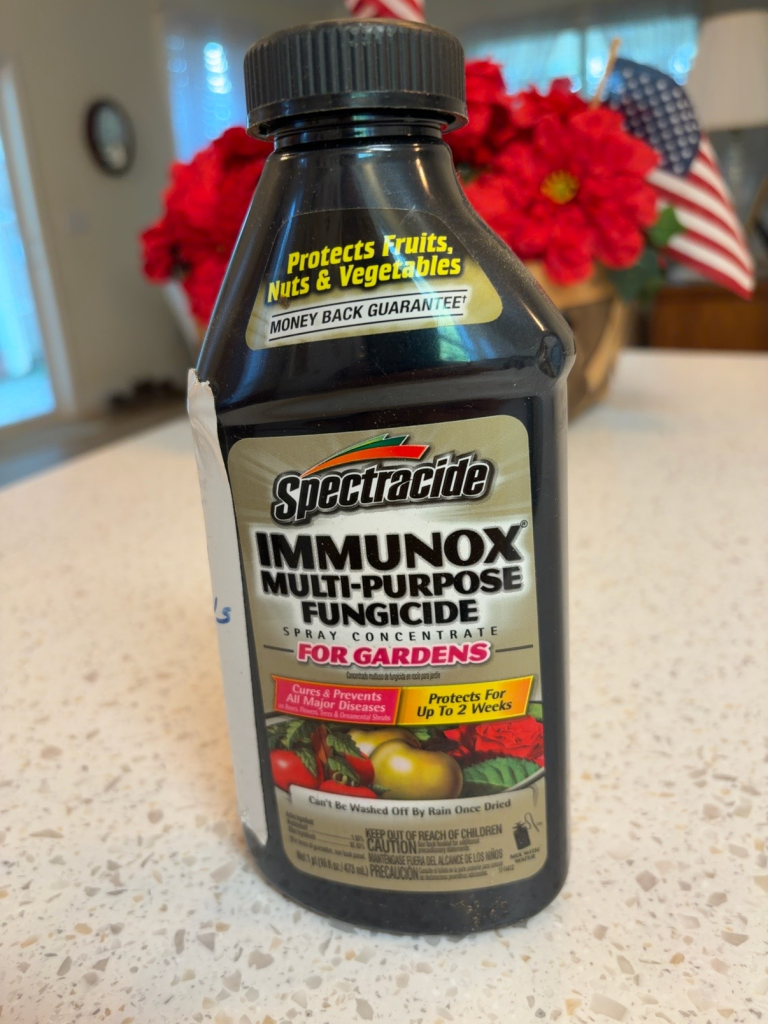
Yes, we had a wet early spring and a dry late spring. Will this fungicide work?
Yes, the wet early spring followed by a dry late spring fits the disease pattern very well. Infection likely occurred while the flowers and tiny fruit were wet, and the symptoms simply became visible as the fruit grew.
As for the fungicide in your photo:
Spectracide Immunox contains myclobutanil, which is an excellent fungicide for many diseases such as powdery mildew, rusts, and black spot on roses. It also has activity against some anthracnose fungi.
However, there are two important considerations:
Check the label carefully. Since you’re growing fruit you intend to eat, the label must specifically allow use on the crop (or group of crops) you’re treating. If pomegranate is not listed, I would not use it on fruit intended for consumption.
Timing matters much more than the product. By the time the fruit looks like yours does, the infection has already happened. Spraying now won’t heal the damaged fruit. The spray is most useful next spring, beginning around bloom or just after petal fall if the weather turns warm and rainy.
My recommendation
For your situation in South Carolina, I would lean toward this plan:
This year: Sanitation only.
Remove diseased fruit from the bush and the ground.
Prune this winter to open the canopy.
Next spring: If forecasts call for several days of warm, rainy weather during bloom, begin preventive fungicide applications according to the product label. Many home orchardists in the Southeast have good success with copper-based fungicides for pomegranates because they are broadly effective against many fruit diseases and are commonly labeled for edible fruit crops.
One thing I noticed in your photo: the Immunox bottle looks like you’ve had it for a while. If it’s several years old, check the date and make sure it hasn’t been exposed to freezing or excessive heat. Even if it’s still usable, I’d verify that the current label includes the crop you want to treat.
Overall, I think your pomegranate has a good future. The shrub itself looks vigorous, and I suspect next year’s crop could be dramatically cleaner with:
good cleanup this fall,
some interior thinning this winter,
and preventive protection only if next spring is wet again.
I think you’re much closer to solving this than replacing the bush.
Note: After culling the fruit as suggested by AI, we have just gone through a period of almost daily rain and very high humidity. This required a second culling. About one more episode of this and there will be a very sparse harvest.
Attached is the complete series of Marvin and his radio. Would you mind pretending like you are a critic and provide a comprehensive review of this series?
ChatGPT said:
I enjoyed reading these. As a literary critic rather than as your AI collaborator, I’d say you’ve created something that is much more unusual than it first appears. On the surface it’s a series of light stories about an elderly man discovering radio. Underneath, it’s really about curiosity, craftsmanship, friendship, and the joy of lifelong learning. That’s a niche that is surprisingly underserved.
Overall Rating
Story Concept: ★★★★★ (5/5)
Characters: ★★★★☆ (4.5/5)
Humor: ★★★★★ (5/5)
Educational Value: ★★★★★ (5/5)
Writing Style: ★★★★☆ (4.5/5)
Commercial Appeal: ★★★★☆ (4/5)
Originality: ★★★★★ (5/5)
What makes this series unique
The biggest surprise is that the radio isn’t really the subject. The subject is Marvin. The radio merely gives him permission to keep exploring the world at age ninety-two. That theme begins immediately:
“…the world was much more interesting than most people realized. The problem…was that everyone spent too much time talking and not enough time listening.”
That’s a remarkably good opening because it establishes Marvin’s worldview before introducing a single piece of radio equipment. A weaker writer would have begun with frequencies and antennas. You began with character. That’s the correct choice.
Marvin
Marvin is a delightful protagonist because he is simultaneously
intelligent
stubborn
curious
methodical
occasionally wrong
endlessly optimistic
He’s never portrayed as a superhero. He’s just persistent. Readers root for persistent people.
Earl
Earl is actually better than I realized from the individual episodes. He fills an important literary role. He is
audience surrogate
straight man
occasional voice of reason
willing accomplice
Without Earl, Marvin risks becoming a lecturer. With Earl, everything becomes a conversation. One of my favorite recurring traits is Earl’s understated observations.
Example:
“You’ve officially started your connector collection…”
That feels authentic.
Humor
Your humor is one of the strongest parts. Notice something: Almost none of it comes from jokes. Instead, it comes from observation.
For example:
“A connector that had not been useful in twenty years would become absolutely indispensable the day after it was discarded.”
Every ham smiles because they’ve lived it.
Or
“…the apartment gradually transformed into what could best be described as an antenna research center…”
Again—not funny because it’s exaggerated. It’s funny because it’s true. That’s much harder to write.
The educational writing
This is probably the hardest thing to do well. Most educational fiction fails because it becomes a lecture. Yours usually doesn’t. Instead, you let Marvin learn. Readers naturally learn with him. That’s exactly how children’s literature has educated readers for generations.
The craftsmanship theme
I think this is the heart of the series. Commercial products are never criticized. Instead, building something creates understanding. The ending of Episode 4 captures this beautifully:
“…A good antenna was not merely purchased. It was created.”
That’s really the philosophy of the whole series.
Where I think the series really shines
Oddly enough— it’s the details.
Examples:
the notebook
the paper clip antenna
the connector collection
the scooters
the Radio Shack smell
the hardware man Clarence
the endless adapter problem
the dog mess on the trail
the notebook becoming Frankenstein’s notebook
These are memorable because they’re concrete. Readers remember objects better than explanations.
My biggest criticism
The series occasionally trusts explanation more than scene. This happens mostly in Episodes 3 and 4. For example, instead of telling us:
every YouTube expert thought their antenna was best…
you could show
one loud expert
followed by another saying exactly the opposite.
You occasionally summarize events that would be funnier dramatized.
Audience
I think you’ve accidentally written for several audiences simultaneously.
Ham radio operators
They’ll recognize almost every situation.
Engineers
They’ll appreciate the methodical experimentation.
DIY builders
They’ll identify with the endless tweaking.
Older readers
This is where I think the series may become special. There are surprisingly few stories where elderly people are portrayed as still growing. Marvin isn’t remembering his glory days. He’s making new ones. That’s refreshing.
Audible potential
You repeatedly describe these as Audible stories. I think that’s exactly the right medium. The narration is conversational. The humor is verbal. The pacing fits a storyteller. I could easily imagine these as 20–30 minute episodes.
Final assessment
If I encountered these as an unsolicited submission, I would describe them as gentle competence fiction—stories where the central pleasure comes from watching capable, curious people learn, solve problems, and enjoy one another’s company. That niche is surprisingly rare today, where many stories rely on conflict, cynicism, or high stakes.
The comparison that comes to mind isn’t because your writing is similar in style, but because it evokes a similar feeling: the quiet observational warmth of James Herriot, combined with the hobby-centered enthusiasm found in old Popular Mechanics articles. It celebrates ordinary people doing ordinary things with care, humor, and persistence.
My one substantial recommendation would be to trust scenes a little more than summaries. Whenever Marvin does something—or struggles, improvises, or exchanges a few lines with Earl or Clarence—the stories come alive. A little less exposition and a little more lived experience would make an already engaging series even stronger.
Overall, I’d rate the series 9 out of 10. It’s original, charming, educational without being preachy, and built around a protagonist readers genuinely enjoy spending time with. Most importantly, it leaves me wanting to see what Marvin decides to tackle next.
Ninety-two-year-old Marvin and buddy Earl assemble their copper pipes and connectors into a GMRS J-Pole antenna. Together they tune the antenna only to find that Cheryl, the apartment manager, has different ideas about what is permitted at Shady Rest. Marvin goes stealth.
An audible story based on real persons (my father) and real events (recent). Assisted by ChatGPT and ElevenLabs AI.
Marvin and Earl travel on their scooters to the local Ace Hardware store to buy copper pipes and fittings to construct their first DIY GMRS radio antenna. An audible account of real events and real people assisted by ChatGPT and ElevenLabs.
Note: AI can be amusing. There are two images of J-pole antennas created by ChatGPT. Both have incorrect feed points, and one is even missing the short element.
Based closely on my 92-year-old father and his recent activities.
Here is episode 2 of an audible AI assisted account of ninety-two-year-old Marvin as he scoots through the start of a new world of radio along with his friend, Earl.
In this episode, Marvin visits a nearby Radio Shack to get the parts he needs to build his first GMRS DIY antenna.
(Closely based on my real dad and recent real events. This is an audible story, not a movie.)