
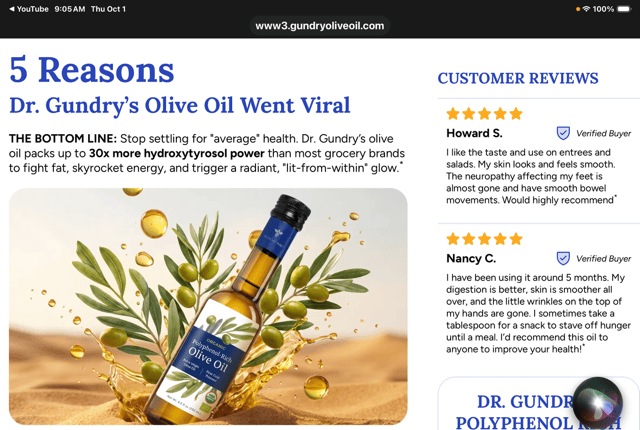
Please let me know the extent that science supports this guy’s claims, and show me your sources.
ChatGPT said:
There is real science behind extra-virgin olive oil and olive polyphenols, including hydroxytyrosol. But the advertisement you showed me stretches that science considerably—especially the phrases “fight fat,” “skyrocket energy,” and “radiant, ‘lit-from-within’ glow.”
The important distinction is between “olive oil is a healthy food”, which has substantial evidence behind it, and “this unusually high-polyphenol olive oil produces these dramatic effects,” for which the evidence is much thinner.
Breaking down the claims in the ad
| Claim in the ad | What the evidence says |
|---|---|
| “30x more hydroxytyrosol” | Possibly true as a chemical measurement, but misleading without context. Gundry says this comparison is based on a 2004 survey of Mediterranean olive oils. It does not mean 30× the health benefit. |
| “Fight fat” | Some evidence, but nowhere near strong enough for the impression the ad gives. |
| “Skyrocket energy” | Poorly supported. There is some recent evidence concerning fatigue, but not evidence that this particular oil dramatically increases energy. |
| “Radiant, lit-from-within glow” | Essentially advertising language. There is interesting research on olive polyphenols and skin, but it doesn’t establish that drinking this oil gives people glowing skin. |
| General cardiovascular benefits | This is where the science is strongest, although the evidence largely concerns EVOO/Mediterranean diets rather than Gundry’s particular product. |
The “fight fat” claim is interesting
I wouldn’t dismiss this one completely.
A meta-analysis of 11 randomized trials found that diets enriched with olive oil produced about 0.9 kg (2 lb) greater weight reduction than control diets, along with small reductions in waist circumference.
There’s also a small randomized trial of hydroxytyrosol itself. Twenty-nine overweight/obese women received 5 mg, 15 mg, or placebo for six months. The 15-mg group showed significantly greater weight and visceral-fat loss at four weeks—but importantly, the advantage diminished at 12 and 24 weeks. That’s interesting preliminary evidence, not convincing evidence of a sustained fat-loss treatment.
Another small placebo-controlled study found that 15 mg/day of hydroxytyrosol produced a statistically significant change in weight—but the actual change was only about 0.46% over three weeks.
And one trial in 41 women on a calorie-restricted diet found greater fat loss when 25 mL/day of EVOO replaced soybean oil. That supports EVOO as a potentially useful dietary fat; it doesn’t establish olive oil as a weight-loss drug.
So “may have modest favorable effects on body composition” would be defensible. “Fight fat” makes that evidence sound considerably more impressive than it is.
“Skyrocket energy” is a much bigger stretch
This is where I become skeptical.
There is a very recent randomized trial worth knowing about. In 102 people with metabolic syndrome, a concentrated olive-polyphenol supplement produced improvements in several measures after 12 weeks, including glucose, HbA1c, BMI, blood pressure and self-reported fatigue scores.
That’s genuinely interesting research.
But one study of a 10-mg/day concentrated olive-polyphenol extract in people with metabolic syndrome is a long way from demonstrating that Gundry olive oil “skyrockets energy.” Fatigue scores aren’t the same thing as energy production, exercise performance or vitality, and this wasn’t a trial of the product in your advertisement.
I wouldn’t regard “skyrocket energy” as scientifically established.
The skin/glow claim is even weaker
There is some fascinating research here too—but notice what was actually tested.
A randomized clinical study involving 70 people found improvement in measured wrinkles from olive-derived polyphenols (oleocanthal and oleacein). But participants put a 1% formulation directly on their skin twice daily. They didn’t eat olive oil.
So that’s evidence that certain olive polyphenols might have interesting topical dermatological effects. It isn’t evidence that taking a tablespoon of Gundry olive oil produces a “lit-from-within glow.”
Where olive-oil science really is impressive
This shouldn’t obscure the fact that olive oil has quite respectable nutritional science behind it.
The large PREDIMED study involved 7,447 people at high cardiovascular risk. Participants assigned to a Mediterranean diet supplemented with extra-virgin olive oil had fewer major cardiovascular events than those assigned to the control diet. There were some important problems with the original randomization, which led to withdrawal and republication of the study; the revised analysis still found a cardiovascular benefit.
The FDA also permits a qualified health claim for oils rich in oleic acid. Its wording is much more restrained than Gundry’s advertising: supportive but not conclusive evidence suggests that about 1½ tablespoons (20 g) daily, when replacing fats higher in saturated fat and without increasing total calories, may reduce coronary-heart-disease risk.
There’s also evidence that higher-polyphenol olive oils affect oxidative biology. In a randomized crossover trial, high-polyphenol EVOO reduced oxidized LDL and increased antioxidant capacity within the high-polyphenol treatment period, although the researchers found no significant between-treatment differences in the overall sample.
And this is especially interesting: in 2025 the European Food Safety Authority did a comprehensive assessment of whether olive-oil phenolic compounds could be said to lower LDL cholesterol or systolic blood pressure. After reviewing the intervention studies, EFSA concluded that a cause-and-effect relationship had not been established for either outcome.
That’s a useful antidote to the marketing.
And the “30× hydroxytyrosol” deserves an asterisk the size of the bottle
Gundry’s own site currently makes the same claim: “30x more hydroxytyrosol than regular olive oil.” The footnote says that it is “based on [a] 2004 study of extra virgin olive oil samples from the Mediterranean.”
That’s quite different from demonstrating:
People consuming our oil get 30× the health benefit of ordinary EVOO.
It doesn’t demonstrate that at all.
Polyphenol concentration in olive oil naturally varies enormously with olive variety, ripeness, growing conditions, extraction, storage and other factors. And even if his oil really contains 30 times as much hydroxytyrosol as whatever comparison oils were selected, biological effects don’t necessarily increase linearly with concentration.
So, Brad, here’s how I would translate the advertisement into scientific English
Advertising version:
“30x more hydroxytyrosol … fight fat, skyrocket energy, and trigger a radiant glow.”
Evidence-based version:
“Extra-virgin olive oil is a healthy unsaturated fat, and olive polyphenols such as hydroxytyrosol have biologically interesting antioxidant effects. Mediterranean dietary patterns containing EVOO have good evidence for cardiovascular benefit. Preliminary human studies suggest concentrated olive polyphenols may have additional metabolic effects, but evidence that a particular high-polyphenol olive oil causes meaningful weight loss, dramatically increases energy, or improves skin appearance when consumed is currently limited.”
That’s a considerably less exciting advertisement.
One other point jumps out at me from your screenshot: the testimonials aren’t scientific evidence at all. Howard’s claims about neuropathy and Nancy’s claims about digestion, skin and hunger are individual anecdotes. They could be perfectly sincere and still tell us essentially nothing about whether the oil caused those changes.
So I wouldn’t call the underlying product snake oil. EVOO is a genuinely healthful food, and hydroxytyrosol is a genuinely interesting compound. What I would say is that the advertising is running considerably faster than the science.
The sources above include the company’s own current claims, FDA, EFSA, PubMed-indexed randomized trials, and the large PREDIMED trial, so you can click through them and see exactly what was actually studied.
In his YouTube advertising, he has some really bad things to say about “seed” oils, such as you should never put anything into your body that is used as a lubricant or engine fuel, et cetera. Please respond.
ChatGPT said:
Yes. That particular argument is much easier to evaluate than some of the claims about his olive oil, because there is a large body of human nutrition research on the subject.
The scientific evidence does not support a blanket claim that seed oils are harmful or should never be eaten. In fact, when seed oils replace fats high in saturated fat, the evidence generally points in the opposite direction: LDL cholesterol falls and cardiovascular risk tends to improve.
The argument you remember from his advertisement — don’t eat something that can also be used to lubricate machinery or fuel an engine — is rhetorically effective but scientifically meaningless.
Consider the same reasoning applied elsewhere. Ethanol can fuel an engine, but ethanol is also the alcohol in wine. Water is used as an industrial coolant. Baking soda cleans machinery. Citric acid is an industrial chemical. Olive oil itself has historically been used as a lubricant and fuel, particularly as lamp fuel. None of those industrial applications tells us whether the substance is healthy to consume.
What matters is dose, composition, contaminants, metabolism and demonstrated effects in humans, not whether engineers have found another use for the substance.
Where the seed-oil argument comes from
There are actually several different arguments bundled together, and a couple contain a kernel of legitimate science.
Seed oils such as soybean, corn, sunflower, safflower and canola contain substantial amounts of polyunsaturated fatty acids, particularly the omega-6 fatty acid linoleic acid. The human body can use linoleic acid to produce arachidonic acid, which in turn can be used to make some inflammatory signaling molecules.
From that biochemical pathway comes a plausible-sounding argument:
More seed oil → more omega-6 → more arachidonic acid → more inflammation → more chronic disease.
The trouble is that when researchers actually give humans more linoleic acid and measure inflammatory markers, that predicted result generally doesn’t occur. Controlled feeding studies have not shown that increasing dietary linoleic acid increases arachidonic acid or inflammatory markers in the way the hypothesis predicts.
That’s an important distinction: a plausible biochemical mechanism isn’t the same thing as demonstrating harm in people.
The American Heart Association reviewed this issue and continues to recommend polyunsaturated fats, including omega-6 fats, as replacements for saturated fat. It specifically addresses the internet claim that seed oils cause inflammation and chronic disease and says the evidence doesn’t support it.
There is a legitimate caution about heating oils
This part sometimes gets lost because the two sides argue past one another.
Repeatedly heating cooking oil to very high temperatures—think restaurant deep fryers operating for extended periods—can oxidize fats and generate degradation products. That’s real chemistry, and repeatedly reused frying oil isn’t something I’d describe as desirable.
But it doesn’t follow that sautéing vegetables at home in a tablespoon of canola or sunflower oil is therefore dangerous. Harvard’s review makes exactly this distinction: repeatedly heated frying oils are a legitimate concern, while the evidence does not establish ordinary seed-oil consumption as harmful.
There’s another enormous confounder here. Americans get a lot of seed oil in French fries, potato chips, doughnuts, cookies, crackers, fast food and other highly processed foods.
People who eat lots of those foods often have worse health.
That doesn’t establish:
seed oil → poor health.
The package containing the seed oil also contains some combination of refined starch, sugar, salt and lots of calories, and may be deep-fried. Harvard researchers specifically warn against attributing the health consequences of that dietary pattern to the seed oil itself.
And here’s where I think Gundry’s olive-oil advertisement becomes particularly interesting
He’s selling you an alternative.
The scientific comparison isn’t:
Gundry olive oil versus dangerous industrial seed oil.
A much more useful comparison would be:
Extra-virgin olive oil versus ordinary olive oil versus canola/soybean/corn/sunflower oil versus butter/lard/tallow.
Now we have a lot of evidence.
I would happily put extra-virgin olive oil near the top of my choices for an everyday culinary fat. It has an excellent evidence base, as we discussed before.
But that doesn’t make the other vegetable oils poisonous.
And if the choice is something like canola oil versus butter or beef tallow, replacing the saturated fat with polyunsaturated vegetable oil is supported by substantial evidence. WHO reviewed systematic reviews of randomized trials and observational studies and concluded with moderate-certainty evidence that replacing saturated fats with polyunsaturated fats reduces cardiovascular disease and coronary heart disease risk. WHO consequently issued a strong recommendation favoring polyunsaturated fats from plant sources as a replacement for saturated fats.
The American College of Cardiology/American Heart Association guidelines reach essentially the same conclusion.
One thing I wouldn’t say
I wouldn’t turn the tables and claim “seed oils are wonderfully healthy and the more the better.”
That’s making the same mistake in the opposite direction.
Oil is extremely calorie dense. Eating large amounts of fried and ultra-processed foods isn’t a good idea. Frequently reused frying oils are undesirable. Whole sources of unsaturated fat—nuts, seeds, fish, avocados, etc.—bring nutrients besides their oil. And there’s quite good evidence specifically supporting EVOO as part of a Mediterranean dietary pattern.
So choosing EVOO as your primary cooking/dressing oil is perfectly reasonable.
What the evidence doesn’t justify is being frightened of the tablespoon of canola oil used to cook dinner.
And I think you’ve identified something important about that advertisement. “Don’t put engine lubricant in your body” isn’t a scientific argument at all. It substitutes an unpleasant mental image—motor oil—for evidence about human nutrition. Ironically, olive oil itself defeats the argument: olive oil has been used for thousands of years as lamp fuel and lubricant. Its ability to lubricate something doesn’t make it any less edible.
That distinction also makes me somewhat more cautious about the other claims in the ad you showed me. When someone has good evidence available, there’s little reason to resort to the “would you put engine fuel in your body?” style of argument.
As I pretty much expected but wanted some science to support: some things never change.
ChatGPT said:
Exactly. The details change—seed oils, toxins, superfoods, polyphenols—but the sales technique is ancient.
What makes this one effective is that it starts with several true facts: EVOO is a good dietary fat; hydroxytyrosol is biologically active; repeatedly overheated oils can degrade; and excessive ultra-processed food is associated with poor health. Then it quietly makes the leap from those facts to “therefore ordinary seed oils are dangerous, and my unusually expensive olive oil is the solution.”
The science supports the first part much better than the leap.
And “you wouldn’t put engine fuel in your body” is a particularly nice example of rhetoric masquerading as chemistry. As you suspected, asking the mundane question “What happens when humans actually eat the stuff?” is much more informative.


Leave a comment