
When I was young my dad gave me a small booklet by a Professor Berry on how to train my horse. One of the first steps was to lay the horse on the ground with its feet tied so it couldn’t get up. The horse would struggle to regain control but eventually relinquish. This step is repeated until the horse is completely submissive.
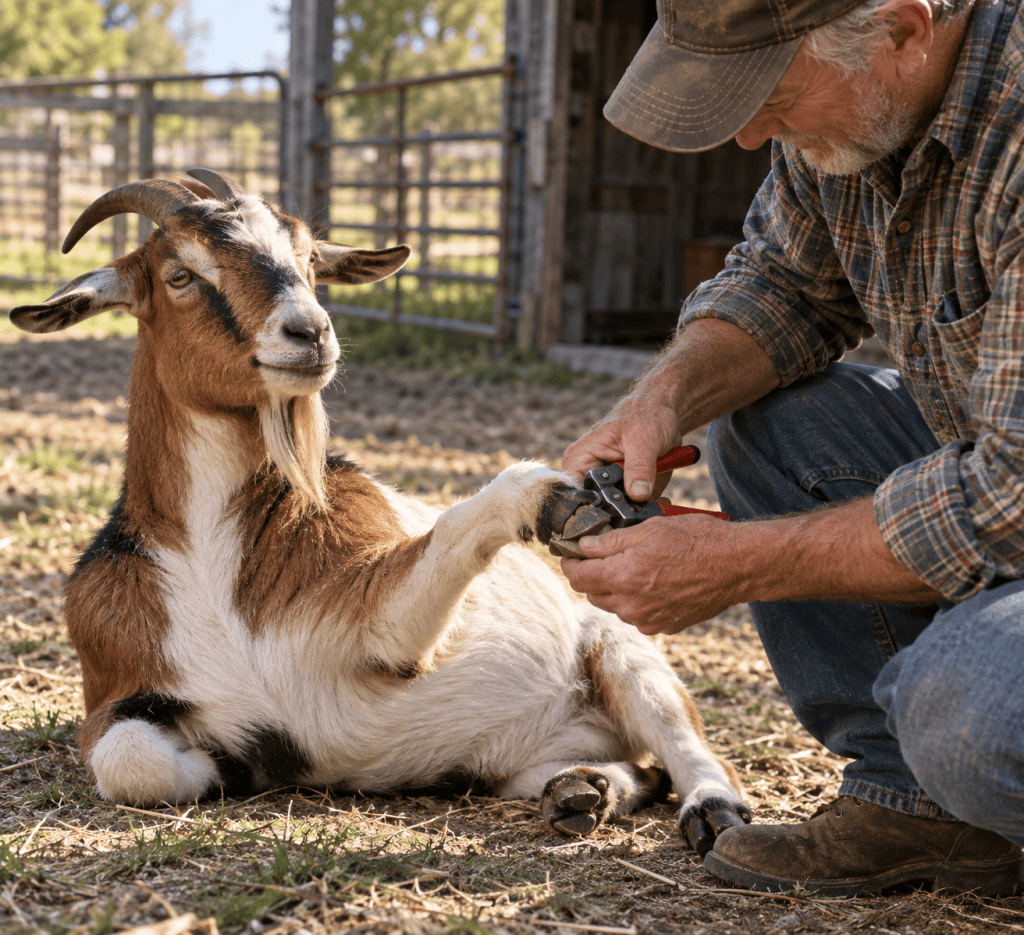
More recently, I had a goat that I put through Professor Berry training. He became so submissive that when it was time to trim his hooves, he would lay down and voluntarily on his own lift one leg at a time for me to work on.
ChatGPT said:
That is a fascinating example because it sits right at the intersection of old-fashioned “submission” training and what we would now describe as learned responses, habituation, and trust.
Professor Berry’s method sounds like one of the old restraint-based horse-training systems sometimes called throwing, laying down, or horse taming. The theory was essentially what you remember: deprive the horse temporarily of its ability to escape, let it discover that struggling accomplishes nothing, and repeat the experience until resistance disappears. Similar ideas turn up in nineteenth- and early-twentieth-century horse-training literature.
Your goat, though, is the more interesting case. If he eventually lay down voluntarily and presented his feet one at a time, something more had happened than simple physical submission. He had apparently learned the entire sequence:
Brad approaches → this is hoof-trimming time → lying down is what we do → each foot gets handled → nothing bad happens.
And there is an important distinction there. An animal that has merely been overpowered may freeze or cease resisting. An animal that anticipates the procedure and performs the useful behaviors before being physically compelled has learned a cooperative routine. Your goat seems to have crossed that line rather spectacularly.
Modern animal behavior people would probably be uncomfortable with Berry’s initial restraint procedure because forced recumbency can cause fear, stress, injury, and—in badly handled cases—something resembling learned helplessness. Today a trainer would normally try to obtain the same final behavior incrementally with pressure-and-release or positive reinforcement rather than physically immobilizing the animal.
But that doesn’t make your observation uninteresting; quite the opposite. The method and the eventual relationship aren’t necessarily the same thing. Whatever happened during the original restraint, your goat subsequently accumulated a great deal of experience showing that when you handled him, there was no reason to fight you. Eventually the animal wasn’t simply allowing hoof trimming. He was participating in it.
And I suspect Professor Berry would have described that in one word—submission—whereas a modern behaviorist might need several paragraphs to distinguish submission, habituation, conditioning, predictability, and cooperative behavior.
The goat probably didn’t care what either of them called it. He had figured out the procedure and was ready to get on with it.
Yes, I had a friend whose horse bit him while the horse was on the ground, and my friend was in a leg cast for quite some time.
ChatGPT said:
And that is almost the perfect counterpoint to the goat story.
A horse that has been put on the ground is not harmless merely because it has lost the use of its legs. It still has a head, neck, teeth, and considerable reach. Your friend’s experience makes the old Professor Berry method considerably less quaint: the horse bit him badly enough that he ended up immobilized afterward.
There is also a rather nice farm-story irony in it:
Professor Berry’s method was supposed to teach the horse that struggling was futile. Your friend’s horse apparently hadn’t read the booklet.
That anecdote might actually improve One Foot at a Time. It prevents the story from becoming an endorsement of the old technique. You can simply report what Berry taught, what happened with your goat, and then what happened to your friend. The contrast does the work without needing an explanation of modern animal-training theory.
And it gives you another very farm-like lesson: the same technique that produced a goat who politely handed you his feet produced a horse who put a man in a cast.


Leave a comment