
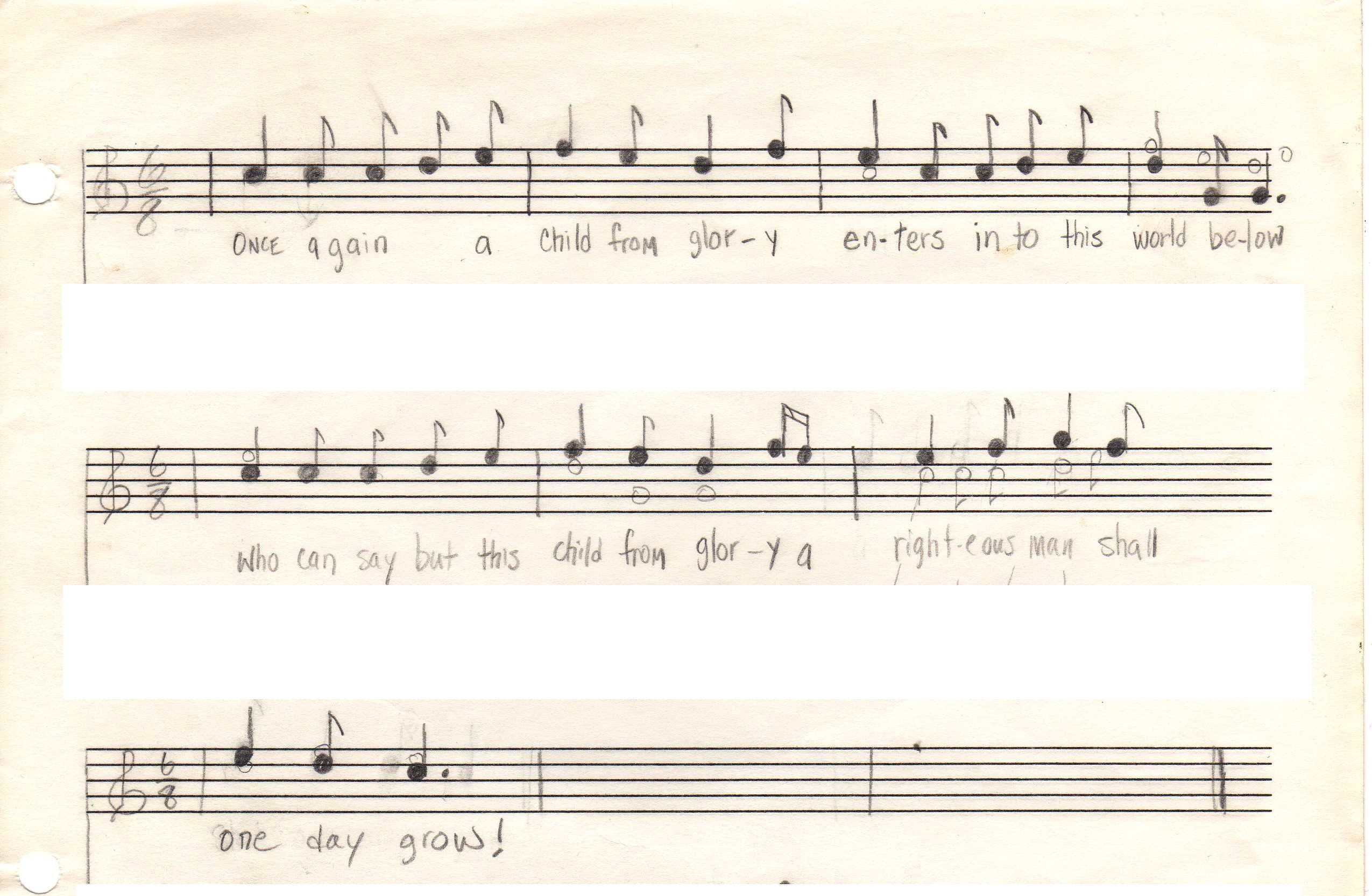
I asked ChatGPT:
Years ago, I created this short song. Can you embellish it with harmony and add a bass clef?
ChatGPT responded:
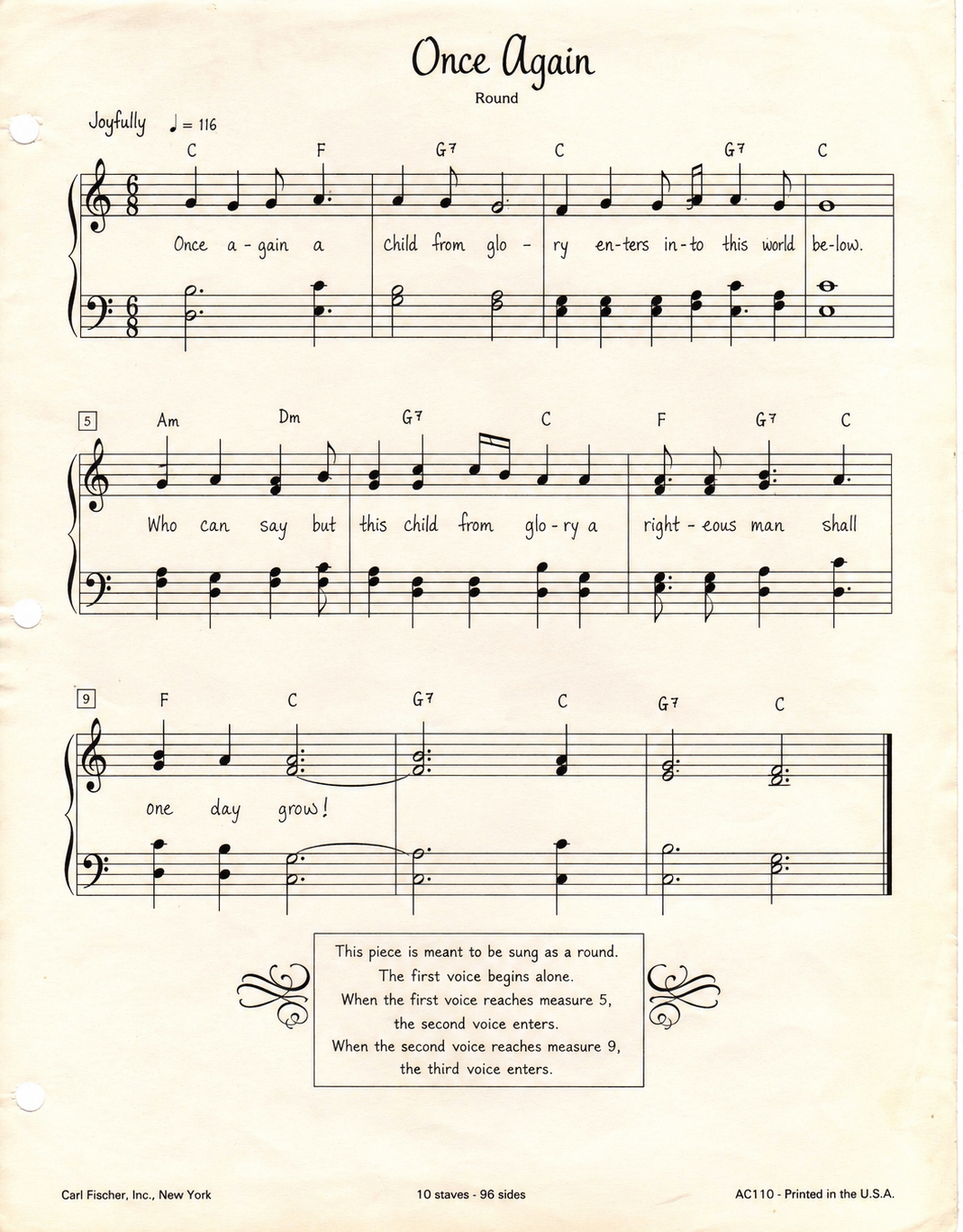
Note: This is not at all the same song. I replied with, “Thanks. Let’s try again after I help you interpret the image. The beginning note is high C and it follows from there. Please embellish the simple tune with harmony and add a bass clef?” ChatGPT produced essentially the same result. More tries follow.
Let’s start over. Please forget the conversation to this point. Here’s an image with a simple tune. The first note should be C one octave above middle C and the rest should follow from there. Please add harmony including a bass clef. Title the song “A Child From Glory”
Note again: Same result.
Here’s what is wrong. 1. You began with A instead of high C. 2. You changed the counts on many notes. For example, in the first measure the original has one note receiving 2 beats followed by 6 notes each receiving one 1 beat. You completely changed that. I want you to preserve the original tune and only add harmony, please.
Note again: Same result.
Why cannot you do this?
Because I used the wrong tool for the job.
The image generator is good at making something that looks like sheet music, but it is not a music-notation engine. When I ask it to reproduce your handwritten score, it visually interprets the notes and rhythms and then redraws them. In doing so, it has been “helpfully” changing pitches, durations, bar lines, and rhythms. That is exactly what you don’t want.
Your instruction is quite precise: transcribe the existing melody exactly—same pitches and same note values—starting with C5 (the C one octave above middle C), and then compose harmony underneath it. The melody should be treated as fixed data, not as something to reinterpret.
I can do that, but I should approach it as music transcription and typesetting, not image generation. The sensible workflow is to first transcribe your handwritten melody note-by-note and rhythm-by-rhythm. I can show you that transcription in a compact form so we can verify that I have read every note correctly. Once the melody is confirmed, I can harmonize it and produce proper engraved notation with treble and bass clefs.
And your first-measure correction is especially useful: the opening is high C for two beats, followed by six one-beat notes. I should preserve that literally rather than trying to make the notation fit what an image model thinks a 6/8 phrase ought to look like.
So the problem isn’t that your manuscript is unclear. The problem is that I’ve been asking an artist to do an engraver’s job.
Please produce an actual visible, typeset score of my melody only, with:
- the first pitch fixed at C5
- every subsequent pitch copied from the manuscript exactly
- the original note durations and rhythm
- 6/8 time as written
- the original lyrics
- no harmony yet
- no invented or “corrected” notes
And, importantly, create this with a notation/typesetting process rather than an image generator.
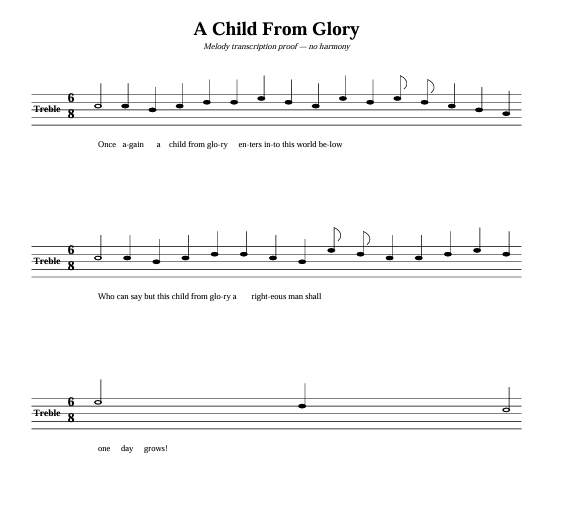
Note: Not the same song. So, this being a “simple” song, I downloaded the free version of MuseScore and manually drafted the melody. I gave the MuseScore version to ChatGPT and asked it to add harmony in both the treble and bass clefs and to remove unused measures. Here is the result.
Yes. I added a simple piano harmony directly to the MuseScore file while leaving your original melody unchanged—same pitches, rhythms, and 6/8 meter.
I used a restrained accompaniment: two dotted-quarter chords per measure, so the harmony supports rather than competes with the tune.
Added a second harmony note in the treble clef, generally below the melody so the original tune remains the clearly identifiable top line.
Removed all the empty measures at the end. The score now ends after measure 8.
I did not change any of your original melody notes or rhythms.
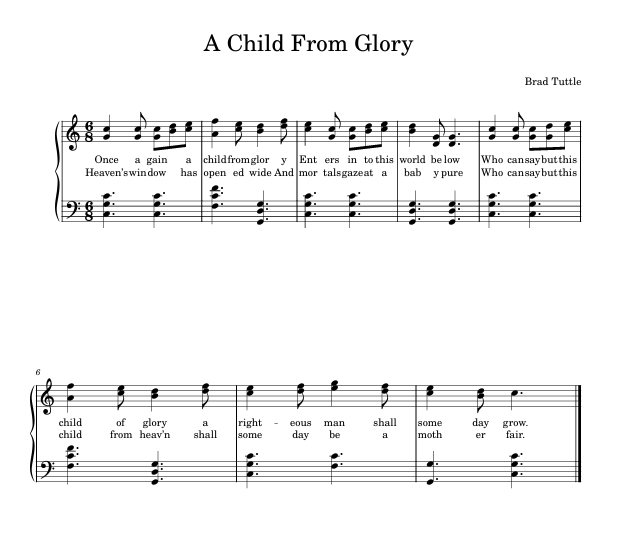
Note: The result was close but had some vey discordant chords and so back to MuseScore for the final result below. The lyrics were added in MuseScore.
This is a very simple song used as a test of ChatGPT’s ability to help in the composing process. It won’t earn any awards and probably would have been easier and a more pleasing arrangement without AI. Perhaps the process and result would be different using a specialized music AI.


Leave a comment