
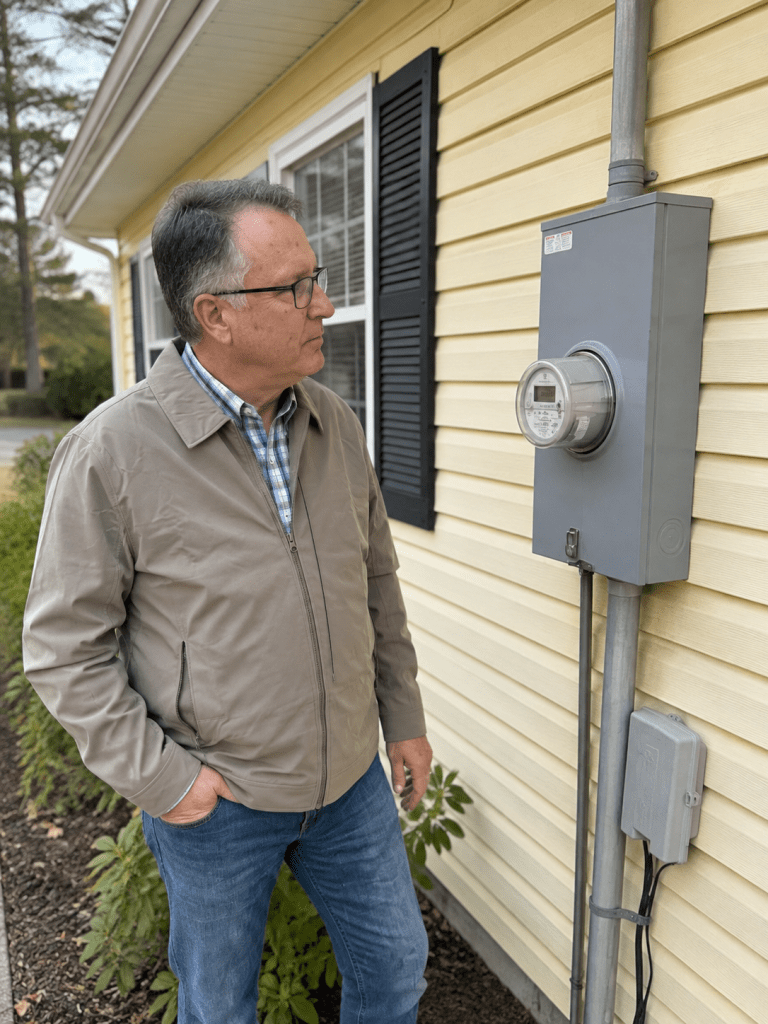
How has the price of electricity per kwh changed over the past several years here at Newberry Electric Cooperative? Prior to 2017 I was paying 14 cents per kwh at SCANA and just taking my bill divided by kwh this last month I get 17.3 cents. This, however, doesn’t take into account any fixed portion.
Right. Your 17.3¢/kWh calculation is useful, but it is an all-in effective rate: So any fixed monthly customer/facilities charge gets spread across your kWh.
Your comparison with SCANA is interesting. If the old 14¢ was the actual energy rate while today’s 17.3¢ is bill ÷ kWh, they’re not quite apples-to-apples.
If you have a handful of old NEC bills—say one from 2017, 2020, 2023 and the current bill—give me just kWh used and the electric charge from each. I can back into the likely fixed charge and variable rate and reconstruct what NEC’s price has actually done over time. Two or three bills from different usage levels in the same rate period would be even better.
Yes, two data points plugged into the equation of a line will give both the fixed and variable portions. 1296 kwh $232.59, 1667kwh $287.49, 1166kwh $218.7.
I’m running my house plus an apartment over the garage: three refrigerators, one freezer, two A/C units, multiple TVs/computers, two washer/dryer combos. In total I’m cooling about 2,000 square feet. How does my total bill compare with others in similar situations?
For what you’re powering, your bill strikes me as quite reasonable, particularly in a South Carolina summer.
The best benchmark is electricity consumption rather than dollars. EIA’s 2024 data show South Carolina is a relatively high-electricity-use state, largely because of climate and widespread electric heating/cooling. Your recent months were 1,166–1,667 kWh, or roughly 39–56 kWh/day.
But you’re effectively operating more than one ordinary household: a house plus an apartment, two separate A/C systems, three refrigerators plus a freezer, two laundry setups, and the normal electronics and lighting associated with two living spaces. Against that backdrop, 1,200–1,700 kWh doesn’t look excessive at all.
For some local context, anecdotal reports around Columbia show summer bills of $270–$350 for ordinary houses aren’t unusual, with some people reporting $500+ during heavy A/C months. Those aren’t controlled comparisons, but they put your $219–$287 bills in perspective.
What particularly catches my attention is your 1,667-kWh / $287.49 month. With two A/C units running in a South Carolina summer, I’d have expected your setup to be quite capable of exceeding 2,000 kWh. Three refrigerators and a freezer alone could plausibly account for perhaps 150–300 kWh/month depending heavily on their age and location. Then you’ve got two A/C systems, which are potentially the elephants in the room.
And our previous calculation makes your bill look better still. At approximately
$54 fixed + 13.96¢ × kWh
the difference between 1,300 and 1,700 kWh costs you only about $56. So your fairly high consumption isn’t being punished by an unusually high marginal electricity price.
One comparison I’d find more meaningful than “average household” would be to treat your property as roughly 1½–2 households. On that basis, 1,667 kWh combined is only about 830–1,110 kWh per household-equivalent. That’s decidedly ordinary territory for South Carolina.
So I wouldn’t look at your $287 bill and think, Where is all my electricity going? Given the equipment you’ve described, I’d be more inclined to think you’re doing surprisingly well.
At about 2,000 sq. ft. total, with two electric dryers and the appliance load you described, your 1,166–1,667 kWh/month still looks pretty efficient to me.
The important point is that your place isn’t really comparable to a typical 2,000-sq.-ft. single-family house. You have two living areas and therefore some duplicated loads: two A/C systems, two laundry setups, multiple TVs/computers, three refrigerators and a freezer. Those duplicated appliances matter more than the square footage itself.
A rough monthly energy budget could look something like this:
| Load | Plausible monthly use |
| Two A/C systems | 400–900 kWh |
| 3 refrigerators + freezer | 150–300 kWh |
| 2 electric dryers | 75–150 kWh |
| Washers | 10–30 kWh |
| TVs/computers/electronics | 75–175 kWh |
| Lighting, cooking, misc. | 100–200 kWh |
| Subtotal | 810–1,755 kWh |
That’s deliberately broad because A/C usage can dwarf everything else.
Your highest figure, 1,667 kWh, works out to about 55.6 kWh/day. Spread over 2,000 square feet, that’s only about 0.83 kWh per square foot per month. For a South Carolina summer property with two A/C units and all those appliances, that doesn’t strike me as wasteful.
In fact, the two dryers probably aren’t nearly as significant as people intuitively think. An electric dryer might consume roughly 3–5 kWh for a complete load. Even if the two households together do 20 loads a month, that’s perhaps 60–100 kWh, or roughly $8–$14 at your estimated 14¢ marginal rate. Air conditioning can burn through that much electricity surprisingly quickly.
And your bill has an interesting psychological effect because of that approximately $54 fixed component we calculated. Even if you managed to cut consumption by a fairly dramatic 25% from 1,667 to 1,250 kWh, your bill would only fall from roughly $287 to $229. You’d save about $58, not 25% of the bill, because the fixed portion doesn’t go away.
So based on what you’ve told me so far, I wouldn’t be hunting for some mysterious electrical hog. Your usage actually seems quite believable—and perhaps somewhat low—for what you’re running.
The main takeaway is that your apparent 17–19¢/kWh all-in cost is being pushed up by a substantial fixed monthly component, while your estimated variable electricity cost is closer to 14¢/kWh. And your total consumption does not suggest an obvious efficiency problem.


Leave a comment