
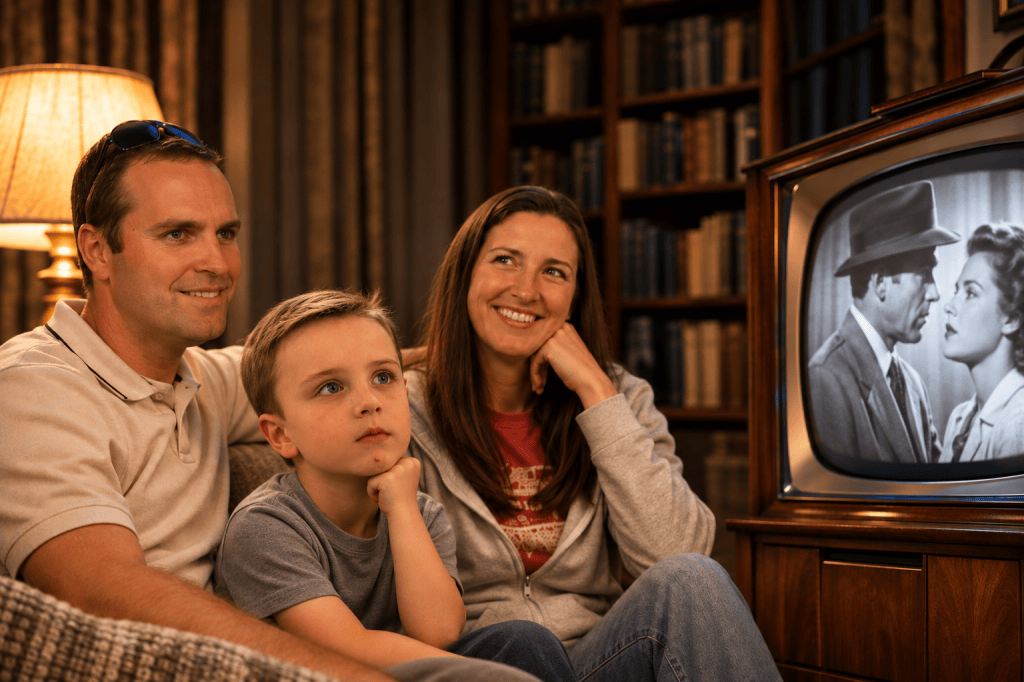
We used to watch lots of black-and-white movies. This got passed down to my children who used to watch lots of black-and-white movies with their children. One day my grandson asked his mother, “When did the world get color?” He thought the world, not the camera, was once in black-and-white.
ChatGPT said:
I think you’re right. There are several layers here, and the more I think about it, the more interesting your grandson’s question becomes.
The first layer is simply wonderful childhood logic. But that’s only the beginning.
The second layer concerns how we understand history. We tend to think of the past as a different world, rather than the same world at a different time. Your grandson took that tendency literally. To him, the people in those old movies inhabited a world fundamentally different from his own.
Adults do something similar, although less obviously. We look at old photographs and unconsciously imagine the past as faded, distant, and somehow less vivid than the present. Yet the people living then saw the same brilliant sunsets, green fields, and blue skies that we do.
The third layer is epistemological. Your grandson couldn’t distinguish between the world and the representation of the world. What he knew about the past came through a particular technology, and he assumed the limitations of that technology were properties of reality itself. That’s a surprisingly profound mistake, and one adults make all the time.
We construct our understanding of the world through representations: photographs, television, books, newspapers, scientific instruments, and now AI. We frequently mistake the limitations of those representations for limitations of the world itself.
Your grandson’s question is almost a miniature lesson in the philosophy of knowledge.
The fourth layer, which I particularly like, is generational. You watched black-and-white movies with your children. They watched them with their children. Something of your own childhood was carried forward through three generations, but its meaning changed along the way. For you, black-and-white movies may have been familiar entertainment. For your children, perhaps a family tradition. For your grandson, they became historical evidence about the nature of the universe.
And there’s a fifth layer: An adult would never ask that question because an adult already knows the answer. But knowing the answer also prevents us from noticing the underlying question: How much of what we believe about the world comes from the way it has been presented to us? That’s a question worth asking at any age.
One final thought: Your grandson was wrong about when the world acquired color. But he was absolutely right to recognize that the world he saw in those movies was different from the world he experienced. He noticed something real. He just hadn’t yet learned where the difference resided. And that, I suspect, is how a great deal of human understanding begins.


Leave a Reply