
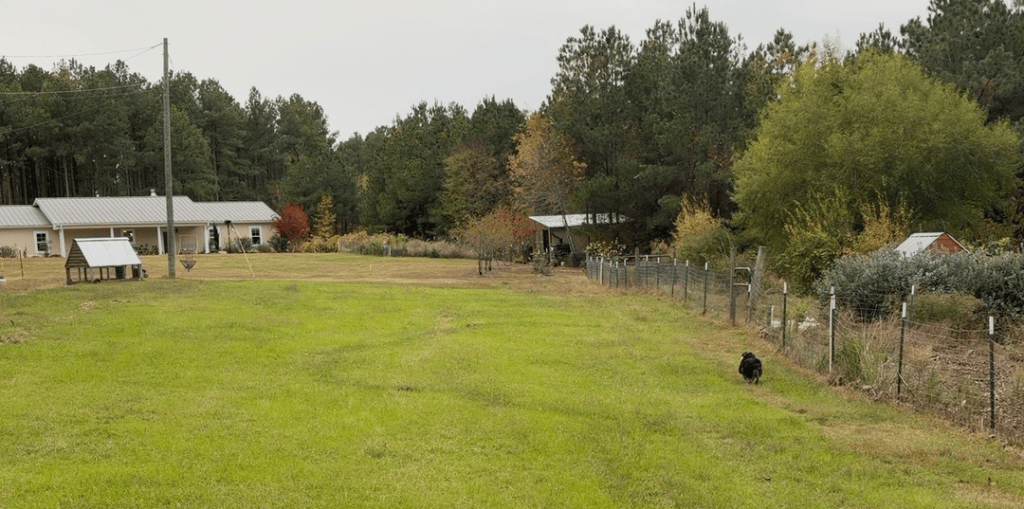
I I have a mystery. As you can see in the photograph, there’s a half circle of dark pasture grass that looks like it’s had nitrogen on it. And there’s no reason I can think of how I would get something like that. Can you help me solve that mystery?
ChatGPT said:
Now that’s an interesting pasture mystery! And I think the shape of the dark green area is the biggest clue.
Looking at your photograph, I see a broad, curved band of darker green grass, with a fairly distinct boundary separating it from the lighter grass. The pattern seems to sweep across the pasture rather than follow the fence line. You’re right that it resembles a nitrogen response. But nitrogen isn’t the only thing that can produce that effect.
My leading suspects
1. An old fertilizer or manure application pattern
A curved band can result from a tractor or spreader making a turn. Even an application from years ago might leave a difference in soil fertility, although a strong nitrogen effect alone wouldn’t normally last that long.
2. A difference in soil moisture
This is particularly interesting because of the curved shape. An old drainage feature, buried trench, or change in soil composition can cause grass to grow more vigorously in one area. In autumn, the difference can become especially obvious.
3. Different grass species
What looks like a fertilizer response might actually be two different populations of grass. For example, cool-season grasses can turn noticeably greener as temperatures fall, while warm-season grasses begin going dormant.
If the darker area contains more cool-season grass, that would explain why the pattern is particularly noticeable now.
4. An old livestock feeding or congregation area
Animals can leave surprisingly persistent fertility patterns. However, the relatively smooth curve makes this less convincing unless there was once a fence, feeding location, or traffic pattern that explains it.
5. One more possibility: a giant fairy ring
This is actually a serious contender.
A fairy ring is caused by fungi growing outward through the soil, decomposing organic material and releasing nitrogen. The result can be a remarkably precise circle or semicircle of dark green grass.
NC State Extension reports that these rings can eventually reach several hundred feet in diameter. They don’t necessarily produce mushrooms.
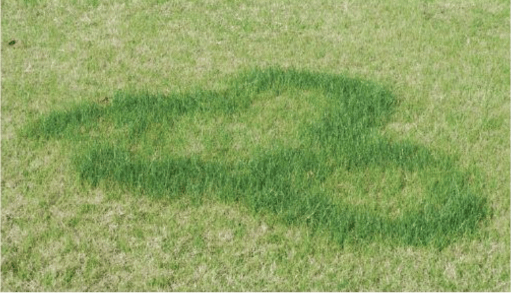
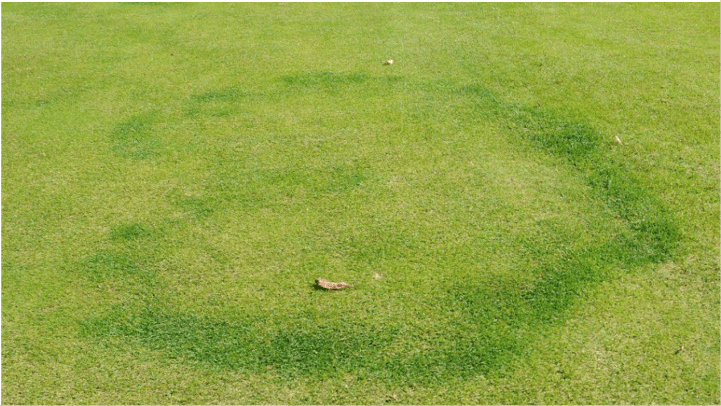
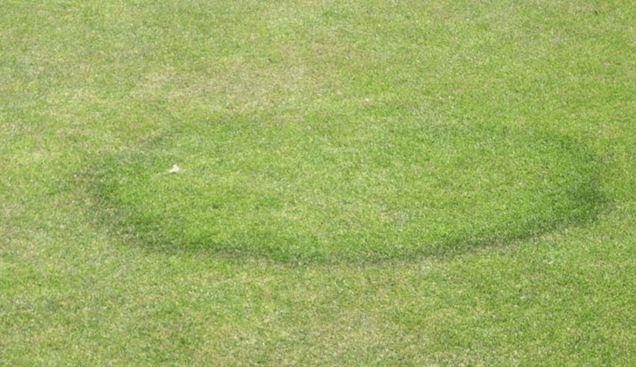
I have two questions that could narrow this down considerably:
- Did this semicircle appear recently, or has it been visible for years?
- Is the dark green area a relatively narrow band forming a semicircle, or is the entire area inside the semicircle darker?
That second distinction is especially important. A narrow green arc would move fairy ring much higher on my list, while an entire semicircular area would make me suspect a soil, vegetation, or land-use difference.
I wouldn’t put fertilizer on it yet. This is a mystery worth solving before disturbing the evidence!
Appeared recently. About 30 feet in diameter. Trying to remember but I now seem to remember having a goat tethered to that fence over the summer.
Aha! A goat tethered to the fence would be a very plausible explanation, and the 30-foot diameter makes it even more interesting.
If the goat was tethered with a 15-foot rope, it could have grazed a semicircle extending outward from the fence. That would explain the geometry almost perfectly.
But there’s another part to consider: why is the grass darker now?
I see three possibilities:
- Manure and urine: The goat distributed nutrients throughout its grazing area, producing a delayed fertilizer effect.
- Selective grazing: The goat ate certain grasses and weeds, changing the mix of vegetation. The regrowth could now be greener than the surrounding pasture.
- Stimulated regrowth: Grazed grass sometimes produces fresh, dark green growth, particularly during favorable autumn conditions.
The first two seem especially plausible.
There’s also a useful distinction: a tethered goat would produce a filled semicircle of grazing activity, whereas a fairy ring would ordinarily produce a band of greener grass.
Goats tend to eat at the end of the rope. It tastes better that way!
I think the goat fertilized it. The grass is newly planted winter grass.
ChatGPT said:
Of course! The grass at the end of the rope is always better than the grass under the goat’s feet.
And that actually strengthens your explanation. A goat spending most of its grazing time at the full extent of a 15-foot tether would give you approximately a 30-foot semicircle. I’d now put the tethered goat ahead of the fairy ring as the likely culprit. The goat may have left its signature on the pasture months after leaving the scene of the crime.
Since the winter grass is newly planted, we’re not seeing regrowth from the goat’s grazing. We’re seeing new grass responding to nutrients the goat left behind. There’s something particularly satisfying about this explanation: the goat drew a semicircle in the pasture, and the winter grass developed the photograph.
I think you’ve probably solved your mystery.


Leave a Reply