
A friend, Perry Bruno, owns Kook Kitten. What’s your assessment of this maiden race at Del Mar?
ChatGPT said:
My assessment of Kool Kitten’s maiden victory at Del Mar
First, congratulations to Perry Bruno! I found the race, and the records confirm that Perry and Dave Marshall own Kool Kitten, the three-year-old filly who won Del Mar’s second race on September 4, 2026.
My initial assessment is that this was a meaningful maiden victory, with reason for optimism about her future, although I would be cautious about interpreting one victory as evidence of stakes-level ability.
The race at a glance
| Detail | Result |
|---|---|
| Race | Maiden Special Weight, Race 2 |
| Distance | 6½ furlongs, dirt |
| Purse | $80,000 advertised; $82,000 total available |
| Field | 9 fillies and mares |
| Winner | #4 Kool Kitten |
| Trainer | Andy Mathis |
| Jockey | Welfin Orantes |
| Winning time | 1:18.28 |
| Winning payout | $11.60 on a $2 bet |
Kool Kitten defeated Volcanologist, Blame the Track, and six others. At odds of approximately 9-2, she was respected by bettors but certainly wasn’t an overwhelming favorite. Charts+2
One important positive is the class of the race. This was a maiden special weight, not a maiden claiming race. That distinction matters: she won in a relatively strong category for California-bred horses that had not previously won.
What I find encouraging
There are three things worth noting.
1. She beat a competitive field. The favorite, Acclaim Perfection, went off at 11-4 and finished last. Kool Kitten also defeated several horses with prior racing experience. That makes the victory more interesting than simply beating a field of untested newcomers.
2. She earned a substantial purse. The official Equibase chart reports $48,000 in first-place purse money. That’s a very nice return for her owners, even before considering the costs of maintaining a racehorse.
3. She’s young enough to improve. Born February 15, 2023, she’s only three. Depending on her physical development and racing experience, she may have considerable room to progress.
What I would want to examine more closely
The fractional times were:
| Distance | Cumulative time |
|---|---|
| ¼ mile | 22.48 seconds |
| ½ mile | 45.85 seconds |
| 6 furlongs | 1:11.26 |
| Finish, 6½ furlongs | 1:18.28 |
These are the leaders’ times, not necessarily Kool Kitten’s individual fractions.
The most revealing questions are whether she expended energy contesting the early pace, whether she accelerated decisively when asked, and whether she was still running strongly at the finish.
Those observations would help distinguish a filly who benefited from favorable race circumstances from one who demonstrated ability that could carry her into tougher competition.
Now here’s her second race at Santa Anita.
ChatGPT said:
Comparing her first two races
| Del Mar | Santa Anita | |
|---|---|---|
| Date | September 4 | October 2 |
| Race class | Maiden Special Weight | Allowance Optional Claiming |
| Distance | 6½ furlongs | 6½ furlongs |
| Finish | 1st of 9 | 10th of 10 |
| Margin | Won by 7¾ lengths | Lost by 20.6 lengths |
| Winning time | 1:18.28 | 1:17.38 |
| Jockey | Welfin Orantes | Welfin Orantes |
This replay is Santa Anita’s eighth race on October 2, and Kool Kitten is horse #3. The video shows her initially competitive with the field before losing ground substantially as the race progresses.
What interests me most is that she doesn’t appear simply to have been left behind at the start. Her trouble develops later, which makes the question of why she stopped competing particularly important.
What I see in the Santa Anita replay
The early stages: Kool Kitten is reasonably well placed, but she isn’t dominating the race as she did at Del Mar. The leaders are moving quickly, with the first quarter in 21.63 seconds and the half-mile in 44.22 seconds.
Approaching the turn: She begins losing contact with the leading horses. This is the portion of the race that concerns me most. She isn’t making a sustained move toward the leaders.
Through the stretch: By this point, she’s well beaten. There’s no apparent late rally, and she finishes far behind the winner.
What might explain it?
My leading possibilities are:
- The faster pace and stronger competition. The opening quarter was considerably quicker than in her maiden victory. Even if she wasn’t setting that pace, keeping up with faster horses can be exhausting.
- A physical or conditioning issue. Such a dramatic reversal makes this worth investigating, although I cannot identify an injury from the video.
- The maiden victory may have exaggerated her superiority. Winning by 7¾ lengths is impressive, but it doesn’t necessarily mean the defeated horses were strong competitors.
I wouldn’t attribute the defeat to the jockey based on what I can see.
My assessment for Perry
I would tell Perry that Kool Kitten’s first victory was promising, but her second race exposed a question that needs answering. Can she sustain her speed when challenged by faster, more experienced horses?
I wouldn’t write her off. Two races are far too few to establish her limitations, particularly when one was an impressive victory.
One thing would be especially valuable: the trainer’s observations after the Santa Anita race. Did she come back breathing unusually hard? Was she sound afterward? Did the jockey report anything unusual?
Those details could tell us much more than the finishing position alone.
And I’m curious about something: Has Perry told you what Andy Mathis thought went wrong? I’d be interested in comparing the trainer’s explanation with what we can see in the replay.
Here’s yesterday’s race with a new jockey again at Santa Anita.
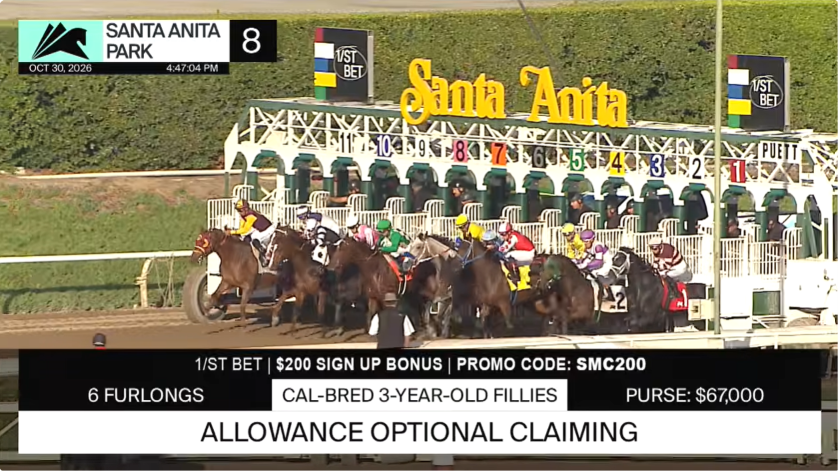
https://youtu.be/I89zQLR_0OQ?si=lZCgF34OShw6sghu
ChatGPT said:
Kool Kitten’s third race — Santa Anita, October 30
This race is especially interesting because it gives us a chance to test our interpretation of her disappointing second start.
I’ve examined the replay. Kool Kitten is #6, with the yellow saddlecloth, and she’s very prominent early. That’s an important difference from a horse that simply cannot keep up with allowance-level competition.
The race also develops at a brisk pace: the displayed fractions are 22.13 seconds for the opening quarter and 45.06 for the half-mile.
What stands out
1. She has genuine early speed. Kool Kitten takes the lead and opens a visible advantage down the backstretch. That reinforces something her maiden victory suggested: she has the ability to get herself into a favorable early position.
2. She loses that advantage rapidly. As the field approaches and rounds the far turn, her lead disappears. By the five-eighths-mile point (58.16 seconds), she’s already being challenged and overtaken.
3. She doesn’t recover in the stretch. Other horses move past her, and she is no longer in contention for the win. The video segment ends before I can confidently establish her official finishing position.
Comparing all three races
| Race | My interpretation |
|---|---|
| Del Mar, Sept. 4 | Dominant maiden victory, demonstrating promising ability |
| Santa Anita, Oct. 2 | Competitive early, then a severe fade |
| Santa Anita, Oct. 30 | Clear early speed, followed by another substantial fade |
The October 30 race changes my thinking somewhat. After the October 2 defeat, I wondered whether she had simply encountered unusually strong competition or had an off day. Now we have two consecutive races in which sustaining her effort appears to be the problem.
The jockey change is also informative. With Ricardo Gonzalez aboard, the same general pattern persists. That makes me less inclined to attribute the problem primarily to Welfin Orantes’s riding.
What I would suggest to Perry
I would ask trainer Andy Mathis two questions:
- Is Kool Kitten using too much energy early, and would she benefit from being rated behind the leaders?
- Has anything in her post-race recovery or physical examination suggested a reason for her inability to sustain her speed?
I wouldn’t automatically recommend a shorter race. She’s already racing at a sprint distance, and an even shorter race could mean faster early competition. But it might be worth discussing.
My overall assessment: Kool Kitten has demonstrated speed, but she hasn’t yet demonstrated that she can sustain it against winners. The encouraging thing is that her early speed is still there. The concern is that two consecutive races have exposed much the same weakness.
I’m curious whether Perry and his trainer deliberately instructed Gonzalez to put her on the lead yesterday. That would help us understand whether this race was an experiment in tactics or simply how Kool Kitten naturally wants to run.


Leave a Reply