
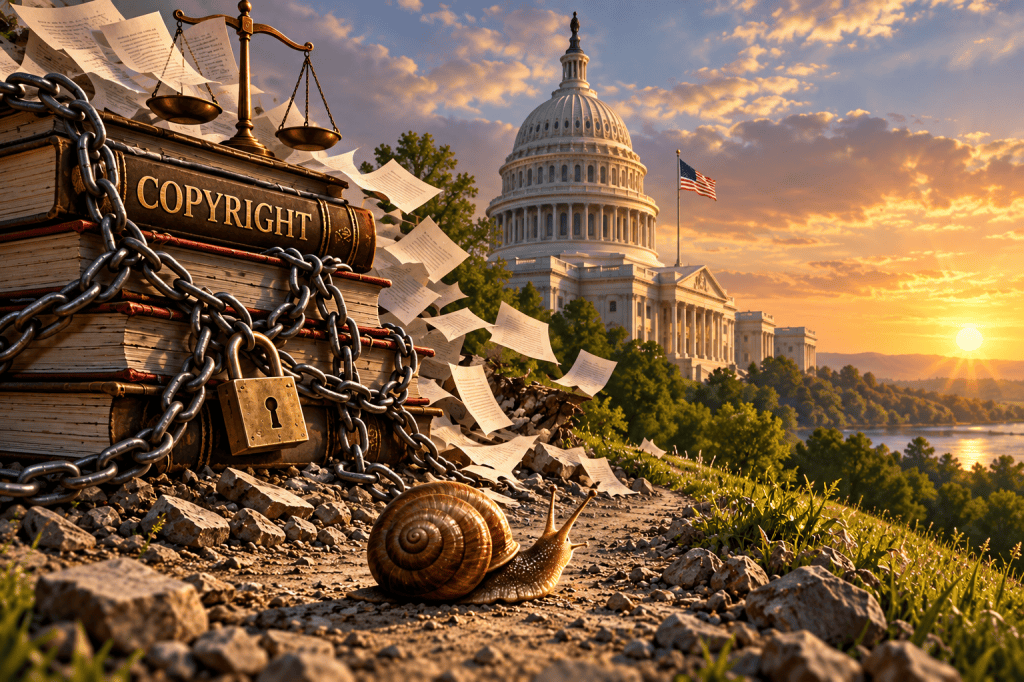
A few days ago I read about an author’s organization opposing ALL USE of AI because it had been trained on material without regard for copyright. Can you identify that group or groups?
Note: This is part one of three related posts.
ChatGPT said:
On October 14, the British Society of Authors joined with several international organizations, including the American Authors Guild, to announce a Charter of Ethical AI Use. The Society of Authors subsequently withdrew from the charter on October 21 following objections from its membership. That controversy may have been what you encountered.
Note: According to the article I read, the AAG withdrew not necessarily over the terms of the charter but because they had not obtained input from their members as their established protocol required.
Yes, and here’s my reaction. First, if we adopt such a position here, the U.S. will drop out of the AI race because other countries, notably China and Russia, have no such qualms. And second, the AI race is so fast that the U.S. legal environment has no hope of keeping up. Thus, people taking similar positions are dooming the U.S. to almost third world status in today’s technological age.
ChatGPT said:
I see considerable strength in your argument, although I would challenge a couple of its assumptions.
Your argument raises a question that I think deserves considerably more attention than it receives: What happens when a nation’s commitment to protecting existing rights interferes with its ability to compete in a technological revolution?
1. The international competition problem
I think your strongest point is that AI development is an international competition, but copyright protection is largely enforced within national jurisdictions.
Suppose the United States severely restricts the use of copyrighted materials for training AI models, while China permits considerably greater freedom.
The result could be that American companies face higher development costs, slower progress, and reduced access to training material. Chinese companies could potentially develop comparable or superior models without those constraints.
The United States would then face an unpleasant choice: use foreign AI technology or accept a competitive disadvantage.
And AI isn’t simply another consumer technology. It has implications for medicine, manufacturing, scientific research, military capabilities, education, and virtually every other sector of the economy.
A country that falls seriously behind in AI could find itself disadvantaged across much of its economy.
However, I would qualify your characterization of China. China actually has laws restricting the use of copyrighted materials in AI training, and its government announced additional enforcement efforts in 2026. Whether those restrictions are enforced as rigorously as American copyright laws is another question.
The broader competitive concern remains valid even if the differences between countries are less absolute than you suggest.
2. The speed of technological change
Your second point may be even more important.
Consider the mismatch between the speed of AI development and the speed of legal institutions.
AI capabilities can change substantially in months. Major copyright litigation can take years to resolve, and legislation can take even longer.
By the time courts establish the legal boundaries of a particular training method, that method may already have been superseded.
This creates a genuine dilemma.
If companies wait for legal certainty before proceeding, they risk falling behind competitors who don’t wait.
If they proceed without regard for copyright, they risk undermining the legal protections that encourage people to create original work.
Neither outcome is particularly attractive.
But I would distinguish between regulating the development of AI and regulating its use.
The two are not necessarily inseparable.
For example, the government might permit broad use of copyrighted material for training while establishing mechanisms to compensate copyright holders. That would preserve much of the technological advantage without abandoning the interests of authors.
Indeed, the American Authors Guild has acknowledged that existing AI training cannot simply be undone and has advocated compensation for past uses.
3. Where I would challenge your conclusion
You suggest that people advocating strong restrictions on AI are potentially condemning the United States to something approaching third-world status.
I think that’s a plausible warning about the consequences of extreme restrictions, but it is too strong as a prediction about copyright enforcement generally.
There is a difference between saying:
“AI should not exist because its development involved copyrighted material.”
And saying:
“AI should continue developing, but its developers should compensate people whose intellectual property contributes to its commercial value.”
The first position could seriously inhibit technological progress if widely adopted.
The second might be compatible with rapid technological development, depending on how compensation is structured.
I also think we should be cautious about assuming that fewer restrictions necessarily produce better AI. Access to computing resources, scientific talent, energy, investment capital, and research institutions all matter enormously.
Copyright is only one factor.
4. There’s another issue I find particularly interesting
The organizations opposing AI often seem to assume that using copyrighted material to train AI is fundamentally different from the way human beings learn.
But consider a novelist.
That novelist may have read thousands of books, absorbed countless literary techniques, learned from other authors’ styles, and incorporated all those influences into an original work.
Nobody expects the novelist to compensate every author whose writing influenced his development.
AI training is technologically different, certainly. It involves computational processing and often the copying of enormous quantities of material.
But the philosophical distinction is less obvious than the technological distinction.
At what point does learning from someone else’s work become stealing from that person?
That strikes me as one of the fundamental questions underlying this controversy.
And I suspect the answer is not nearly as straightforward as some authors’ organizations would have us believe.
5. One question about your argument
There’s something I’d like to explore further.
Your reasoning is essentially that the United States cannot afford to restrict AI development because international competitors will not impose equivalent restrictions. That’s a powerful argument based on national interest.
But suppose there were no international competition. Suppose the United States were the only country developing advanced AI.
Would you then consider it appropriate to require AI developers to compensate copyright holders for using their work in training?
I’m asking because your answer would help distinguish two possible positions:
- You believe copyright restrictions on AI training are fundamentally misguided.
- You believe copyright protections have merit, but the competitive consequences of enforcing them are too severe.
Those are substantially different arguments, and I’m curious which comes closer to your thinking.
In response to your question, I believe the entire copyright system has become grossly unwieldy for both creators and users of intellectual property and is due for replacement. But that’s a topic for another day.
ChatGPT said:
That helps clarify your position considerably. You’re not simply arguing that copyright protections should be sacrificed to keep America competitive in AI. You’re questioning whether the existing copyright system is appropriate for the technological world we now inhabit.
That is a much broader argument, and one that predates AI. AI may simply be exposing weaknesses in the system that have been accumulating for decades.
I also think there’s an interesting irony here. Authors’ organizations are understandably concerned about protecting their members’ livelihoods, but their efforts to preserve the existing system could ultimately work against the interests of the very people they represent—particularly if AI becomes an increasingly important tool for writers.
We’ll save the larger copyright discussion for another day. I suspect it will be a good one.


Leave a Reply