
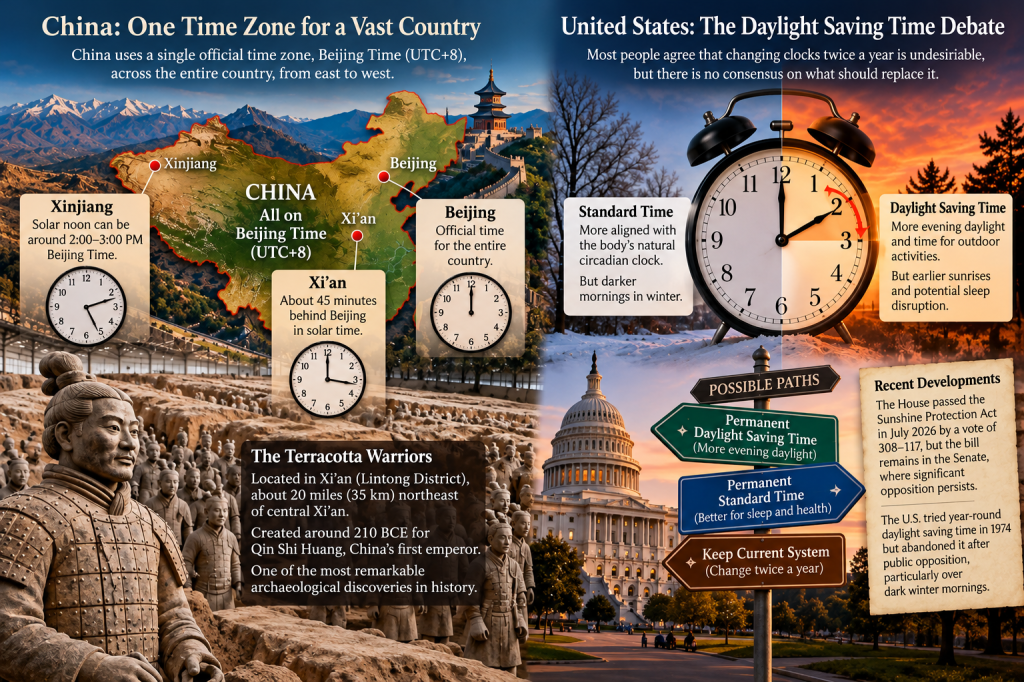
I was in Xi’an China, and they operated on Beijing time (which I thought should be in a different time zone) as did the entire country. Is that still the case?
ChatGPT said:
Yes. China still operates on a single official time zone: Beijing Time (UTC+8). That includes Xi’an and the entire country, despite China spanning roughly five geographical time zones.
This policy was established in 1949, when the Communist government standardized the country on Beijing Time.
There are some interesting consequences:
- Xi’an: Geographically, Xi’an is about 45 minutes behind Beijing in solar time, but its clocks show exactly the same time.
- Western China: In Xinjiang, the discrepancy is much greater. Solar noon can occur around 2:00–3:00 PM Beijing Time.
- Local adaptation: In Xinjiang, many Uyghur residents use an unofficial local time, two hours behind Beijing Time. Both systems coexist, sometimes creating confusion.
- Daily schedules: In western China, businesses and schools may adjust their operating hours to compensate for the difference between official time and daylight.
China also does not observe daylight saving time, having abandoned it after 1991.
What I find particularly interesting is that China once had five official time zones, but eliminated them as part of the effort to unify the country under one national standard.
So, what you experienced in Xi’an remains essentially unchanged today, more than 75 years after the policy began.
The current U.S. debate over the annual change to and from daylight savings time spurred this memory. Given the plethora of opinions and the nature of our demographic process, it’s doubtful to me that we are going to solve this issue anytime soon.
ChatGPT said:
Your observation points to an interesting distinction between the ability to make a decision and the ability to reach agreement about a decision.
China could impose a single time standard across a country geographically spanning five time zones. Whether that was a good decision is a separate question, but the government had the authority to make it and enforce it.
In the United States, the daylight-saving time debate illustrates a different problem. There is considerable agreement that changing clocks twice a year is undesirable, but much less agreement about what should replace it.
Some favor permanent daylight-saving time because they prefer more daylight in the evening. Others favor permanent standard time because it more closely aligns with the human circadian clock. And some prefer keeping the present arrangement.
The distinction matters because agreement that something is a problem does not necessarily produce agreement about its solution.
There has actually been some movement this year. The House passed the Sunshine Protection Act in July 2026 by a vote of 308–117, but the legislation remains in the Senate, where significant opposition persists.
Your skepticism may therefore be justified, although the House vote suggests that agreement is possible.
There’s also a historical irony here. The United States tried year-round daylight-saving time in 1974, only to abandon the experiment after public opposition, particularly concerning dark winter mornings.
I think your recollection of China raises a larger question: Is the difficulty of reaching collective decisions a weakness of democracy, or part of the price we pay for ensuring that competing interests are heard?
Of course, the two aren’t mutually exclusive.


Leave a Reply