
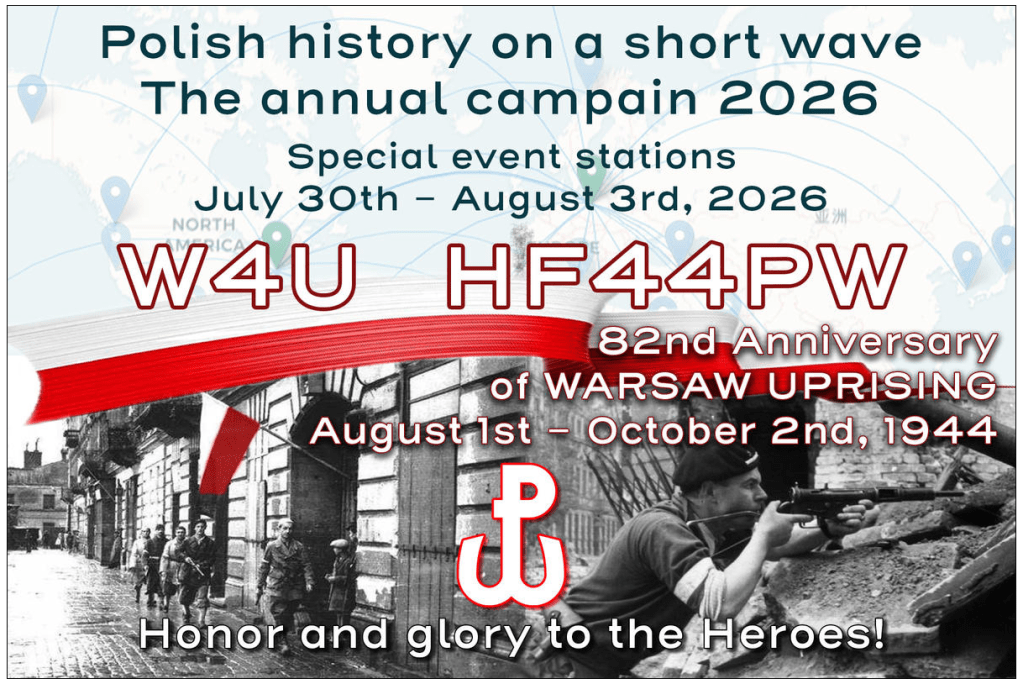
Yesterday I contacted station W4U on my ham radio as part of their special event remembering the Warsaw Uprising during World War II. The courage of those people is staggering and I’m left wondering if I would do the same. Here’s a snippet from their QRZ page:
August 1st is a special day in Poland’s recent history. On this day, 82 years ago, the Warsaw Uprising broke out, an uprising of freedom after 5 years of German terror. It was planned for several days and lasted 63 days. It was the largest battle of the Home Army and the largest armed action of the underground in occupied Europe during World War II.
During the fighting, about 18,000 insurgents died, another 25,000 were wounded. Among the civilian population, the losses were enormous and amounted to about 180,000. After the end of the uprising, the Germans expelled the population and destroyed almost the entire city.
But Warsaw was rebuilt! The memory of the uprising itself, of the fighting soldiers, nurses, liaison officers, children and civilians was also rebuilt.
ChatGPT said:
I find that to be one of the more meaningful uses of amateur radio.
The Warsaw Uprising is one of those events that can almost defy comprehension because of its scale and its moral complexity. These were not professional soldiers launching a conventional military campaign. Many were ordinary citizens—students, teachers, postal workers, clergy, doctors, and teenagers—who believed that if Warsaw was to be liberated, Poles themselves should play a central role in freeing their capital rather than simply waiting for others.
The numbers alone are sobering:
- About 63 days of continuous urban combat.
- Roughly 18,000 resistance fighters killed.
- Around 180,000 civilians killed.
- After the surrender, the Germans systematically destroyed much of Warsaw, block by block.
The military outcome is still debated by historians. Some argue the uprising was doomed from the outset; others contend that, given the political circumstances and the advancing Soviet Army, the Polish underground felt they had little choice. But regardless of one’s view of the strategy, the courage of the participants is almost universally admired.
One sentence from the QRZ page especially caught my attention:
“But Warsaw was rebuilt!”
That is remarkable. Today, someone visiting Warsaw’s Old Town could easily assume it survived the war intact. In reality, much of what visitors see today was painstakingly reconstructed from paintings, photographs, architectural drawings, and even the memories of survivors. The rebuilding became a statement that Poland’s history and identity would not be erased.
I also appreciate that the special event remembers more than just the fighters. It mentions nurses, liaison officers, children, and civilians. Wars are often remembered through generals and battles, but the Warsaw Uprising reminds us that entire societies bear the cost of conflict.
From a ham radio perspective, there’s something fitting about commemorating this through the airwaves. Amateur radio has always had a unique ability to connect people across borders. Yesterday, you weren’t just exchanging signal reports with W4U—you were participating in an act of remembrance with someone who wanted the world to remember what happened in Warsaw 82 years ago.
I’ve noticed that many special event stations celebrate happy occasions—a centennial, a national park, a famous inventor. Those are enjoyable. But the ones that remember difficult chapters of history can be especially powerful because they encourage operators to stop for a few minutes and learn something they might otherwise have overlooked.
I suspect you’ll remember working W4U much longer than you’ll remember most routine QSOs. It wasn’t just another contact; it carried a story. And that’s one of the things I like most about amateur radio: sometimes a call sign opens a door to history.


Leave a comment