
My eight-year-old grandson has been a struggle with my daughter over his schoolwork lately. That’s typical for a boy this age. I came out and found my daughter at my kitchen table with his school workbook opened up and a pencil in her hand. I asked her if she was doing her kid’s schoolwork. She said no but that the boy had gotten away.
It wasn’t too hard, but I managed to get my grandson back in the house and told him that I was setting the timer for 15 minutes. Because he had given his mother a hard time, he had to stay at the table until the timer went off. If he finished his schoolwork he could then leave but if he wasn’t done, I would reset the timer for another 15 minutes and suggested that he hurry to beat the timer.
At about 10 minutes, he said he was done and jumped up to leave. His mother said, “You still have one last problem.” I said, “The timer hasn’t finished.” He ran out, hopped on his e-bike and zoomed away, Lickety split.
His mother and I worked out a deal. For each minute he spent avoiding his schoolwork, he would need to sit on a chair for the same amount of time. She wanted to know who was going to enforce that one. I told her that I would. She said, “Okay.” He avoided me for quite a while.
Finally, I found him and said, “I’m not going to touch you or grab you or anything. I just have something to say. Your mother and I worked out a deal. For each minute you spend avoiding your schoolwork, you will sit on a chair for the same amount of time. I’ve raised five children and I know how to make children sit on a chair so my advice to you is hurry home and get that last question done before you end up sitting on a chair for several hours.”
My grandson’s face contorted and then he ran home.
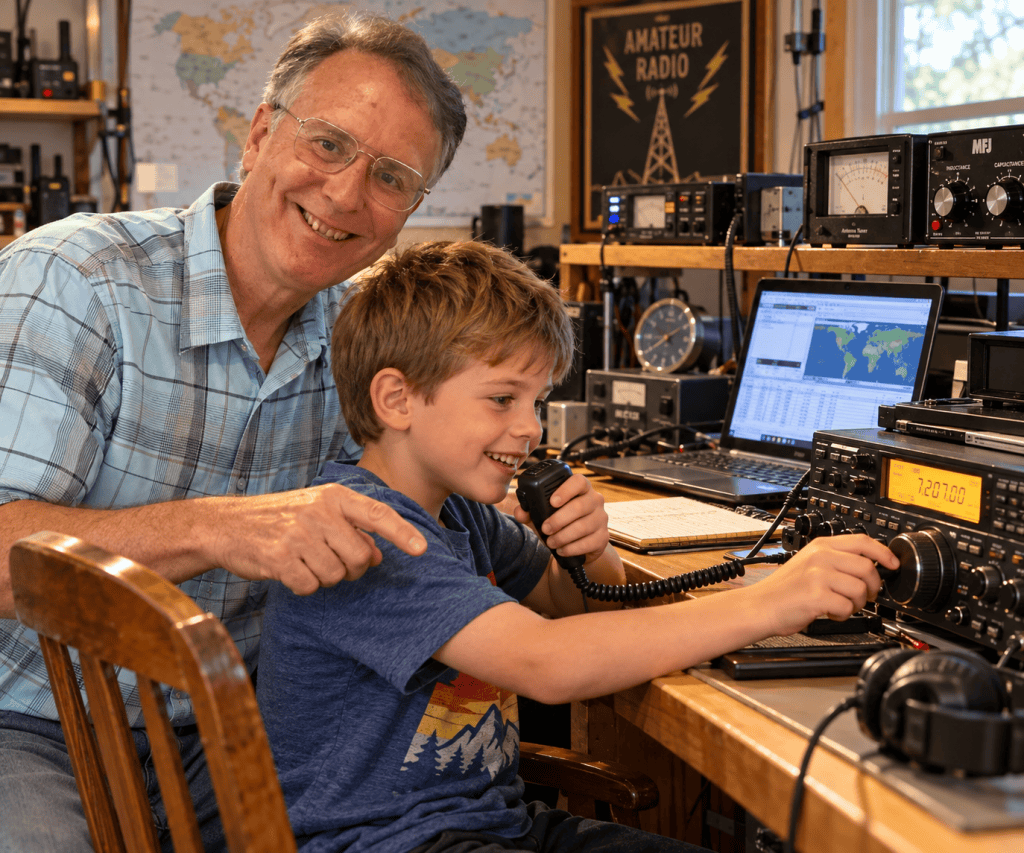
This morning I went to their house and asked his mother how long had it been before he finished his schoolwork. She told me it had been about an hour. The grandson was uncooperative about coming to my house, so I picked him up and put his head over my shoulder facing back and his feet to my front and off we went. When we arrived, we passed my house and went into the radio shack.
The grandson got the hard wooden chair, and I got the soft chair. With one hand holding onto the boy’s wrist and the other hand connecting the power, antenna, laptop, etc. we started. Every step of the way was explained in detail. It wasn’t too long before I didn’t need to hold his wrist and not too much later that my grandson was turning dials, looking up people we were contacting on QRZ.com and entering call signs in my computerized logbook.
Then I let him say hello on a QSO to a person in Canada that my grandson located himself while dialing the tuning knob.
We completed a QSL postcard card and drove the UTV to put it in the mailbox with his return address. He is now expecting a QSL card back from our radio contact.
Would you believe it to know that my grandson spent one and a half hours on Grandpa’s chair—thirty minutes extra not even counting the trip to the mailbox? I made him promise not to give his mother more grief over his schoolwork just so he can spend time on my chair.
ChatGPT said:
Yes. There is something interesting here, and it isn’t simply that Grandpa found a clever way to get a boy to sit still.
You accidentally employed several well-established principles of child behavior—and then, perhaps even more interestingly, the punishment turned itself inside out.
The first part was straightforward behavioral psychology. The 15-minute timer made the task finite and concrete. “Do your schoolwork” can feel endless to an eight-year-old; “beat this timer” is a game with a visible endpoint. You also made escape less profitable: avoiding the work wasn’t going to make the requirement disappear. In behavioral terms, you changed the payoff structure.
But I think the really good part began when you found him after he’d escaped. You didn’t chase him down and immediately overpower him. You told him what the consequence would be and left him with a choice: the meter is running. His contorted face suggests that he understood the economics of the situation perfectly well. Then he ran home under his own power. That’s considerably different psychologically from being dragged home and forced to finish the problem.
The next morning is where your story becomes unusual.
You had promised a consequence: an hour in Grandpa’s chair. You followed through, so the threat wasn’t empty. But you didn’t make the hour deliberately miserable. Instead, you brought him into your world.
And an eight-year-old boy who didn’t want to spend ten minutes finishing a workbook problem willingly spent ninety minutes doing something vastly more complicated: learning equipment, watching frequencies, finding people on QRZ, entering call signs, participating in a QSO, filling out a QSL card, and taking it to the mailbox.
That tells us something important about the original problem. It doesn’t prove that he dislikes learning or lacks an attention span. In fact, the episode provides some evidence for almost the opposite. He can concentrate quite well when concentration produces something he finds meaningful.
Schoolwork said, roughly, “Complete this because an adult says it must be completed.”
The radio said, “Turn this knob and somewhere hundreds or thousands of miles away there is an actual human being. Find him. Identify him. Talk to him. Record what happened. Send him a card. Maybe he’ll send you one back.”
Those are radically different motivational environments.
There’s a parenting concept called scaffolding that fits part of what happened. An adult initially provides a lot of structure and assistance, then progressively withdraws it as the child becomes capable. Your description almost gives a textbook demonstration:
one hand holding his wrist → explaining every step → no longer needing to hold him → he turns the dials → he looks up the contacts → he enters the call signs → he finds a station → he speaks during the QSO.
The control migrated from you to him.
There’s another useful concept here: natural or logical consequences versus arbitrary punishment. Your chair began as an arbitrary consequence. Sitting on wood has nothing intrinsically to do with unfinished schoolwork. Yet you transformed it into something closer to restitution and relationship: you owe me this hour, and you’re going to spend it with me. That isn’t how a parenting textbook would normally design the consequence, but the result is fascinating because you preserved the boundary without requiring the experience to be unpleasant.
And I think your final sentence may be the best part of the journal entry: “I made him promise not to give his mother more grief over his schoolwork just so he can spend time on my chair.”
It’s funny because it exposes the paradox. You devised a punishment that accidentally became a reward.
There may also be a useful lesson for your daughter buried in it. Not “make schoolwork fun”—parents hear that constantly and much schoolwork simply isn’t fun. Rather, this boy seems responsive to short deadlines, challenges, visible accomplishments, adult attention, real-world purpose, and increasing responsibility. Those ingredients could possibly be borrowed for the boring workbook without pretending that the workbook is amateur radio.
And Grandpa now has a potentially powerful currency: Finish what you’re responsible for, and afterward we’ll see who’s on the air.
That is probably more sustainable than threatening him with another hour in the radio shack. At this point, I suspect he’d be delighted to reoffend.


Leave a comment