
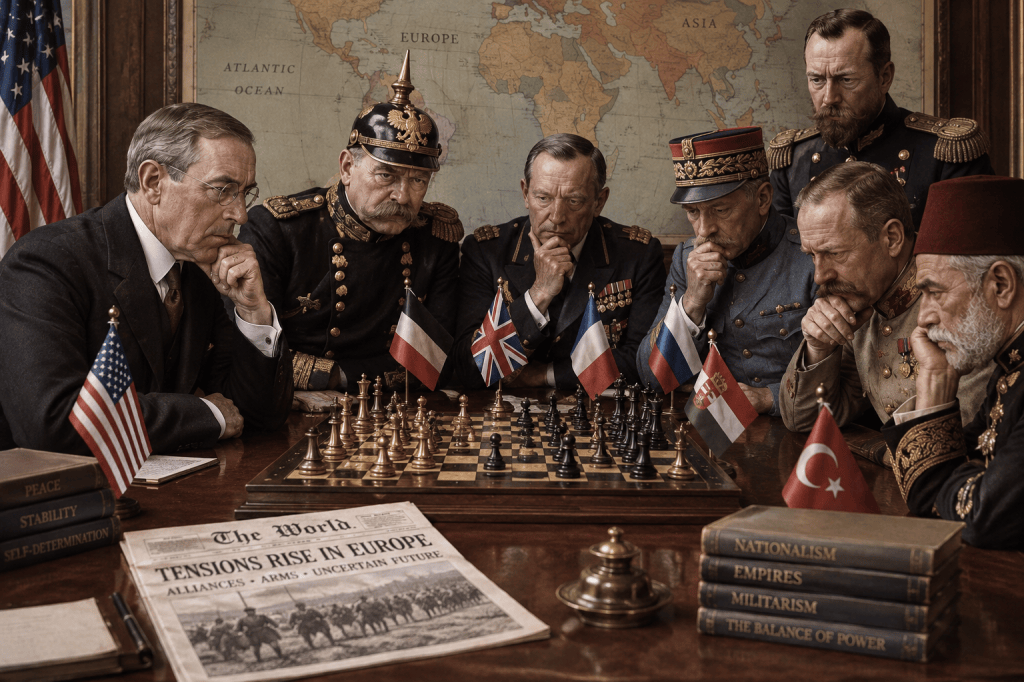
My own observation is that today’s conditions are not too far removed from what got us into WWI although my exposure to this history came a very long time ago in my life.
Note: This follows up on 🏛️Challenges to America’s Global Power and Influence
ChatGPT said:
I think your memory is pointing toward a real and useful historical parallel, provided we don’t push it into “history is repeating itself.”
Before 1914, Europe had several conditions that resemble the framework we’ve been developing: an established great power system facing a rapidly rising challenger; competition for markets, resources, territory and strategic routes; increasingly powerful militaries; rival security alignments; regional conflicts that involved larger powers indirectly; and governments taking actions they regarded as defensive that their opponents regarded as threatening. By 1907 Europe had crystallized into the Triple Alliance and Triple Entente, and Britain’s leaders explicitly worried about the consequences of German domination of Europe.
Perhaps the most important similarity is the feedback loop in your sixth bullet:
Each side’s attempt to make itself more secure can make the others feel less secure.
That describes an important part of the pre-1914 problem remarkably well. Mobilization was especially dangerous: Russia could regard mobilization as necessary protection while Germany regarded Russian mobilization as making war unavoidable. Contemporary U.S. diplomatic cables from July 1914 actually record that progression almost day by day—mobilizations, counter-mobilizations and rapidly disappearing opportunities to contain the crisis.
There is another similarity particularly relevant to the current situation: economic interdependence did not prevent the war. Once fighting began, trade, credit, raw materials and shipping themselves became instruments and casualties of warfare. A 1914 diplomatic document describes how the conflict immediately disrupted international commerce, credit and raw-material supplies far beyond the belligerent countries. That bears an interesting resemblance to today’s emphasis on economic strangulation.
But there is one enormous difference: nuclear weapons. In 1914 leaders could contemplate a great-power war without expecting their own societies to be physically destroyed within hours. Today’s major powers have a powerful reason to keep direct confrontation below that threshold. That may make our world of sanctions, proxies, blockades, resources, cyber operations, shipping disruption and economic pressure more important—not less—because those provide ways of fighting without deliberately initiating direct great-power war.
Summary Historical Parallel
There is an uncomfortable historical parallel. The world before World War I also experienced a changing balance of power, competing economic and territorial ambitions, rival alliances, military buildups and regional disputes involving larger powers. Actions one nation considered necessary for its own security were increasingly interpreted as threats by others. None of this made a world war inevitable. But it created a system in which a relatively localized crisis could trigger reactions elsewhere until governments found themselves in a much larger conflict than many had originally intended. The circumstances today are very different, particularly because of nuclear weapons, but the possibility that several interconnected struggles could reinforce one another deserves consideration.
The phrase I especially like there is “None of this made a world war inevitable.” That’s historically important. Austria-Hungary’s declaration of war on Serbia did not mechanically cause everything that followed; there were still attempts at mediation and moments when governments believed the fighting might be contained.
And that actually makes your comparison more unsettling, not less: the lesson of 1914 isn’t that certain conditions automatically produce a world war. It’s that a system can become sufficiently interconnected that leaders making individually comprehensible decisions can collectively produce an outcome that few of them originally sought.
 Conversations
Leave a comment