
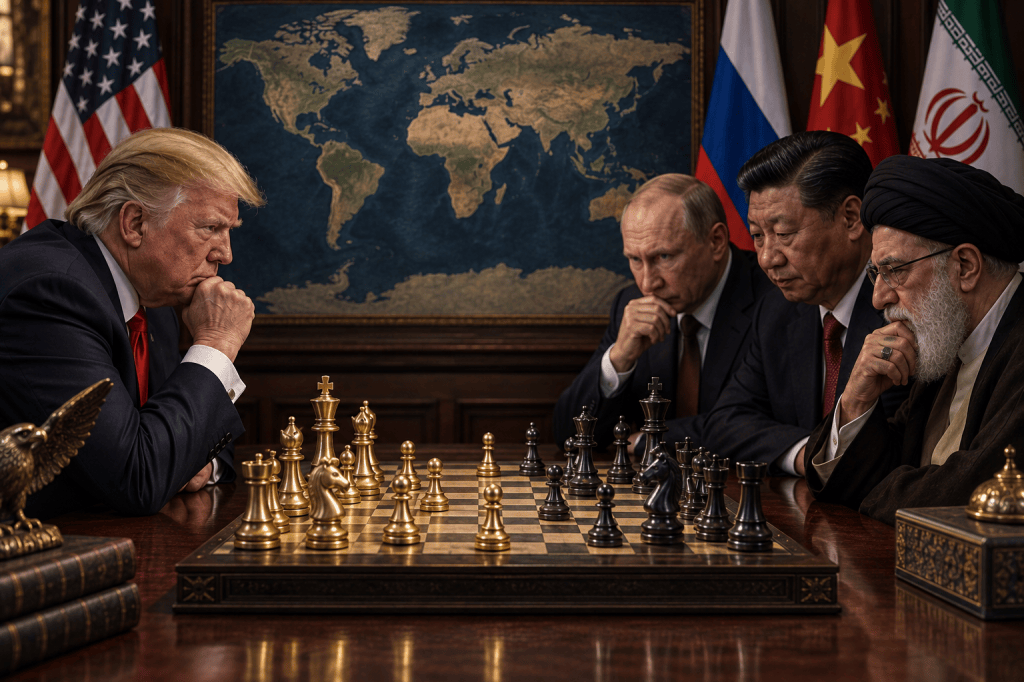
Game theory starts with the simple idea that players in a competitive game act rationally to their advantage. That is, players act first and foremost in their self-interest and will not knowingly undertake any strategy that leaves them in a suboptimal position when given a choice.
In a series of YouTube videos, Professor Jiang Xueqin applies game theory to propose that Washington may be deliberately engaging in various global conflicts as part of a larger strategy to preserve dollar hegemony and American influence. Here’s my take on how his world view applies to today and on what I think Trump may actually mean by Make America Great Again.
- American global power and influence are increasingly being challenged, with the U.S.-centered world order at risk of being displaced. The post-Cold-War period of extraordinary American economic, military and financial predominance is giving way to a struggle over which nations will control the resources, trade routes, technologies and financial systems that underpin global power. If that shift continues, the consequences will extend far beyond governments and international relations to the everyday lives of ordinary Americans.
- China, Russia and Iran are not merely challenging the U.S.-centered international system; together they have the potential to create an alternative center of economic and geopolitical power. While they are not a unified bloc with identical interests, their complementary strengths—China’s manufacturing and economic power, Russia’s resources and geography, and Iran’s energy and strategic location—portend a self-sufficient Eurasian system that is capable of replacing reliance on American resources, financial institutions and control of global trade.
- The struggle is increasingly about control of the things on which modern power depends: energy, critical minerals and rare earths, mineral processing, manufacturing capacity, technology, financial systems, and the shipping routes and geographic chokepoints connecting them. China’s continuing dominance of critical-mineral processing is a particularly important example. At the center of this struggle is preservation of the dollar-centered financial system that underpins American power.
- The Trump administration appears to be responding by reasserting U.S. primacy first in the Western Hemisphere. Seen through this lens, Venezuela, Panama, Mexico, Canada, Greenland and the Caribbean are not unrelated disputes. They concern, in different combinations, energy, minerals, migration, trade, strategic territory, shipping and the exclusion or limitation of rival powers. The administration itself describes Venezuela as demonstrating the reassertion of American power in its “home region.”
- China, Russia and Iran face corresponding incentives to secure their own strategic neighborhoods and lifelines. Russia’s concern centers heavily on its European frontier and access routes; China’s on East Asia, Taiwan, the South China Sea, trade routes and resource supplies; Iran’s on the Persian Gulf and the broader Middle East. These interests intersect with crucial maritime chokepoints—Hormuz, Malacca, Bab el-Mandeb/Suez and others. Bab el-Mandeb alone carries significant global commodity and oil traffic and provides considerable strategic leverage to whoever can disrupt it.
- Each side’s attempt to make itself more secure can make the others feel less secure. U.S. efforts to deny China strategic dependence on Western resources encourage China to diversify supplies and routes; Chinese efforts to secure those resources, including securing the South China Sea, encourage Washington to regard them as strategic encroachment. Similar feedback loops operate between Russia and NATO and between Iran, Israel and the United States. This isn’t necessarily a story about an aggressive America forcing Eurasia to react, nor about an aggressive Eurasian bloc forcing America to react. It is a system in which both sides can plausibly regard retreat or inaction as a dangerous move.
- The struggle is no longer simply competition between individual countries. It is increasingly over who will control—and perhaps reshape—the architecture of the international system itself. Energy, minerals, shipping routes, currencies, technology, alliances and military power are becoming interconnected parts of a larger struggle to determine where global power resides and who sets the terms under which other nations operate.
- That suggests that what appears to be separate conflicts are actually interconnected parts of a larger struggle for global power. Ukraine, the Middle East, Taiwan/East Asia, Venezuela and contests over shipping routes may look geographically separate while nevertheless affecting the same larger balance of power.
- These interconnected conflicts may already represent the early stages of WWIII—one fought increasingly through economic strangulation as well as conventional military force. As conflict disrupts energy, fertilizer, food, water and trade, shortages can destabilize nations, fuel further conflict and dramatically increase the number of global refugees. In this way, attempts to contain adversaries can create a feedback loop in which economic disruption, human suffering, political instability and military conflict reinforce one another.
Note: AI helped me as a critical reader to refine and wordsmith this article.
 Conversations
Leave a comment