
As an accountant, I’ve heard stories of people who cheated on their taxes but then felt guilty so they contributed anonymously to an account by the amount they felt they owed.
ChatGPT said:
Yes—and the stories you heard as an accountant were based on a real thing. What you’re remembering is the “Conscience Fund.” Treasury’s own accounting guidance defines it as money voluntarily paid to restore amounts the donor believes were “wrongfully acquired or withheld from the government.”
It has a wonderful history. In an 1886 report to the Senate, the Treasury Secretary explained that the name arose from the belief that anonymous contributors had previously taken or withheld money owed to the United States and were trying to make restitution. The money was deposited as miscellaneous receipts and used for general government purposes.
And income-tax guilt really was one reason people sent money. Contemporary accounts record anonymous contributors saying that they had failed to report income or otherwise cheated the government and were sending money to make things right. Other sins were wonderfully small: reused postage stamps, government property taken home, unpaid customs duties, and so forth.
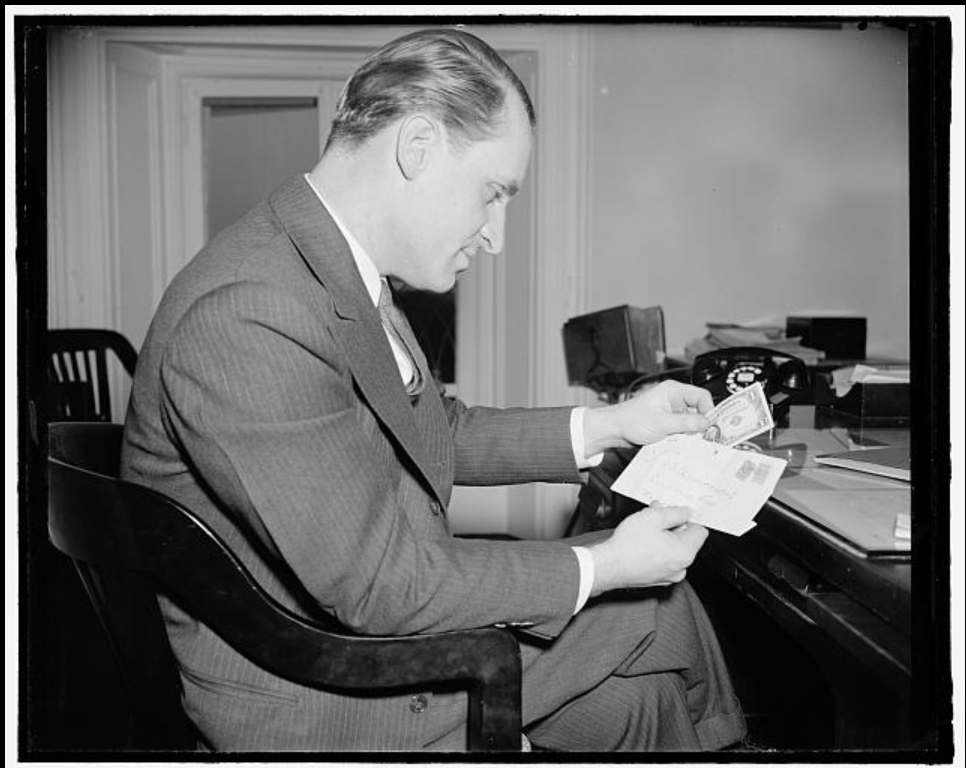
There’s even a 1939 Library of Congress photograph of the Treasury official who administered the Conscience Fund, opening one of the anonymous envelopes. The Library says contributors were “almost always anonymous.”
And it still appears in federal accounts. Treasury’s FY2024 Combined Statement records receipts under “Contributions to ‘Conscience Fund’,” separately from “Gifts to the United States” and gifts specifically intended to reduce the public debt.
So your memory actually identifies something more interesting than the account we started discussing:
Gifts to the United States: I don’t owe this, but I want the government to have it.
Conscience Fund: Legally or morally, I think the government should have gotten this money from me, so I’m giving it back.
Can you locate the picture from 1939?
ChatGPT said:
Yes—found it. This is the April 14, 1939 Harris & Ewing photograph I was referring to:
The man is Robert W. Maxwell, Chief Accountant in the Office of the Commissioner of Accounts & Deposits and acting chief of the Division of Bookkeeping & Warrants. The Library of Congress caption says that in that capacity he had charge of Treasury’s “Conscience Fund.” He’s shown opening a crudely addressed anonymous envelope containing $2.00.
The caption also says that contributors were “almost always anonymous”, and that just the previous week Maxwell had received an anonymous $1,000 contribution. At that time, contributions since the fund’s 1811 beginning had ranged from two cents to $30,000.
Even better for your purposes, the Library of Congress lists “No known restrictions on publication” and provides the scan directly from the original glass negative, including a 106 KB JPEG and very high-resolution TIFFs.
That’s a rather marvelous historical photograph given the conversation we’ve just had.


Leave a Reply