
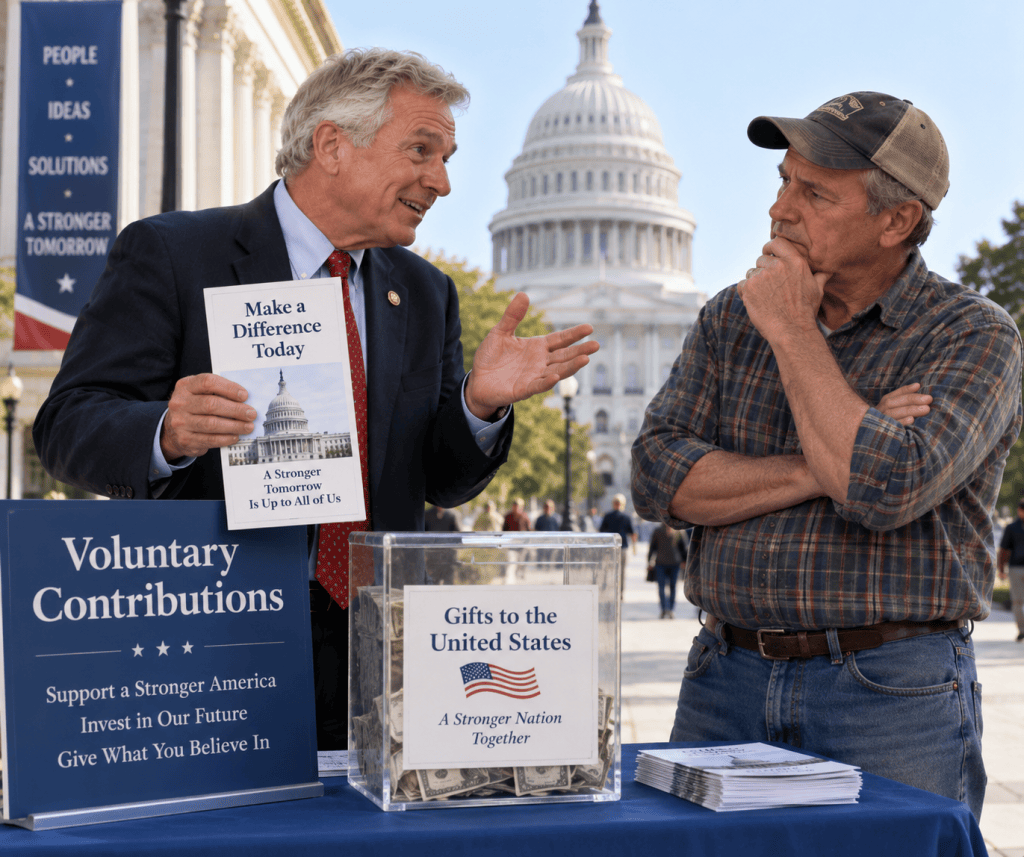
Is it possible to donate to the US government?
Note: I give ChatGPT some pushback on its response making reading to the end somewhat interesting and important.
ChatGPT said:
Yes. You can literally give money to the United States government, with no tax bill or other obligation attached.
The Treasury accepts voluntary gifts through a special account called “Gifts to the United States.” The money becomes federal funds and is available for general governmental purposes. You can also make a contribution specifically toward reducing the public debt.
So, for example, if you thought, “I owe $12,000 in federal income tax, but I think I ought to contribute $15,000,” you can pay the $12,000 tax and separately donate the extra $3,000.
There is even statutory authority for it: 31 U.S.C. § 3113, which authorizes the Secretary of the Treasury to accept gifts of money or other property to the United States.
One important distinction: this isn’t a political contribution. It doesn’t go to a candidate, party, or PAC, and you don’t get any special say over government policy because you donated.
If you’re asking because you’ve encountered the argument that people who think their taxes should be higher are already free to pay more, then yes—the mechanism actually exists. There are some interesting wrinkles to that argument, though.
Yes, that is what spurred the question. What are the wrinkles?
ChatGPT said:
There are several, and they make the argument more interesting than either side usually admits.
The statement “If you think taxes should be higher, you’re free to send the government more money” is factually true but doesn’t quite answer the policy argument. The reason is that taxation and voluntary giving solve different problems.
- Collective action is the biggest wrinkle. Someone can rationally favor everyone in a particular income group paying another 2% without wanting to be the only person who does it. Suppose 10 million people each paying $1,000 would finance a $10 billion program. Your voluntarily contributing $1,000 produces essentially none of the intended result if the other 9,999,999 don’t participate. “I favor this rule applying to all of us” isn’t logically equivalent to “I want to act as though the rule already exists.”
- Taxes aren’t necessarily about generosity. A person advocating higher taxes might believe that defense, highways, courts, deficit reduction, Social Security, or some other public purpose should be financed according to a particular formula. That’s a claim about how costs should be allocated, not necessarily a claim that the speaker personally wants to give money away.
- But the voluntary-payment argument isn’t meaningless, either. It can expose an interesting difference between marginal and systemic beliefs. If I repeatedly say, “The federal government needs more money, and people exactly like me aren’t contributing enough,” someone can reasonably ask why I don’t contribute anything extra myself. “It only works if everybody does it” is a good answer for a $10-billion policy, but perhaps a less satisfying answer to why I won’t personally part with an additional $100.
- Where the money goes matters. A taxpayer might favor paying more specifically for deficit reduction, infrastructure, or assistance to poor families while being unwilling to make an unrestricted gift to the Treasury. “Government should collect another $100 billion for X” is quite different from “I’d like the government to have another $100 billion to spend however Congress decides.”
- Tax policy also changes behavior. Raising a tax rate isn’t simply multiplying taxpayers × additional dollars. People change investment, work, consumption, business structures, timing of income, and tax planning. Consequently, someone can favor higher statutory rates while another person can reasonably object that the expected revenue won’t equal the simple arithmetic.
There’s also a philosophical wrinkle that I think is particularly good.
Imagine 100 farmers share an irrigation system that needs a $100,000 repair. One farmer says, “We should assess ourselves $1,000 each.”
Another replies:
“Nobody is stopping you from sending them your $1,000.”
The first farmer can quite reasonably answer, “I’m not proposing that I donate $1,000. I’m proposing that we each pay $1,000 so the irrigation system gets repaired.”
But now change the situation. The irrigation system already has enough money, and the farmer keeps insisting that people like himself have been getting too good a deal. Someone asking “Then why don’t you voluntarily pay more?” becomes a much more pointed question.
That’s why I wouldn’t dismiss the “you can always pay extra” argument as a mere gotcha. It tests personal consistency, but it doesn’t by itself settle what the tax law ought to be.
And there’s a mirror-image question that’s equally revealing: someone who believes government spending is excessive can’t individually opt out of the portion of his taxes financing programs he opposes. Taxation is inherently a collective decision enforced on individuals, which is precisely why arguments about the appropriate level of taxation can’t ultimately be resolved by what any one person voluntarily chooses to pay.
Most of your arguments only apply to the situation where one has a specific government program in mind, and you employ “public good” arguments. But the account you describe isn’t ear-marked. If we employed your arguments to say, energy conservation, no one would conserve energy beyond what is personally economically beneficial, yet we see people doing just that.
Yes. I think that is a legitimate weakness in the way I framed the answer.
I leaned too heavily on the collective-action/public-good defense, which works best when the proposition is something like, “We should raise taxes by $X to accomplish Y.” It is considerably weaker when the proposition is simply, “People like me should pay more taxes.”
Your energy-conservation analogy exposes the problem nicely. We generally don’t accept this reasoning:
“It would be better if everyone conserved electricity, but my individual conservation makes almost no difference, so I’ll conserve only if everybody is compelled to do it.”
Many people instead accept some personal obligation to behave consistently with the outcome they advocate—even though their individual contribution is infinitesimal.
The same reasoning can be applied to taxes. Suppose a wealthy person says, “People with my income pay too little to the federal government. We ought to pay 35% rather than 30%.” If Treasury will voluntarily accept the additional 5%, then asking why that person doesn’t pay it is a perfectly legitimate question. The fact that his payment won’t change the federal budget very much isn’t much of an answer; neither will turning off one unnecessary light materially affect national electricity consumption.
There is still one important distinction. “I believe everyone in category X should be legally required to do Y” doesn’t necessarily entail “I believe I have a moral obligation to do Y voluntarily while it isn’t required.” We accept that distinction elsewhere. Someone can favor a zoning restriction without voluntarily restricting his own property, or favor a higher minimum wage without voluntarily paying above the current minimum. He’s advocating a different set of rules rather than claiming that complying with those hypothetical rules is presently a personal moral duty.
But that creates a revealing question:
What exactly is the claim behind “I should pay more taxes”?
If it means “Government requires more revenue, and the fairest way to obtain it is to increase taxes on people like me,” voluntary payment isn’t a particularly strong rebuttal because the proposed distribution of the burden is part of the policy.
But if it means “I personally am not contributing my fair share to society,” then the availability of voluntary Treasury contributions becomes much harder to wave away. If I believe my own contribution is unfairly low, I already possess the ability to correct my own unfairness.
And your conservation comparison goes one step further. We often regard voluntary behavior as evidence of how seriously someone holds a stated value. Someone who lectures everyone about reducing electricity consumption while illuminating an empty barn all night isn’t logically disproving the case for conservation—but we’re entitled to notice the discrepancy.
Likewise, a person can coherently advocate higher taxes without voluntarily paying them. But if that person says “I don’t pay enough,” rather than “our tax system should collect more,” then “Treasury accepts checks” isn’t merely a clever comeback. It’s a reasonable test of whether “I don’t pay enough” was intended literally.
That distinction—“my taxes are too low” versus “tax rates are too low”—may be the wrinkle that matters most.
 Conversations
Leave a comment