
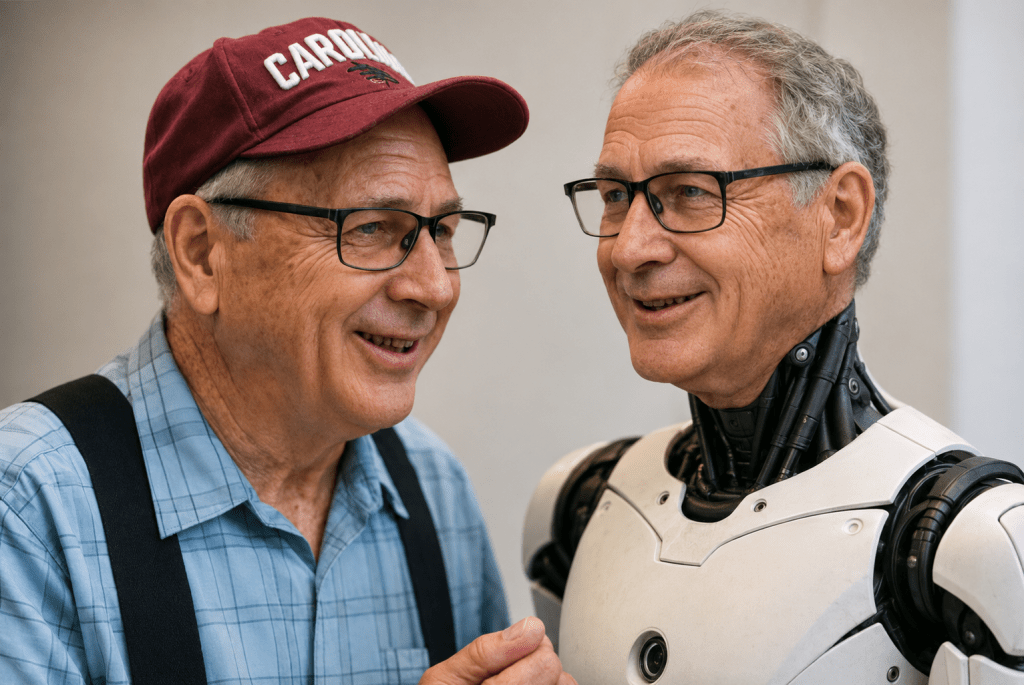
Here’s the robot video I found most fascinating. China unveils humanoid AI ‘companion robots’ to ease loneliness
Note: ChatGPT needed updating on what’s current in robots. This goes to show just how quickly the world of humanoid robotic is advancing. Here’s the link I provided to ChatGPT.
ChatGPT said:
Yes—that video clears it up. This is the company you were remembering, and I need to correct part of my previous answer: your recollection was considerably closer to the reporting than my caution suggested.
The video is Al Jazeera’s report on UBTech’s UWORLD U1 companion robots. China unveils humanoid AI “companion robots” to ease loneliness Independent reporting from Reuters confirms that UBTech unveiled these ultra-realistic humanoids in Shenzhen at the end of June, specifically positioning them for companionship and emotional support.
What particularly changes my reaction is that the human likeness isn’t incidental. The U1 can be customized to resemble loved ones or celebrities, and UBTech is deliberately targeting single people and people over 60 as potential customers.
And now I understand why this particular video struck you as so science-fictional.
It’s not really the robot that is startling
We’ve had humanoid robots for years. We’ve had realistic silicone faces. We’ve had speech synthesis. We’ve had conversational AI.
What you’re looking at here is the convergence.
Give the machine a convincing human body and face. Give it vision and hearing. Give it an AI capable of recognizing emotional cues. Give it conversational ability. Give it a persistent personality and memory. Then customize its appearance—and potentially its voice—to a particular person.
Suddenly it occupies an entirely different psychological category.
The company’s language is revealing. One of the ideas being promoted is essentially a companion that doesn’t leave, age, or betray you. Reuters describes the concept as including AI-powered “cyber boyfriends” and “cyber girlfriends.”
That raises a question that is considerably more interesting than whether the engineering works:
What happens when humans become emotionally attached to something specifically engineered to become emotionally indispensable?
And I think there is an even stranger possibility
Suppose the technology matures for another 10–15 years.
A person could deliberately create a digital record of himself for the robot: thousands of hours of conversation, family stories, opinions, jokes, photographs, video, mannerisms and voice recordings.
Now add the kind of enormous long-term AI memory we were discussing.
Grandpa dies.
But Grandpa is sitting in the living room the following morning.
He looks something like Grandpa. He sounds remarkably like Grandpa. He remembers Christmas in 2032. He remembers taking you fishing. He knows your children’s names. He tells Grandpa’s stories in Grandpa’s voice.
And when the eight-year-old grandchild asks:
“Grandpa, remember when we found that turtle?”
it says:
“Of course I do.”
Except it doesn’t.
A database contains information about the event.
That distinction is philosophically enormous—and emotionally it might become almost irrelevant to the child.
That’s where this gets much more interesting to me than Rosie the Robot doing the laundry.
There’s another side I hadn’t appreciated enough
These robots don’t necessarily have to impersonate people.
Imagine an elderly widower whose children live 1,000 miles away. His robot notices that he hasn’t eaten breakfast. It reminds him about an appointment. It plays cards with him. It listens to the same story for the 47th time without becoming impatient. It notices that his walking has changed. When he falls, it calls his daughter.
And every morning:
“Good morning, George. You slept almost eight hours. Beautiful day outside. Want to sit on the porch?”
It is easy to dismiss that as fake companionship.
But if George is otherwise sitting alone for twelve hours, I’m not sure the moral calculation is quite so simple.
That’s why this particular development deserves more thought than “creepy robot.” There are potentially extraordinary benefits and extraordinary psychological dangers sitting inside exactly the same machine.
And one thing in that video especially caught my attention in light of your original question about the next generation of AI:
The body may turn out to change AI almost as profoundly as better intelligence does.
Right now you and I can have quite a sophisticated conversation—but when you close this window, I disappear from your physical environment.
Put an intelligence like mine into something that can see you, hear you, recognize you, remember yesterday, walk beside you and interact with your physical world, and the relationship becomes fundamentally different.
That’s the science-fiction threshold I think you’re reacting to.
And after watching what you were referring to, I agree: this is a much better example of it than the industrial humanoid robots I initially had in mind.


Leave a Reply