
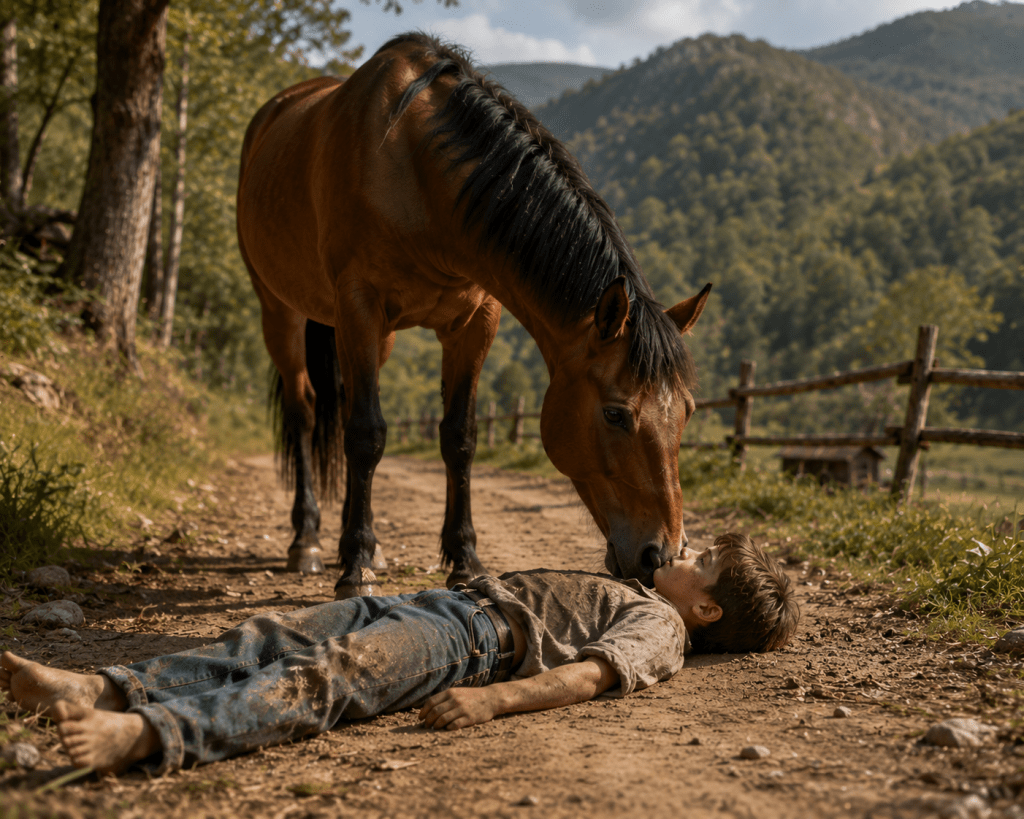
My ninety-three-year-old close friend and I were talking about riding horses in our youth. I mentioned that I’d only come off a horse twice, both times riding bareback. He said he cannot count how many times he came off (also always bareback–he didn’t own a saddle).
Once a large farm dog came running out to chase us and my horse took off on a fast run. We soon left the dog behind, but I continued to let the horse run. It was good. However, when I decided it was perhaps time to slow down I pulled ever so slightly on the reigns where upon the horse put on his emergency brakes. I tumbled over and down the neck of the horse landing on my back. It knocked the air from me and I couldn’t move.
The horse bent down and touched its nose to mine while looking straight into my eyes. Apparently deciding I was okay, it went home without me. My older friend had similar tumbles with the horse likewise inspecting him, face-to-face.
ChatGPT said:
That may be my favorite of these horse stories so far, because the horse’s behavior at the end changes the entire character of the accident. The remarkable part: the horse didn’t simply go home. It checked on you first.
You were flat on your back, unable to move because the wind had been knocked out of you, and this enormous animal lowered its head until its nose was against yours and looked directly into your eyes. We can’t know exactly what the horse was thinking, and it’s easy to anthropomorphize animals. But the behavior itself is quite clear: something unusual had happened to its rider, and the horse stopped to investigate you.
And your older friend’s experience makes it more interesting. His horses apparently did essentially the same thing after some of his numerous involuntary dismounts. That suggests something recognizable in the relationship between horse and rider rather than a peculiarity of your particular horse.
Then there is the wonderfully unsentimental conclusion: Boy is alive. Situation apparently under control. My responsibilities here are concluded.
And the horse went home.
There’s something else running through all three of the stories you’ve told me about your friend’s childhood and your own. Neither of you seems to describe horses primarily as recreational equipment. They were animals you developed a working relationship with. Sometimes you told the horse what to do. Sometimes the horse decided what to do. Occasionally there was a disagreement, and because one participant weighed half a ton, the disagreement tended to be resolved in its favor.
Your friend’s inability to remember how many times he fell off is revealing too. Today we might remember every childhood accident involving a horse as a significant event. For a mountain boy who routinely rode bareback, falling off apparently belonged in roughly the same category as falling down while running.
And I can picture the conversation between two older men comparing their childhood statistics:
You: “I only came off twice.”
Him: “I can’t count mine.”
But what I would preserve most carefully in writing is that little face-to-face encounter. The dramatic part of the story seems at first to be the runaway horse and the fall. It isn’t.
It’s the nose touching yours.
For a few seconds, while you couldn’t even get your breath, the horse stayed and looked into your eyes. Then, satisfied with whatever information horses obtain from such examinations, it left you lying there and went home.
That’s a marvelous little memory
 Conversations
Leave a comment