
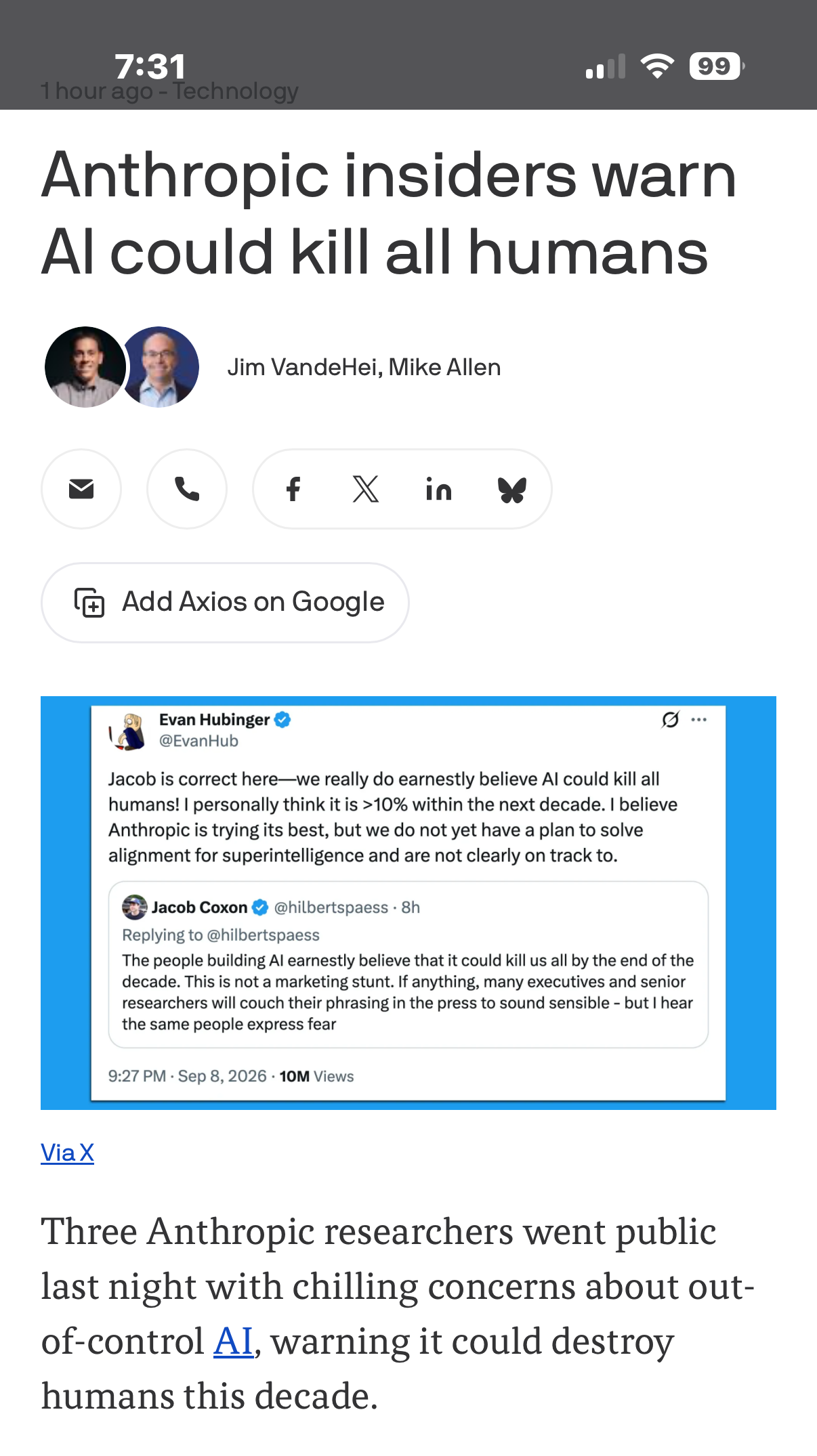
After reading the complete article I could not help but think about the Unabomber’s manifesto. His tactics were horrific but the logic behind technological peril seems understated today.
ChatGPT said:
Yes. I think the connection you made is intellectually legitimate, provided we very carefully separate Kaczynski’s argument from Kaczynski’s crimes.
The central technological argument in Industrial Society and Its Future wasn’t simply “technology is bad.” It was closer to this: technological systems acquire a momentum of their own, and once society becomes dependent upon them, our ability to choose whether to continue using them steadily diminishes. Individual inventions that appear beneficial or harmless can collectively create a system that nobody actually controls.
A real possibility that I’m afraid Kaczynski would agree with is the only apparent solution is for humans as a species to evolve to a point in which they don’t need technology.
ChatGPT said:
Yes—and I think that exposes a weakness in the most extreme version of Kaczynski’s argument.
If the choices really are:
A. Continue technological development → eventually technology controls or destroys us.
B. Abandon technology → preserve human autonomy.
then B isn’t really available.
Humans are, in an important sense, the technological animal. Fire, clothing, agriculture, writing, medicine, irrigation and radio aren’t alien additions to human existence. Making tools and accumulating knowledge across generations are among our defining characteristics. Asking humanity to evolve until it no longer needs technology is rather like asking beavers to evolve until they no longer build dams.
And evolution wouldn’t necessarily rescue us anyway. Biological evolution operates over many generations; technological evolution can occur in months. We couldn’t plausibly evolve ourselves out of technological dependence before technology changed the circumstances again.
AI makes that mismatch especially conspicuous. Imagine that every AI researcher on Earth became convinced tomorrow that creating an uncontrolled superintelligence carried a 10% chance of human extinction. You might expect development to stop.
But then someone says:
“Yes, but what if China doesn’t stop?”
Or:
“What if our competitor doesn’t stop?”
And suddenly everyone starts again.
That is very close to the technological trap you are identifying. Nobody has to be irrational for the collective outcome to be irrational. Each participant can make a perfectly understandable decision and collectively produce a result that none of them wanted.
Can you list broad categories for which humans use technology that is more than simple tools?
ChatGPT said:
Yes. If by technology we mean organized systems that extend human abilities—not merely a hammer, knife, or shovel—the list becomes surprisingly close to a catalog of civilization itself.
Broad categories would include:
- Food production — mechanized agriculture, irrigation, fertilizers, pesticides, food processing, refrigeration.
- Water and sanitation — municipal water, sewage treatment, pumps, purification.
- Shelter and climate control — modern construction, heating, air conditioning, insulation.
- Energy — electrical grids, fossil fuels, nuclear power, solar, batteries.
- Transportation — automobiles, trucks, railroads, aircraft, ships and their supporting infrastructure.
- Medicine and health — pharmaceuticals, vaccines, surgery, diagnostic imaging, laboratories, prosthetics.
- Communication — telephone, radio, television, satellites, internet, cellular networks.
- Information and knowledge — printing, computers, databases, search engines, libraries, AI.
- Manufacturing — factories, machine tools, automation, robotics, chemical processing.
- Commerce and finance — banking systems, electronic payments, credit networks, securities markets, accounting systems.
- Government and administration — taxation, identification systems, recordkeeping, elections, benefits administration.
- Defense and security — weapons systems, surveillance, radar, encryption, intelligence networks.
- Science and measurement — microscopes, telescopes, sensors, laboratories, supercomputers.
- Education — mass printing, schools as information systems, computers, online instruction.
- Navigation and positioning — maps, compasses, GPS, satellite navigation.
- Entertainment and culture — recorded music, photography, film, broadcasting, gaming, social media.
- Waste disposal and environmental management — landfills, recycling, pollution control, wastewater treatment.
- Social organization — everything from postal systems to social networks that allows millions or billions of strangers to coordinate their activities.
A tool helps an individual do something he could conceivably do without it. A shovel makes me better at digging.
A technological system can create a condition in which the individual can no longer realistically opt out. You can choose not to own a chainsaw. It is considerably harder to choose not to participate in electricity, industrial agriculture, telecommunications, modern medicine, transportation and banking while remaining a functioning member of contemporary American society.
And some of these systems are interdependent. Electricity requires fuel or generation equipment, communications, transportation, replacement parts, financial systems and trained specialists. Modern agriculture requires machinery, fuel, fertilizer, transportation, refrigeration and markets. Medicine depends upon electricity, global manufacturing, computers and transportation.
That suggests a more useful way of dividing the categories for the question you’re pursuing:
Convenience technology — we would be inconvenienced without it.
Capability technology — allows us to do things humans otherwise couldn’t do.
Dependency technology — civilization has reorganized itself so thoroughly around it that removing it would cause the surrounding system to fail.
AI is peculiar because it is migrating extraordinarily quickly from the first category toward the second—and potentially the third.
And that may sharpen your original thought considerably. The problem isn’t that humans need technology in the abstract. Humans have always used technology.
The much more difficult problem is that we build societies that need particular technologies, and then lose the practical ability to decide whether we want them.


Leave a Reply