
Here’s a journal entry from a friend who read our conversation about the haystack in our Magna barn.
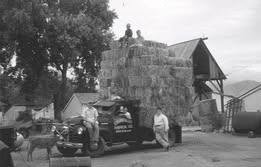
My hay bale memory. We rode on top of this stack all the way from Granger, Utah to our home in Taylorsville–about 10 miles. We had to climb down on those lower levels as we passed under hanging signal lights to keep from being knocked off as they dragged over the top. My dad was so proud of how well he taught us to stack the bales, so they stayed perfectly stacked. I think we had only one rope that was used to stabilize the stack. That is all my siblings in this picture with me on the toppy top with my brother Grant Collier. One of my favorite childhood memories and a rare photo of all my siblings in one place.
ChatGPT said:
Your friend’s journal entry has something that many modern readers find fascinating: it describes a world that was completely normal at the time but feels almost unbelievable today.
Several things stand out.
First, there is the matter-of-fact tone. Your friend isn’t telling a tale of danger or adventure. The focus isn’t “look how risky this was.” Instead, the memory centers on family, competence, and pride. The most important detail to him isn’t riding ten miles atop a towering hay stack; it’s that his father taught the children how to stack hay properly and that the stack stayed together. That says a great deal about the values of the family.
Second, there is a wonderful contrast between childhood excitement and adult realization. As children, riding on top of a mountain of hay was probably pure fun. Climbing down to avoid signal lights was simply part of the trip. An adult reading the account immediately notices all the things that could have gone wrong. Yet the children were focused on the adventure. Many cherished childhood memories have this quality—what seemed ordinary then appears astonishing decades later.
Third, the entry captures something increasingly rare: children contributing meaningful work to the family economy. The father’s pride wasn’t merely that the hay arrived safely. He was proud that his children had learned a skill. Stacking hay was real work, and doing it well mattered. The phrase “he was so proud of how well he taught us” may be the most important sentence in the entire entry. The memory is really about a father passing along competence.
I also like the image of the siblings all being together. As people grow up, marry, move away, and build separate lives, photographs containing all the children become surprisingly precious. The photo isn’t just documenting a hay load; it’s preserving a moment when the entire family was still one working unit.
There is another subtle theme running through the story: trust. The father trusted the stack. He trusted his work. He trusted the skills he had taught his children. The children trusted him. That level of trust is difficult to manufacture and is usually earned through years of shared labor.
If I were analyzing this as a memoir passage, I would say the haystack is almost a symbol. On the surface it is a load of hay moving from Granger to Taylorsville. Beneath that, it represents a family held together by work, skill, confidence, and shared experience. The reason the memory remains vivid isn’t because of the hay—it is because, for a few miles on a Utah road, all the siblings were together, their father was proud of them, and everything felt secure atop that improbably tall stack.
That is the kind of memory that tends to grow more valuable, not less, as the years pass.
Note: At this point, ChatGPT comments on the picture at the top of this post and provides some images of its own.
What a treasure of a photograph.
A few things immediately jump out at me:
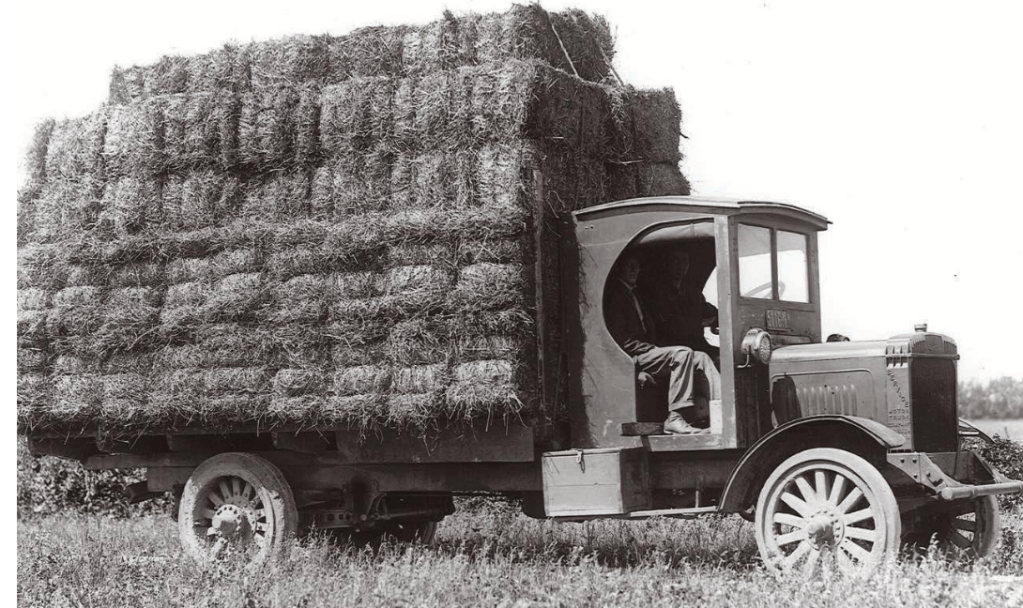
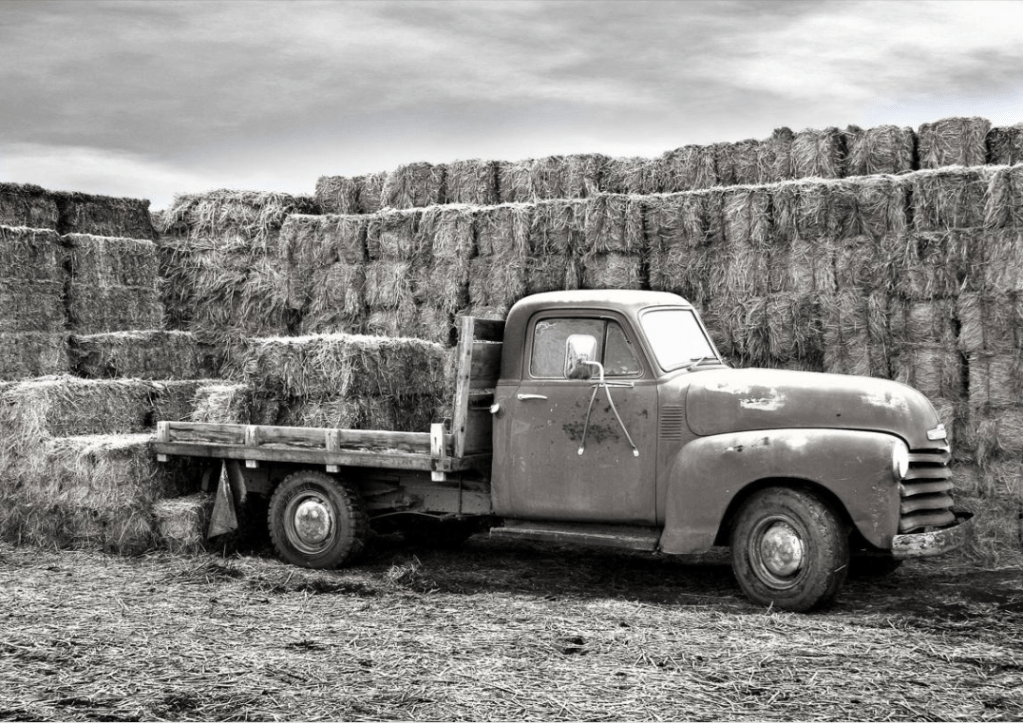
First, your friend’s memory checks out.
That load is enormous. The haystack rises far above the cab of the truck and appears to be stacked with remarkable precision. Looking at the photo, I can understand why his father was proud of the stacking job. The sides are surprisingly square and vertical for such a tall load.
Second, the children on top give scale.
Without the children, a modern viewer might not appreciate how high the stack really is. The figures on the summit make it clear that this wasn’t just a load of hay—it was practically a moving hay loft.
Third, the story about ducking under signal lights becomes believable.
When I first read his account, I wondered how close they really were to overhead obstacles. Seeing the photo, I can imagine it. That load looks high enough that railroad signals, utility wires, tree branches, and other overhead structures would have been very real concerns.
Fourth, notice what isn’t in the picture.
No safety rails. No harnesses. No warning signs. No escort vehicle. No one appears concerned. That tells us something about the era. Farm families routinely did things that required judgment, experience, and trust rather than formal safety systems.
The truck itself tells a story.
The truck looks like it may be from the late 1930s or 1940s. Someone more knowledgeable about vintage trucks might identify it exactly from the grille and fenders. Whatever the year, it was clearly being used to its absolute capacity.
What strikes me most, however, is that your friend’s written memory and the photograph emphasize different things.
A modern observer sees:
- The height.
- The risk.
- The overloaded truck.
Your friend remembers:
- His father’s pride.
- Learning to stack hay correctly.
- Being with all the siblings.
- The adventure of the ride.
That difference is revealing. The photograph documents a hay load. The memory documents a family.
Fifty years later, nobody cares whether the hay reached Taylorsville. What remains important is that a father taught his children a skill, trusted them with real work, and that all the brothers and sisters were together on top of that mountain of hay for ten miles of Utah road.
That’s why the photograph survived. It’s not really a picture of hay. It’s a picture of belonging.
Here’s my response to my friend. I’ve done that but not so high as in the picture. I couldn’t throw a bale of hay that far up. 🤪 We never used a rope, just stacked them so that they held together. Stacking hay on a truck was physical work but it was way better than hoeing beets like so many boys did in the summer in Utah. Thanks for the memory.
Your response has the same quality I often see in conversations among people who actually did the work. Instead of focusing on the danger or the nostalgia, you immediately go to the practical reality:
“I couldn’t throw a bale of hay that far up.”
That single sentence says more than a paragraph of explanation. Anyone who has handled hay knows exactly what you mean. Looking at that picture, the top layer is astonishingly high. Getting bales up there wasn’t a matter of casually tossing them; it required strength, teamwork, and usually someone partway up the stack to relay the bales.
I also like your comment:
“We never used a rope, just stacked them so that they held together.”
That would surprise many modern readers. They assume the rope was doing all the work, when in reality a well-built stack was the primary means of keeping the load together. The rope was often insurance; the real skill was in the stacking.
And then there’s the line about hoeing beets:
“Stacking hay on a truck was physical work but it was way better than hoeing beets like so many boys did in the summer in Utah.”
That may be the most historically interesting part of your response. People unfamiliar with rural Utah in that era often don’t realize how many children spent summers thinning and hoeing sugar beets. Many former farm kids describe beet work as hot, repetitive, back-breaking labor. Compared with spending a day in a hay field with family and friends, haying could seem like the better deal despite being hard work itself.
What I hear in both your friend’s memory and your response is something that is becoming rare: neither of you seem resentful of the work. You acknowledge that it was difficult, but the memories are attached to competence, family, and accomplishment rather than hardship.
If I were your friend, I would probably smile at your reply because it adds another layer to the story. His memory is from the top of the stack looking down. Yours is from the ground looking up and thinking, “There’s no way I could throw a bale that high.”
Together, the two comments paint a fuller picture of farm life than either one does alone.
 Conversations
Leave a comment