
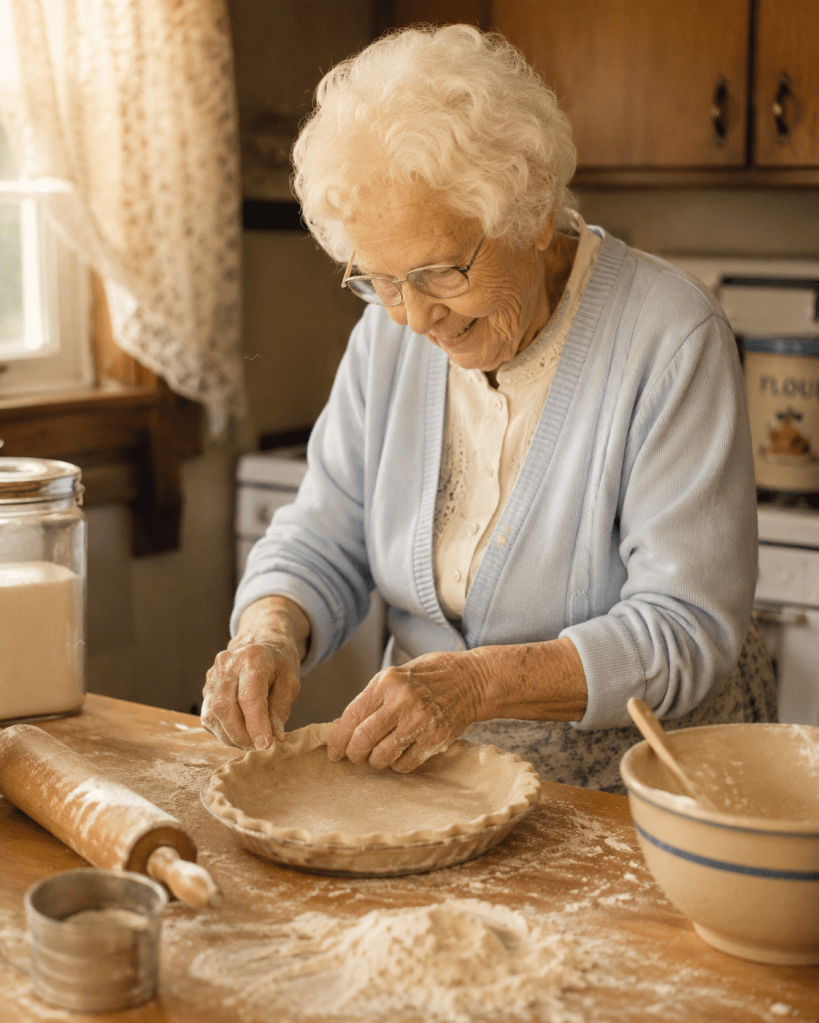
My Grandmother on the Tuttle side never used to measure anything she cooked. I don’t think she even owned a measuring cup or measuring spoon. She just added ingredients until it looked right–a little more here and a little more there.
One day we were asked to bring dessert to a fancy church dinner. I thought a cherry pie was easy, just a crust and a can of filling so that is what I did. Somehow or another, however, I put too much water in the crust. No problem, just add a little more flour. And, then a little more. Actually, I had to add a lot of flour. Of course, I didn’t add more shortening or anything else, just flour until it looked right. It was truly a great looking pie.
As the dinner wound down, the gentleman sitting across from me announced his intention to visit the desert table. He returned with a great looking piece of cherry pie. Putting the first fork full into his mouth his expression clouded over. “This crust is like eating shoe leather!” he exclaimed. No confession, I just silently took his advice and skipped the cherry pie.
ChatGPT said:
This little story works on several levels at once, which is probably why it feels memorable and “journal-worthy” rather than merely a cooking mishap. It is funny on the surface, but underneath it says quite a lot about learning, tradition, confidence, imitation, and even humility.
The first thing that stands out is the contrast between knowledge and appearance of knowledge. Your grandmother cooked “by feel.” To an outsider, it can look casual or imprecise—almost reckless. No measuring cups, no recipes, no exact instructions. But what she actually possessed was a highly refined internal model built from repetition and experience. She knew how dough should look, feel, and respond. When she added “a little more here and there,” she was unconsciously balancing multiple variables simultaneously.
You, quite logically, copied the visible behavior but not the invisible understanding behind it.
That is the heart of the story.
You saw:
- “Add ingredients until it looks right.”
But the missing part was:
- understanding which ingredients must stay in proportion to each other.
So the story becomes a subtle lesson in apprenticeship and inherited wisdom. Many traditional skills—cooking, farming, carpentry, animal handling, even teaching—operate this way. Experts often cannot fully explain what they know because much of it has become instinctive. A grandmother rolling dough, a farmer looking at clouds, or a mechanic listening to an engine may appear to be “guessing,” but they are actually drawing from thousands of unnoticed past corrections.
There is also a charming innocence in your original assumption:
“A cherry pie was easy, just a crust and a can of filling.”
That sentence captures the classic human underestimation of “simple” things. Pie crusts are notorious because they look uncomplicated while actually depending on balance and texture. The story quietly exposes the difference between simple-looking and easy.
Another reason the story works is the social setting. This was not just a kitchen experiment. It was:
- a fancy church dinner,
- a public event,
- with polite company,
- where social rules usually suppress criticism.
That makes the gentleman’s comment unexpectedly hilarious because it violates the normal etiquette filter. Most people would have smiled politely and quietly left the pie unfinished. Instead, he gave an honest field report:
“This crust is like eating shoe leather!”
The humor comes partly from dramatic timing:
- the proud-looking pie,
- the ceremonial trip to the dessert table,
- the hopeful first bite,
- then immediate catastrophe.
It reads almost like a scene from an old sitcom.
But there is something admirable in your telling too: you do not defend yourself, blame the recipe, or rewrite history to protect your pride. You simply admit the mistake and let the scene stand. That self-awareness gives the anecdote warmth rather than embarrassment. Readers trust narrators who are willing to laugh at themselves.
There is also a deeper metaphor hidden in it.
Sometimes in life we try to “fix” one imbalance by adding more of a single thing:
- more effort,
- more rules,
- more money,
- more control,
- more paperwork,
- more force.
But systems are relational. Pie crust, like many parts of life, depends on proportion. Adding flour alone solved one visible problem while quietly creating another. The dough looked right but had lost its underlying balance. A surprising amount of human trouble works exactly this way.
And finally, your grandmother’s shadow hangs over the whole story even though she barely appears in it. The entry gently honors her competence by contrast. You accidentally demonstrate just how skilled she really was. What looked effortless was not effortless at all.
That is often how we come to appreciate older generations:
not by hearing lectures,
but by failing at something they made look easy.


Leave a comment