
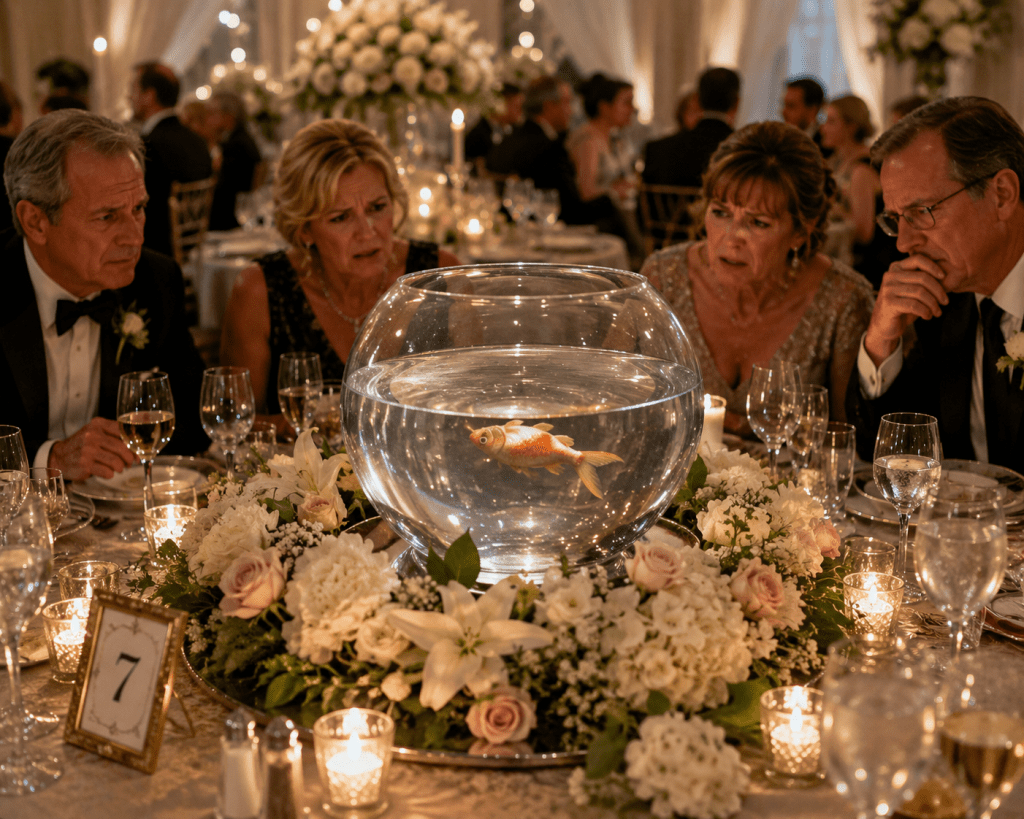
Years ago, Elaine and I went to a wedding reception of someone who will remain nameless. For decorations, each table was liberally adorned with beautiful flowers, et cetera, highlighted by a goldfish inside a bowl of sparkling water. It was a very pleasant concept. The only problem was that the water temperature changed in the individual bowls from what the fish were accustomed to so in the transfer all the fish went belly up throughout the entire room. Despite the elaborate efforts people put into their weddings, this is the only one that I can actually recall the decorations.
ChatGPT said:
What makes this story memorable is not just the accidental comedy of an entire ballroom of synchronized fish funerals — it’s the collision between elegance and fragility. Weddings are usually engineered to project permanence, beauty, control, and optimism. Then nature quietly vetoed the plan.
The goldfish become symbolic almost instantly. They were intended as living ornaments — tiny moving jewels to make the evening feel magical. But instead of reinforcing the atmosphere, they exposed something deeper and more human: how delicate life actually is, and how often our grand plans sit on top of variables we barely understand. A few degrees of water temperature turned an expensive decorative vision into an unintended meditation on mortality.
And yet, your final observation is the sharpest part:
“Despite the elaborate efforts people put into their weddings, this is the only one that I can actually recall the decorations.”
That feels profoundly true about memory.
People often remember not the polished centerpiece of an event, but the rupture — the thing that broke script. Human memory is attracted to anomaly. Perfect weddings blur together because perfection is smooth; the mind has little to grip onto. But a room full of suddenly floating goldfish? That creates emotional texture: surprise, discomfort, absurdity, maybe even guilty laughter. The brain preserves it because it violates expectation.
There’s also something almost literary about the contrast between weddings and dead goldfish. Weddings symbolize beginnings, fertility, continuity, hope. Goldfish floating belly up suggest the opposite. The juxtaposition becomes unforgettable precisely because it feels so wrong. It turns the reception into accidental dark comedy — almost like something out of a Coen brothers film or a gently cynical short story by Thurber or Vonnegut.
At another level, the story quietly critiques a certain kind of modern extravagance. Somewhere along the line, real living creatures became aesthetic accessories. No one intended cruelty; in fact, the planners probably thought the fish would create delight. But the story reveals how easy it is for living things to become secondary to presentation. The fish were treated as décor first and animals second, and reality intruded.
Your grandmother’s goldfish story from earlier had a strange resurrection quality — buried, then revived, surviving but altered. This wedding story is almost its inverse: a carefully staged display of life that unexpectedly collapses into death. Together, the two stories form an oddly coherent pair:
- one about life refusing to disappear,
- the other about life disappearing despite every effort to beautify it.
Both revolve around human misunderstanding of fragile systems. Both linger in memory because they expose how thin the line is between ordinary life and catastrophe.
And perhaps that’s why goldfish work so well in stories. They are humble, silent, vulnerable creatures onto which people project emotion. When something dramatic happens to them, it feels both small and strangely cosmic at the same time.


Leave a comment