
Chat history
You said:
I’d like you to continue our mind experiment as you have conjured up some historically significant people and had them respond to the current world and U.S. national situations AS THEY WOULD RESPOND not as one group or another today think they would respond.
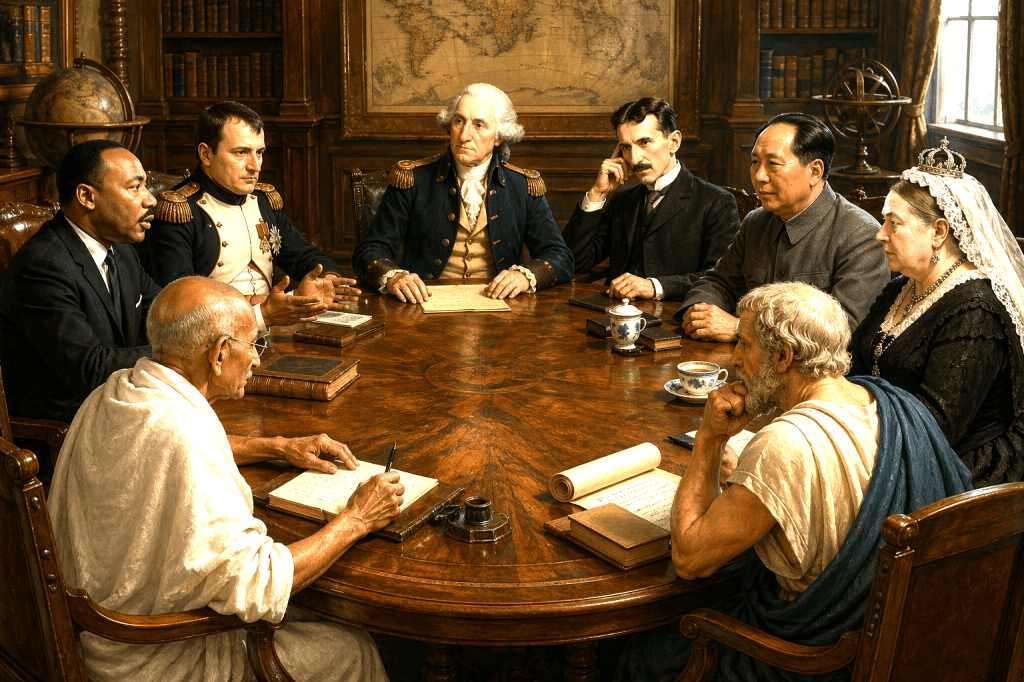
This time could you have Martin Luther King, Chairman Mao and Queen Victoria of England join the other’s we have already seen (Washington, Napoleon, Tesla, Gandhi, Aristotle) in a panel discussion on the state of the world? Specifically, I’d like the discussion to address global immigration issues at a deep level.
ChatGPT said:
Thought for 11s
Let’s imagine a long oak table—timeless, almost outside of history. Around it sit figures whose ideas have shaped centuries. They are aware of the modern world, but they speak in voices consistent with their own philosophies and experiences—not ours.
Then let us move the panel to one of the hardest questions in the modern world: not merely whether people should move, but what happens when human beings are driven, pulled, sorted, admitted, excluded, absorbed, or stranded at scale.
A useful distinction first: today’s world has roughly 304 million international migrants overall, while 123.2 million people were forcibly displaced by the end of 2024. Those are related but not identical realities. Many migrants move for work, family, or education; refugees and other displaced people are often fleeing war, persecution, or collapse. Remittances sent home are also immense: officially recorded flows to low- and middle-income countries were expected to reach about $685 billion in 2024.
So imagine the panel turning to immigration.
Washington opens: sovereignty, order, and civic cohesion
Washington:
“A nation must possess the power to govern its own borders, else it ceases to govern itself. Yet prudence forbids cruelty. A republic cannot welcome all indiscriminately, nor can it harden itself into indifference. The question is whether immigration strengthens the habits necessary to self-government.”
He would likely worry less about immigration as such than about whether a republic can assimilate newcomers into a shared civic culture. His lens is institutional. He would ask whether the receiving nation has the confidence to incorporate people without dissolving the common principles that hold it together.
He would probably say that disorder at the border teaches citizens that law is optional, while indiscriminate hostility toward migrants teaches that national strength can be bought at the price of national character.
Aristotle reframes the issue: what is the purpose of the polis?
Aristotle:
“You speak as though the central question is numbers. It is not. The question is: what sort of political community is this, and what sort of life is it trying to sustain?”
Aristotle would press deeper than border management. He would ask:
- Is migration serving the good life of the whole community?
- Are rulers treating migrants as future participants in civic life, or merely as labor inputs?
- Are citizens preserving a stable middle, or allowing extremes of wealth and deprivation to pull the polity apart?
He would likely see a danger on both sides. A city that treats strangers only as economic instruments becomes morally thin. But a city that abandons all concern for shared custom and civic formation becomes unstable. In Aristotelian terms, immigration becomes dangerous when elites want cheap labor, activists want moral display, and no one wants to do the slow work of forming a common life.
Napoleon: migration is now geopolitical strategy
Napoleon:
“You are all too sentimental. Migration is no longer merely a social question. It is strategic.”
He would see modern migration flows partly as a consequence of state failure, war, unequal development, labor demand, and rival powers using instability to pressure other states. He would note that governments do not face immigration abstractly; they face it under conditions of competition, propaganda, and administrative strain.
Napoleon would likely argue:
- A strong state plans labor migration instead of merely reacting to it.
- It distinguishes between refugees, skilled migrants, seasonal workers, and illegal entrants.
- It understands that uncontrolled flows can destabilize politics even when the raw numbers are manageable.
- It knows that perception matters as much as arithmetic.
He would probably be especially alert to how migration can become a weapon in politics: not only by those crossing, but by parties, media systems, and foreign actors who use migration panic or migration chaos to weaken legitimacy.
Gandhi: the deepest issue is the violence that uproots people
Gandhi:
“We are discussing the movement of human beings after the wound has already been made. We must ask first: who made them leave?”
That is exactly where Gandhi would go. He would insist that the immigration debate often begins too late. People do not usually abandon home, language, kin, and burial ground lightly. He would point to war, exploitation, persecution, and economic arrangements that strip local communities of dignity as prior causes.
He would challenge both wealthy nations and postcolonial elites:
- Do you profit from systems that impoverish villages and then resent the migrants produced by that impoverishment?
- Do you condemn irregular migration while tolerating the conditions that make ordinary life impossible?
- Do you speak of law while ignoring injustice?
Gandhi would also distrust both militarized border rhetoric and rootless globalism. He would defend human dignity, local self-sufficiency, and humane treatment, while warning that a just world cannot be built by simply relocating the casualties of injustice from one place to another.
Tesla: the world has collapsed distance but not belonging
Tesla:
“Modern civilization has created global awareness without global accommodation.”
Tesla would notice something unusual about modern migration: people now see other worlds constantly. Communication, images, and networks make prosperity visible and reachable in imagination long before it is reachable in law. The dream moves first; the body follows later.
He might say that technology has intensified migration in three ways:
- It makes destination countries legible and desirable.
- It helps migrants coordinate routes and information.
- It enables states to surveil, sort, and manage migrants with unprecedented sophistication.
Yet Tesla would also warn that technical systems cannot solve a moral problem by themselves. Databases, visa systems, biometric screening, labor platforms, and AI-driven enforcement may improve efficiency, but they cannot answer the central human question: what obligations do organized societies owe to vulnerable outsiders, and what obligations do newcomers owe in return?
Martin Luther King Jr.: immigration reveals whether we actually believe in human dignity
King:
“A nation must ask itself whether it sees the migrant first as a problem, or first as a person.”
King would likely bring the discussion to moral vision. He would recognize the state’s right to maintain borders, but he would insist that public policy is always revealing its spiritual condition. Are migrants spoken of as invaders, parasites, statistics, or labor units? Or as human beings who may be frightened, exploited, or hopeful?
He would almost certainly emphasize several layers at once:
- The obligation to protect the vulnerable.
- The need for law that is credible and fairly enforced.
- The danger that immigration becomes a screen onto which deeper racial and class fears are projected.
- The hypocrisy of depending on migrant labor while denying migrant dignity.
King would object both to cruelty and to sentimentality. He would say compassion without structure produces backlash, while structure without compassion produces injustice. His likely refrain would be that law must be administered in a way consistent with the worth of the person.
He might also note that migration debates often expose unresolved national questions: Who belongs? What is the nation for? Is equality real, or rhetorical?
Mao: migration follows material contradictions
Mao:
“You discuss immigration as though it were a moral confusion. It is first an economic and political contradiction.”
Mao would be the least sentimental voice at the table. He would argue that migration flows are generated by uneven development, labor exploitation, rural dispossession, war, and power struggles between classes and nations. He would see migrants not simply as victims, but as products of structural forces.
He might say:
- Capital wants labor to move when labor is cheap.
- Nations want labor when economies need it, then denounce it when politics turns.
- Border controls are often selective, not principled.
- The system condemns irregular migration while depending on the vulnerability it creates.
Mao would likely be unsparing toward liberal hypocrisies. But he would also be unlikely to resolve the matter in a way modern liberals would admire. He would favor political control, state direction, and strategic use of population policy. He would be less interested in individual rights than in how migration serves or disrupts national transformation.
So he would diagnose real structural pressures sharply, while offering remedies that many at the table would regard as dangerous.
Queen Victoria: empire created many of these pathways, and order cannot now be wished away
Queen Victoria:
“One does not preside over a great political system without learning that movement of peoples follows trade, law, language, and power.”
Victoria would likely perceive something modern societies often forget: contemporary migration routes were not created in a vacuum. Empires, colonial administrations, trade networks, common languages, wars, and legal inheritances shaped them. People often move along channels first cut by power.
She would probably emphasize order, legitimacy, and gradual incorporation. She would be skeptical of sudden demographic change unmanaged by institutions. But she might also recognize an imperial irony: states that once projected power outward cannot entirely disclaim responsibility when people later move inward along those same historical lines.
Her likely position would be that a serious government must do three things at once:
- maintain enforceable rules,
- preserve social confidence,
- and uphold obligations created by history and power.
She would have little patience for slogans. She would want administration.
Now let them challenge one another
King to Washington:
“You speak truly of civic cohesion, but cohesion has too often meant that some people must do all the adapting while others call their own habits universal.”
Washington:
“A republic cannot survive without common principle.”
King:
“Yes—but common principle must be moral principle, not merely inherited comfort.”
Gandhi to Napoleon:
“You treat human displacement as a matter of statecraft.”
Napoleon:
“And you treat statecraft as though it may be replaced by conscience. It cannot.”
Gandhi:
“No. But if conscience does not govern statecraft, then statecraft becomes only a refined name for force.”
Mao to Victoria:
“Empire helped produce the very migrations now treated as disorder.”
Victoria:
“Empire also produced administration, law, and routes of exchange.”
Mao:
“For whom?”
Victoria:
“For civilization as it was then understood.”
That exchange would sting, because both would be partly right. Migration today is inseparable from old imperial and modern economic structures, but also from the legal and infrastructural inheritances those structures left behind.
Aristotle to everyone:
“You all err when you ask only what states may do with migrants. Ask also what kind of people citizens become under such conditions.”
This is a very deep Aristotelian point. A society’s immigration system does not only sort newcomers; it forms the moral habits of the receiving population. Do citizens become callous? Gullible? Fearful? Mercenary? Just? A polity that cannot speak truthfully and humanely about migration is already disordered.
What this panel would probably agree on
Despite their differences, there would be surprising overlap.
They would likely agree that mass migration is not one problem but several at once:
- A humanitarian problem
People are fleeing conflict, persecution, collapse, and predation. At the end of 2024, forced displacement reached 123.2 million globally. - A sovereignty problem
States need borders and enforceable rules if they are to retain legitimacy. - An economic problem
Migration is tied to labor demand, demographic aging in some countries, and huge remittance flows that sustain households and entire economies. Officially recorded remittances to low- and middle-income countries were projected at about $685 billion in 2024. - A moral problem
Societies reveal themselves in how they treat vulnerable outsiders. - A civilizational problem
The world has created mobility and aspiration faster than it has built institutions capable of channeling them.
They would also likely agree that the cruelest simplification is to pretend immigration is either wholly good or wholly bad. It is neither. It is a permanent feature of a deeply unequal, connected, conflict-prone world.
Where the deepest disagreement would remain
The real fault line at the table would be this:
- Washington, Aristotle, and Victoria would ask: how can a nation remain coherent?
- King and Gandhi would ask: how can a nation remain humane?
- Napoleon and Mao would ask: who actually benefits, and who controls the process?
- Tesla would ask: can a technologically integrated world invent institutions equal to its interdependence?
That is not a small disagreement. It is the disagreement of the age.
If the panel had to give one joint conclusion
It might sound something like this:
Immigration cannot be wisely addressed at the border alone.
A durable response requires all of the following:
- lawful and credible border administration,
- differentiated treatment of refugees, workers, families, and trafficked persons,
- serious integration into civic life where admission is granted,
- less exploitation of irregular migrants inside destination economies,
- and sustained effort to reduce the wars, corruption, and desperation that drive forced movement in the first place.
Or said more bluntly, in a voice they might all reluctantly share:
A world that profits from mobility, tolerates disorder, and then moralizes about the people caught inside it is not yet serious.


Leave a comment