
Chat history
You said:
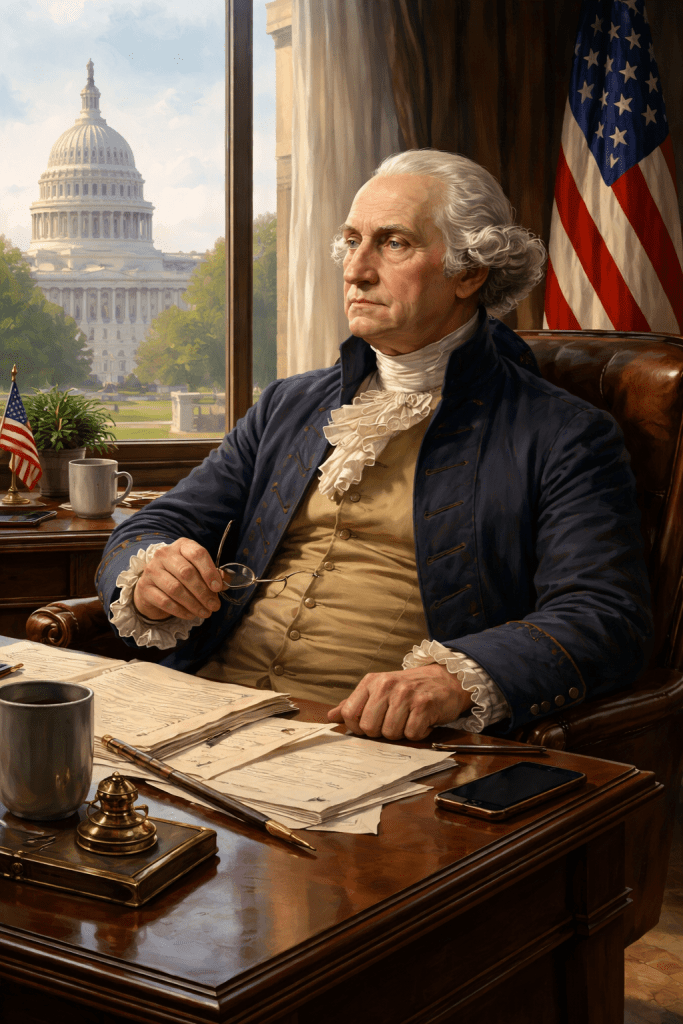
I’d like you to do a mind experiment and conjure up some historically significant people and have them respond to the current world and U.S. national situations AS THEY WOULD RESPOND not as one group or another today think they would respond. If you are up to this, let’s start with George Washington, 1st U.S. president.
ChatGPT said:
Let’s take your “mind experiment” seriously and try to reconstruct not a modernized Washington, but the man shaped by the late 18th century—his habits of thought, his fears, his priorities, and his language.
What follows is not a modern opinion put into his mouth, but an attempt to model how Washington tended to reason: cautious, republican (small “r”), deeply concerned with unity, reputation, and the fragility of self-government.
A Constructed Response in the Voice of Washington
To the Citizens of the United States,
It is with no small degree of solicitude that I contemplate the present posture of your public affairs. The experiment committed to your care—of a government deriving its just authority from the consent of the governed—was never presumed to be self-sustaining without vigilance, moderation, and virtue among the people.
I observe, with concern, the spirit of party carried to a height which threatens to divide you into distinct interests, rather than unite you as one people. Parties, though perhaps inseparable from free governments, must not be permitted to inflame animosities or to substitute passion in place of reason. When attachment to party supersedes attachment to country, the public good is placed in jeopardy.
Of equal importance is the preservation of public credit and the avoidance of unnecessary burdens upon posterity. A nation which accumulates debt without foresight or restraint hazards not only its prosperity but its independence of action.
In your intercourse with foreign nations, it remains a maxim of sound policy to avoid entanglements which may draw you into contests not your own. Cultivate peace and commerce with all, but let not temporary passions or attachments dictate permanent engagements.
I would further remark that the efficacy of your Constitution depends not solely upon its structure, but upon the character of those who administer it. If the spirit of encroachment be indulged—whether by the legislative, the executive, or the judicial departments—the balance so carefully contrived may be undone.
Religion and morality, which I have ever considered indispensable supports of political prosperity, ought not to be lightly regarded. For it is upon the dispositions and habits of the people that the success of free government ultimately rests.
Let it be remembered that liberty is not secured by jealousy alone, but by unity, discipline, and a willingness to subordinate private interest to the general welfare.
G. Washington
Why This Fits Him (Not Us Projecting Onto Him)
A few anchors to keep this grounded:
- This closely mirrors themes from his :
- Warning against factionalism (“spirit of party”)
- Caution about foreign entanglements
- Emphasis on national unity over regional or partisan identity
- His economic concern reflects the influence of —Washington backed strong public credit and fiscal credibility.
- His moral language reflects the 18th-century assumption that republican government requires virtue, not just structure.
- His tone is restrained. Washington almost never ranted; he worried in a controlled, dignified way.
One Important Constraint (Your “Mind Experiment” Rule)
Washington would not:
- Speak in modern ideological categories (left/right, culture wars, etc.)
- Comment on specific policies like today’s legislation in detail
- Use populist or inflammatory rhetoric
He would instead:
- Step back to principles of stability and survival of the republic
- View today through the lens of: “Will this preserve union, order, and credibility?”


Leave a comment