
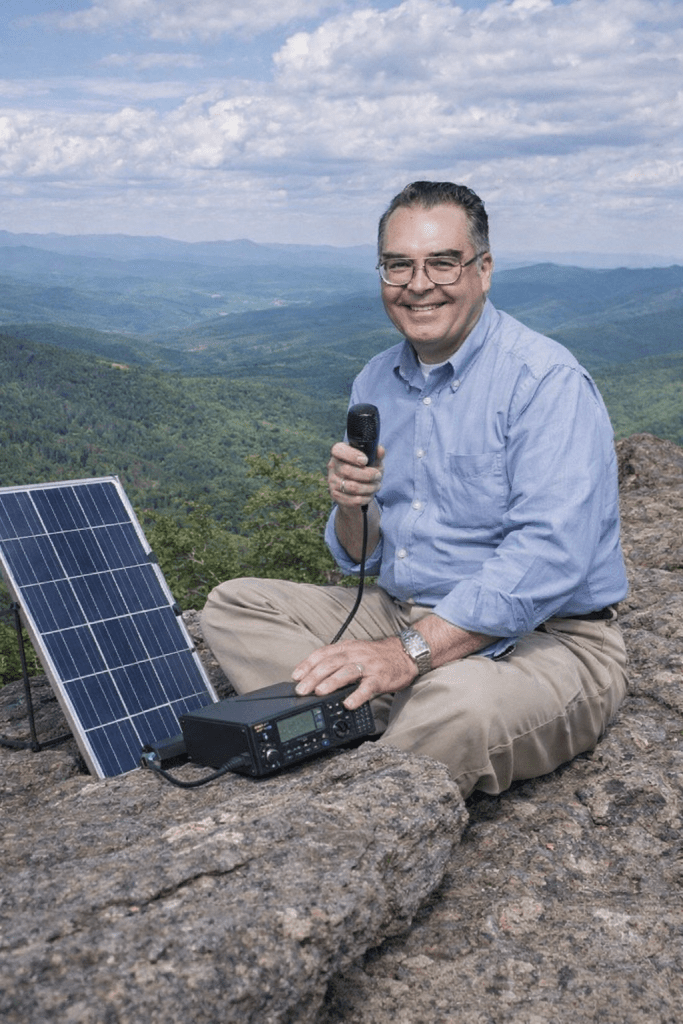
Can I use a voltage regulator between a solar panel and radio without a battery, such as a DC 9-36V Converter to DC 13.8V 10A Boost Buck Power Module Voltage Regulator?
ChatGPT said:
Usually not well, and not safely as a general setup.
A radio wants a fairly steady 13.8 V source. A bare solar panel is a poor source for that because its voltage and available current swing constantly with:
- sun angle
- clouds
- panel temperature
- load changes from the radio
That converter can only regulate if the panel is giving it enough power at that moment. So in practice:
- receive might work
- transmit may cause the voltage to sag or the converter to drop out
- the radio may reset, shut down, or behave oddly
- switching noise from the converter may get into your receiver
The biggest problem is power balance, not just voltage.
A 13.8 V, 10 A output means up to about 138 watts output. With converter losses, you would need more than that from the panel, realistically something like 160+ watts available in real conditions, and that is before cloud losses, panel heating, and less-than-perfect sun.
Also, most “12 V” solar panels are not really 12 V sources. Their operating voltage may be around 18 V in good sun, but it moves around. Without a battery or at least substantial buffering, the converter is being fed by a source that is constantly wandering.
For ham use, a much better arrangement is:
solar panel → charge controller → battery → radio
That gives:
- stable voltage
- surge current for transmit
- much better behavior when clouds pass
- less chance of brownouts
If you absolutely wanted to try batteryless operation, you would want at minimum:
- a panel with lots of excess wattage
- a converter known to be RF quiet
- large input/output capacitance
- acceptance that transmit performance may be unreliable
For an FT-891 specifically, I would not recommend panel → converter → radio as the main setup. A small LiFePO4 battery between them makes a huge difference.
Tell me your panel wattage and the radio model, and I can estimate whether it would work at all on receive only, light transmit, or not realistically.
You said:
Here is why I’m bringing this up. I know an older ham who says he used to go to mountain tops with a solar panel and radio without a battery or even a regulator and talk on the 10m band all the time and all over the world.
ChatGPT said:
That story could be true.
Not because it was a generally good setup, but because under the right conditions it can work well enough.
A few reasons his experience might have been real:
1. 10 meters can reward very low power.
When 10 m is open, it can be astonishing. A few watts can go a long way. So he may not have needed much transmit power to make satisfying contacts.
2. Older outings were often done in a very narrow operating window.
He may have been:
- operating only in bright, steady sun
- choosing times when the band was open
- transmitting briefly
- accepting that the station was fussy
That is very different from saying the setup was robust.
3. A “12-volt” panel can sometimes land in a usable range by itself.
A radio like the FT-891 wants something around 13.8 V, but it will tolerate a fair bit of variation. If a panel happened to sit in a usable voltage range under load, the operator might get away with running directly from it, especially at low power.
4. The radio may not have been as demanding as we imagine.
He might have been using:
- a lower-power rig than a 100 W mobile transceiver
- an older analog rig that tolerated supply variation better
- a very efficient receive/transmit pattern
- CW or SSB with modest average power rather than constant-duty modes
5. Memory compresses the failures.
This is a big one. He may remember the successful mountain-top days and forget:
- the times clouds ruined things
- the times the voltage sagged
- the times the radio acted odd
- the times he had to reposition the panel constantly
So “I did it all the time” may really mean “I did it often enough, and it worked often enough, that I remember it fondly.”
There is also a subtle point: without a regulator does not automatically mean impossible. A solar panel is not a fixed voltage source, but under load its voltage can settle into a range that a radio will tolerate. It is crude, but sometimes crude works.
So I would not call the old ham a teller of tall tales. I would say:
Yes, that absolutely could have been done.
But it was probably:
- band-dependent
- weather-dependent
- power-level-dependent
- equipment-dependent
- less reliable than nostalgia makes it sound
Your instinct is still sound. The fact that something can work on a mountain top in bright sun on 10 m does not mean it is a good general design.
His story is best understood as:
“A workable field trick under favorable conditions,”
not
“proof that batteries and regulation are unnecessary.”
I rather like the story, actually. It has the flavor of old ham radio: climb high, wait for the band to open, and make do with whatever you carried up the hill.
You said:
We’re talking 40 years ago, different solar panels and different radio and yes, a different memory today.
ChatGPT said:
That actually makes his story more believable, not less.
Forty years ago changes a few key variables in his favor:
1. The radio was likely far less “picky.”
Older rigs—especially simpler analog designs—often tolerated:
- wider voltage swings
- brief dips without resetting
- less-than-perfect DC
Your Yaesu FT-891 is a modern, microprocessor-controlled radio. It expects a reasonably clean, stable supply. An older rig might have just kept going where the FT-891 would reboot or complain.
2. Solar panels behaved differently (and sometimes more simply).
Older “12 V” panels often:
- had a fairly predictable operating region under load
- weren’t optimized with modern MPPT assumptions
- could land in a “good enough” voltage range for direct use
Not efficient—but sometimes conveniently compatible.
3. Expectations were different.
He may have been perfectly happy with:
- brief QSOs
- occasional dropouts
- fiddling with panel angle mid-contact
- only operating when everything lined up just right
Today we tend to expect things to just work continuously.
4. Operating style mattered a lot.
If he was on 10 meters during a good opening:
- even a few watts SSB (or especially CW) goes far
- transmit duty cycle is low
- average power draw is modest
That plays nicely with a fluctuating source like a panel.
5. Memory smooths the edges.
After 40 years, what survives is:
“I used to go up there and make contacts with just a panel!”
What fades is:
- the times clouds rolled in and ended the session
- the times the rig acted strange
- the fiddling and compromise
So I’d sum it up this way:
Your old ham friend was probably describing something that really worked often enough to be memorable—but under a narrow set of conditions:
- strong sun
- favorable band (10 m open)
- low power
- forgiving equipment
- patient operator
And that last one might be the biggest difference.
Today, with a rig like the FT-891, you can flirt with that same idea—but the radio is less tolerant, and your expectations are higher. That’s why your instinct to keep a battery in the system is the more solid approach.
Still… there’s something admirable about the old method:
panel, radio, mountaintop, and a bit of luck.
 Conversations
Leave a comment