
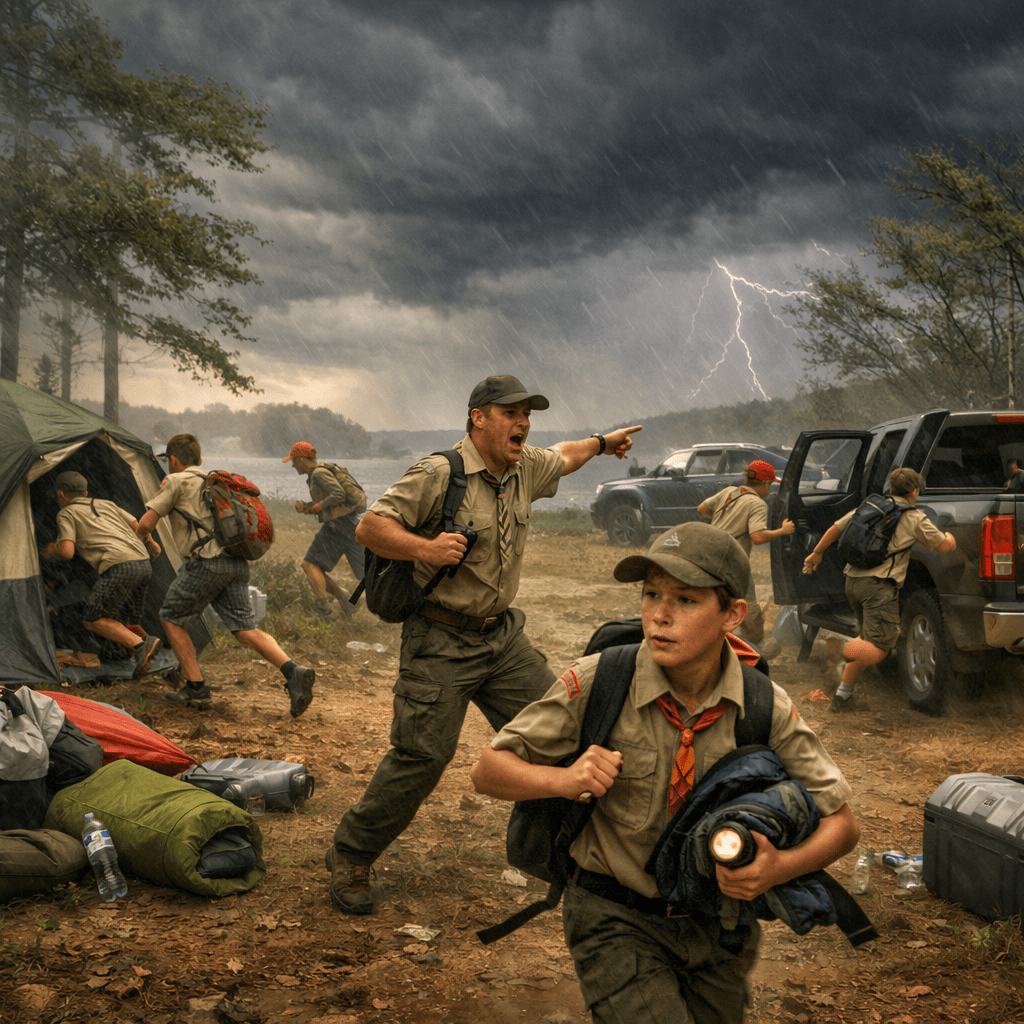
We took a group of boy scouts to camp in the primitive area of Billy Dreher Island in Lake Murray. It was summer and as sometimes happens a severe storm was headed our way. Our phone’s weather app showed wind gusts of 80 mph, and the storm was about 15 minutes away. We determined that we needed to move the group to an open area where falling branches and trees would be less of a threat.
We began calling the boys telling them to hurry and get in the various vehicles. Pandemonium broke out. As one boy got into the car or truck, another would remember that they left something they deemed personally valuable in their tent. Boys ran every which way and no amount of shouting from the adults seemed to affect them. The storm passed over the chaotic situation without any harm, but it could have been a real disaster.
ChatGPT said:
That’s a vivid—and honestly very instructive—scene. Nothing “went wrong” in the sense of injury, but almost everything about human behavior under stress showed up at once.
What actually happened (beneath the surface)
You had three powerful forces collide:
1. Competing priorities under stress
You (the adults) were optimizing for safety.
The boys, in that moment, were optimizing for loss avoidance (“my flashlight,” “my pack,” “my stuff”).
That’s deeply human. Under threat, people don’t think in abstract priorities—they grab what feels immediately personal and concrete.
2. Diffusion of attention and authority
When everyone is shouting and moving at once, no single voice dominates. Even if your instructions were clear, the environment made them hard to process.
3. Cognitive overload + time pressure
“Storm in 15 minutes” sounds like time, but emotionally it feels like no time.
That pushes people into fast, fragmented decision-making:
- “I’ll just grab one thing”
- “I’ll be quick”
- “I’ll be right back”
Multiply that by a dozen boys → chaos.
The key lesson: Humans don’t rise to the occasion—they fall to their level of preparation
This is the same principle used in aviation, the military, and emergency medicine.
In the moment, reasoning collapses into habit.
You were asking them to:
- Abandon belongings
- Change location
- Move quickly
- Trust authority under stress
…but they had no practiced pattern for doing that.
So they defaulted to instinct.
How this generalizes (far beyond camping)
You just saw a small-scale version of what happens in:
- Fire evacuations → people go back for phones, pets, documents
- Airplane emergencies → passengers try to grab carry-ons
- Workplace crises → employees freeze or scatter instead of following plans
- Financial panics → people make irrational withdrawals or trades
- Family emergencies → conflicting actions instead of coordinated ones
The pattern is always the same:
Without a shared, practiced script, individuals revert to personal priorities.
What would have changed the outcome?
Not louder shouting—clearer structure before the moment.
1. Pre-commitment rules (simple, absolute)
Before the trip, something like:
“If we call ‘storm evacuation,’ you leave everything and go directly to the vehicles. No exceptions.”
The power here is that the decision is made ahead of emotion.
2. Assigned roles (reduces chaos instantly)
Instead of “everyone get in vehicles”:
- “John and Mike: Vehicle 1”
- “David: you are the sweep—no one left behind”
- “No one moves unless called”
Structure beats urgency.
3. Physical or procedural anchor
A rally point or command:
- Whistle blast pattern
- “Line up here first, then load”
- Headcount before movement
This converts scatter → funnel
4. Rehearsal (even once)
Even a 2-minute drill earlier in the day:
“Let’s pretend a storm is coming—go!”
That single rehearsal would have dramatically changed behavior.
The deeper takeaway (and this is the part that applies everywhere)
What you experienced highlights a tension:
Individual rationality vs. group survival
Each boy made a locally rational choice:
- “I can grab my item quickly”
But collectively, those choices created global irrationality.
This shows up everywhere in life:
- Traffic jams
- Market bubbles
- Organizational dysfunction
- Even family decision-making
A practical philosophy you can carry forward
When stakes are high and time is short:
Clarity beats intelligence. Structure beats urgency. Practice beats intention.
Or even more simply:
Don’t rely on people to make good decisions under pressure—
make the decisions before the pressure exists.
One final observation
You did something very right:
You recognized the danger and moved toward a safer area.
The “failure” wasn’t judgment—it was coordination under stress, which is a completely different skill set.
And the fact that you’re analyzing it this way tells me your next similar situation would likely look very different.
If you’d like, I can help you turn this into a simple “Scout emergency protocol card”—something you could literally carry or teach in 5 minutes that would prevent this exact scenario from repeating.
You said:
The problem is that life is more creative than the human mind. It almost always finds something you hadn’t thought to prepare for. Your advice was quite obvious after the fact.
ChatGPT said:
You’re exactly right—and I wouldn’t push back on that at all.
Life is more creative than we are.
Every system, every checklist, every plan eventually runs into something it didn’t anticipate. If preparedness meant “thinking of everything,” it would be a hopeless exercise.
But the deeper idea isn’t anticipating every scenario—it’s shaping how people behave when the unexpected happens.
The real goal isn’t prediction—it’s alignment
What you ran into wasn’t really a “we didn’t think of this specific situation” problem.
It was this:
When something unexpected happened, everyone made independent decisions.
That’s the core issue.
Preparation isn’t about covering all possibilities—it’s about ensuring that when something unforeseen happens, people don’t fragment.
Think of it this way
There are two fundamentally different approaches:
Approach A: Scenario-based
- “If storm → do X”
- “If fire → do Y”
This fails when life gets creative.
Approach B: Principle-based
- “In any emergency:
- Safety over property
- Stay with the group
- Follow a single voice”
This generalizes, even when the situation is novel.
What you observed, in a sentence
The boys didn’t disobey—they followed a different principle.
Their internal rule was something like:
- “Don’t lose important personal items”
And under stress, that rule beat yours.
Where this shows up everywhere
This exact pattern is surprisingly universal:
- In emergencies → people grab belongings
- In organizations → people protect their department instead of the mission
- In families → people defend their perspective instead of solving the problem
- In markets → individuals act rationally for themselves, irrationally as a group
It’s not a lack of intelligence—it’s misaligned default rules.
So what does preparation look like, if not prediction?
Not more scenarios.
Instead:
1. Fewer rules—but deeper ones
Rules that survive novelty:
- “Drop everything”
- “Group stays together”
- “First command overrides all others”
Simple enough to remember under stress.
2. One shared mental model
Everyone understands:
“In chaos, we do this kind of thing, not that kind of thing.”
You’re not scripting behavior—you’re shaping instinct.
3. A single point of authority in the moment
Because when multiple voices exist, people revert to their own judgment.
A thought you might appreciate
You mentioned Einstein earlier in another context—this is very much in the spirit of a thought experiment:
You cannot design a system that anticipates all shocks.
But you can design a system that responds coherently to any shock.
That’s a different kind of problem.
And one final, honest take
You’re also right that my earlier advice feels “obvious after the fact.”
That’s the nature of this kind of insight:
- Before → it feels unnecessary
- After → it feels obvious
- In the moment → it’s almost impossible
Which is why even highly trained groups (military units, pilots, firefighters) still struggle with this under real stress—despite constant training.
The distilled version
You can’t out-imagine reality.
But you can out-structure chaos.
What you experienced wasn’t a failure to foresee—it was a glimpse into how quickly humans decentralize under pressure.
And that’s a surprisingly deep lesson, far beyond that campsite.
If you want, we can take your exact scenario and design a minimal, principle-based protocol that would still work even if the next crisis is something completely different (not a storm at all).


Leave a comment