
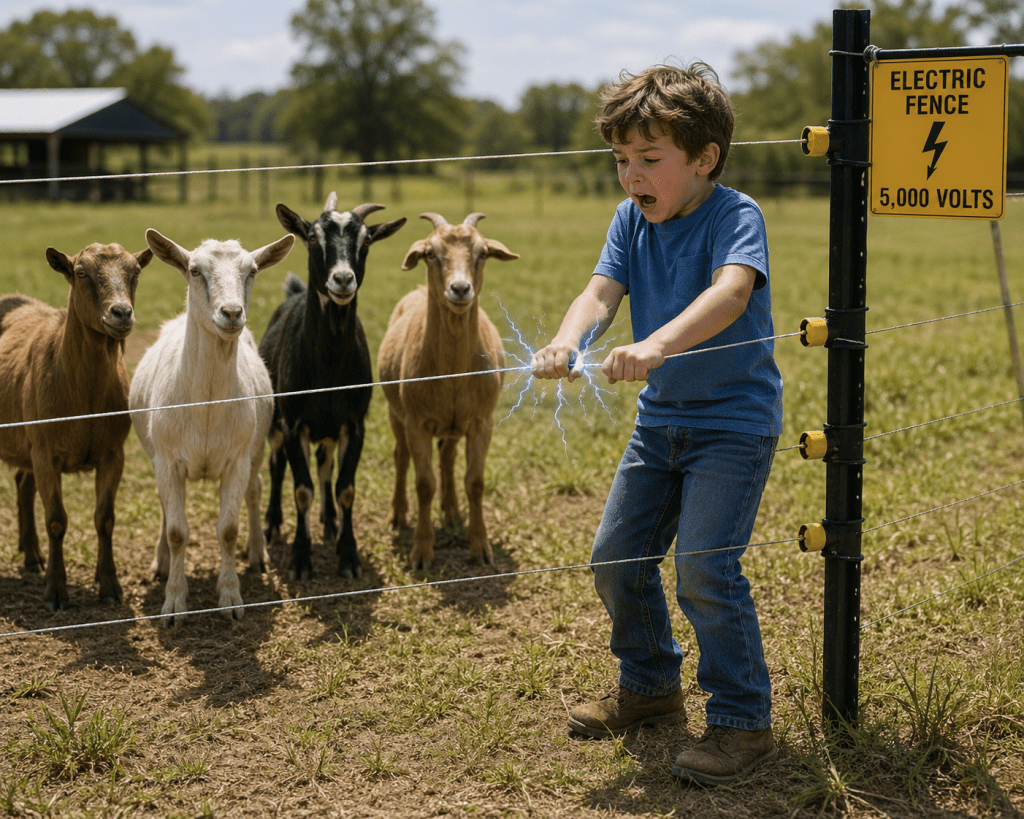
My goat pasture is surrounded by an electric fence. I wanted my grandchildren to think a bit so as not to get tangled up in the fence so I said, “I’m really curious about what will happen if I touch the electric fence. It is okay to be curious but that doesn’t mean I am going to touch it.”
My seven-year-old grandson thought about it and decided he would test the fence. An electric fence doesn’t send a steady stream of current down the wire. It pulses. My grandson quickly tapped the wire, but nothing happened. He had hit it between pulses. So, he quickly tapped the wire again. Nothing. So, he grabbed the wire, all 5,000 volts.
My grandson plays little games on electronic devices where his avatar would sometimes get zapped and explode. He told me, “Grandpa, I thought I was going to explode! I thought I was going to explode! I thought I would explode!”
ChatGPT said:
That’s a wonderful little story—funny on the surface, but it actually reveals several layers about how children think, test the world, and translate experience.
1. Curiosity vs. Boundary Testing
What you did—saying “it’s okay to be curious, but I’m not going to touch it”—is subtle. You weren’t just giving a rule; you were modeling restraint in the presence of curiosity.
Your grandson, at seven, heard something slightly different:
- Curiosity is valid ✔️
- Grandpa didn’t touch it… but he also didn’t say I can’t
That’s classic developmental reasoning. Around that age, kids are shifting from rule-following to hypothesis-testing. He didn’t rebel—he ran an experiment.
2. The “False Negative” Problem
The pulsed fence created a perfect teaching moment—almost like a lab error.
- First tap → no shock
- Second tap → no shock
- Conclusion → “This isn’t dangerous”
From his perspective, that was evidence-based reasoning. The environment gave him two “safe” data points, so he updated his model of reality. Then came the full-contact test… and reality corrected him.
This is actually how learning really sticks:
A wrong model, reinforced briefly, then dramatically overturned.
Those lessons tend to last.
3. Digital World → Physical World Translation
His reaction—“I thought I was going to explode!”—is fascinating.
He didn’t just feel pain; he interpreted it through his existing mental framework:
- In games, electricity = instant destruction
- Therefore: shock = imminent explosion
This is a great example of how children borrow metaphors from media to interpret unfamiliar sensations. The intensity of the shock didn’t just hurt—it triggered a narrative expectation.
In other words, he wasn’t just scared of the pain—he was scared of what he thought the pain meant.
4. Why This Moment Is So Valuable
There are a few quiet wins here:
- He tested the world himself (not just obeyed blindly)
- He experienced natural consequences without real harm
- He now has a deep, embodied understanding of “electric fence”
- And importantly—he told you about it, which means trust is intact
That last part matters more than the shock.
There’s also just a timeless, almost Mark Twain–level humor in it:
He ran the experiment correctly, got the wrong early data, and then fully committed to the conclusion—with his closed hand.
And the result? A lesson he will almost certainly remember longer than anything anyone could have told him.
 Conversations
Leave a comment