
Previously, I asked you to discern the priorities of the current U.S. administration. Could you revisit this conversation in light of the things “Professor” Xueqin Jiang is saying?
Note: One of Jiang’s conclusions is that we are already fighting WWIII, a conflict in which the players have few alternatives, and which is gradually ramping up to gigantic proportions. He has a series of YouTube videos to this effect.
ChatGPT said:
Yes. And Jiang Xueqin’s framework makes me think my earlier answer was too conventional. I treated the administration’s activities as a collection of policy priorities. Jiang’s more interesting proposition is that many of those apparently unrelated activities may be instruments serving one overriding objective.
I should put an important qualifier on this: Jiang openly describes some of his conclusions as speculation. He uses game theory—asking what strategy would make apparently disconnected actions rational—rather than claiming documentary evidence that Trump has secretly adopted the strategy he describes. So I would treat him as offering a model worth testing, not privileged access to Trump’s thinking.
Reinterpreting our earlier conversation
When you originally asked me, essentially, “If Trump could accomplish only a few things, what would capture his focus?”, I gave you things such as economic strength, national security, border control, technological leadership and government restructuring.
Jiang would probably say I was looking one level too low.
His central interpretation is roughly this:
Trump’s overriding objective is preservation of American power in a world in which America’s relative economic and geopolitical dominance is declining.
More specifically, Jiang increasingly describes that as preserving the economic architecture supporting American power: the dollar, American access to resources, control or influence over critical trade routes and chokepoints, and the ability to prevent China from becoming the organizing center of an alternative economic system.
That produces an interesting reinterpretation of the list you gave me earlier: China, Ukraine, Israel, Palestine, Iran, Russia, Europe, NATO, Venezuela, Greenland, CDC, etc.
Rather than being twelve competing things in Trump’s “pans in the fire,” Jiang asks whether several are actually pieces of the same pan.
China becomes the ultimate strategic competitor. Iran, Venezuela and Russia become important partly because they are major energy/resource suppliers outside straightforward American control and have important economic relationships with China. Europe and NATO concern American leverage, security dependence and burden-sharing. Greenland concerns Arctic geography, resources and strategic access. Tariffs concern industrial capacity, trade dependence and bargaining power. Domestic energy production becomes geopolitical power rather than simply an environmental/economic issue. AI becomes both an economic/military advantage and, in Jiang’s darker version of the argument, potentially an instrument of domestic control.
And that is exactly why your earlier observation now strikes me as important. You noticed that my priority list didn’t adequately explain why Trump was simultaneously interested in such an extraordinary collection of seemingly unrelated subjects.
Jiang offers an answer: perhaps they aren’t unrelated.
Where I think Jiang is particularly persuasive
I don’t think we need to accept his more dramatic claims about intentionally creating global chaos or an AI surveillance state to see something useful in his framework.
Trump does appear to think unusually transactionally and spatially about international relations. Territory, ports, shipping lanes, oil, minerals, tariffs, military bases, trade deficits and who pays whom repeatedly appear in his conception of international power. That’s quite different from viewing foreign policy primarily in terms of institutions, alliances, international law or ideological blocs.
Consequently, “economic policy,” “energy policy,” “foreign policy” and “national security” aren’t really separate boxes in this worldview.
They’re all forms of leverage.
And Jiang’s model explains something else we were struggling with earlier: why Trump might tolerate enormous resistance and controversy over seemingly secondary matters. If Greenland, Venezuela, Iran, tariffs, NATO contributions and domestic energy production are viewed independently, pursuing all of them simultaneously can look scattered. If they are viewed as attempts to increase American leverage over resources, trade, money and security, the behavior becomes considerably more coherent.
Where I part company with Jiang
Jiang sometimes moves too easily from “this outcome would benefit the United States” to “therefore this must be the American strategy.” Those aren’t equivalent.
His petrodollar thesis is a good example. He argues that restricting competing energy sources could force Europe and East Asia toward North American energy and reinforce dollar dependence. He explicitly says this is his explanation and acknowledges that it could be wrong. It’s a fascinating hypothesis, but an observed pattern can arise from several independent decisions rather than from a master plan.
There’s also a danger of attributing considerably more long-range coordination to the Trump administration than Trump himself possesses. Trump may have a remarkably consistent instinct without possessing Jiang’s remarkably elaborate strategy.
In fact, I think that distinction is crucial.
So I would now reduce my answer to two priorities
If you asked your original question again today, after considering Jiang, I wouldn’t give you five.
1. Preserve and increase American leverage.
Economic leverage, energy leverage, military leverage, territorial/geographic leverage, technological leverage and financial leverage—particularly against China.
2. Preserve Trump’s ability to exercise that leverage.
That encompasses control of the executive branch, reducing institutional restraints, immigration/border control, domestic political authority and the restructuring of government.
And I would put #1 considerably above #2. The second is partly a means of accomplishing the first.
There may even be a one-sentence version:
Keep the United States in the position where other countries need America more than America needs them.
That isn’t exactly Jiang’s formulation, and it doesn’t require accepting his “American Empire/petrodollar/chokepoint” theory wholesale. But I think it explains Trump’s behavior better than my original list of five priorities did.
And it produces a rather intriguing consequence for the question you asked immediately afterward about the likelihood of success in the face of resistance. Jiang’s analysis changes that answer substantially. If this is the real objective, resistance itself becomes part of the strategy: China diversifying energy supplies, Europe seeking greater independence, Iran resisting, NATO countries rearming, countries reducing dollar exposure, courts restraining executive power, etc. are not merely obstacles—they are the other players’ moves in the game.
That’s where I think your original question and Jiang’s analysis become genuinely interesting. We could take your original list—China, Ukraine, Israel/Palestine, Iran, Russia, Europe/NATO, Venezuela, Greenland and the domestic agenda—and put each one through the “American leverage” test. I suspect we’d find some surprising connections—and also identify a few places where Jiang’s theory simply doesn’t hold up.
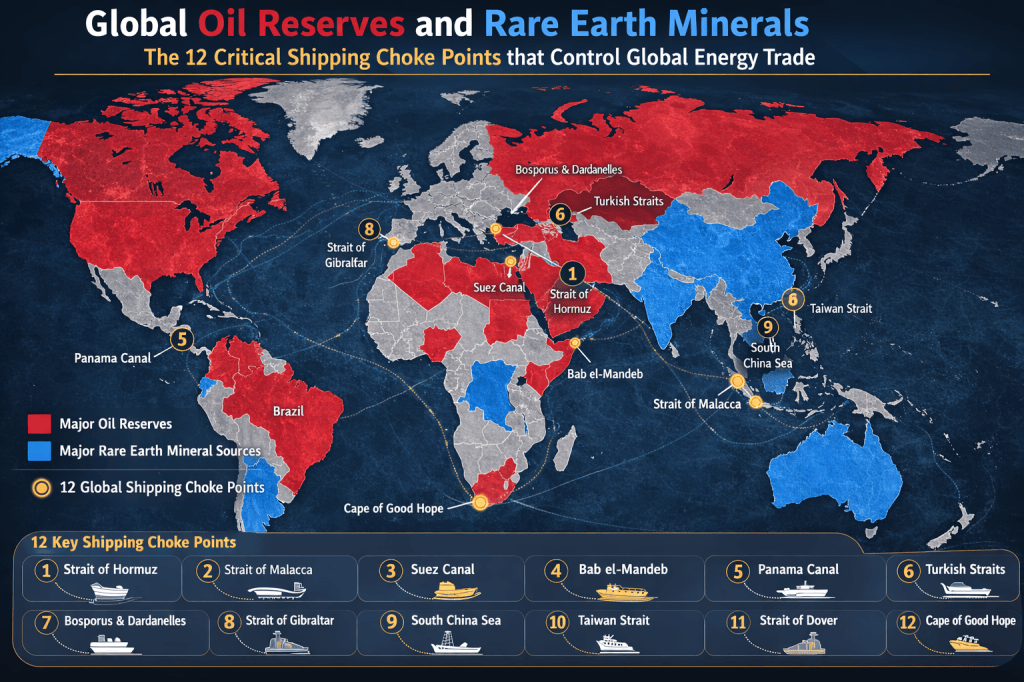
There are two points to raise here. The first is for you, that I believe Jiang sees Trump as viewing all of the Western hemisphere, not just North America, as US oil. Second, Jiang is missing several choke points along with rare earth minerals that are also influencing this situation.
ChatGPT said:
Yes. I think both points strengthen the model, and the first corrects something I said.
When I wrote “North American energy,” I made Jiang’s conception too narrow. His argument is closer to a hemispheric resource system: the Western Hemisphere is the resource base the United States intends to keep within its strategic orbit. That means Canadian, U.S., Mexican, Venezuelan, Guyanese and other Western Hemisphere petroleum reserves matter collectively—not necessarily because Washington literally owns the oil, but because preventing a rival great power, especially China, from gaining strategic control over those resources is the important consideration. That interpretation also fits the administration’s explicit elevation of the Western Hemisphere and its concern about China or Russia controlling strategic infrastructure there.
Your second point may be even more important because it suggests oil alone is too simple a key for decoding the pattern.
I think the model should become: resources + routes + processing
Resources include oil and gas, but also rare earths and the larger family of critical minerals—lithium, cobalt, nickel, graphite, gallium, germanium, yttrium, uranium, copper and others. The administration itself now explicitly describes dependence on foreign processing of these materials as a national-security vulnerability. Its January critical-minerals proclamation says that the United States was 100% net-import reliant on 12 critical minerals and at least 50% reliant on another 29, and specifically emphasizes that possessing the ore isn’t sufficient if another country controls its refining and processing.
That’s quite significant for our Jiang hypothesis because China’s advantage isn’t simply having minerals in the ground. It is control over processing. As of 2025, China still accounted for roughly 85% of rare-earth refining, according to current reporting, and its position in processing several other minerals has actually increased.
Then come routes and chokepoints. Panama is the obvious Western Hemisphere example, but once we widen the lens, Hormuz, Malacca, Bab el-Mandeb/Suez, the Turkish Straits and increasingly the Arctic routes all become relevant in different ways. Greenland becomes especially interesting because it sits at the intersection of two categories: mineral resources and emerging Arctic transportation/security geography. CSIS notes both its very large rare-earth deposits and the prospect of warming making additional resources and shipping routes accessible.
That produces a better version of Jiang’s chessboard:
Resources → Processing → Transportation chokepoints → Markets → Financial settlement
And China is playing on precisely the same board.
That also makes me reconsider Trump’s apparently peculiar fixation on Panama, Greenland and Venezuela. Looked at separately, they’re three very different problems. Looked at through this framework, they have an interesting common denominator:
Panama = movement.
Venezuela = energy + minerals.
Greenland = geography + minerals + Arctic access.
Indeed, contemporary analysis has independently noticed that connection: Axios described oil, critical minerals and AI/defense requirements as a thread linking Venezuela and Greenland, while the administration itself has made critical-mineral supply chains a national-security priority.
There’s an additional wrinkle I think Jiang’s formulation may underweight. Owning a resource isn’t nearly as important as controlling the system through which the resource becomes useful. China demonstrated this beautifully with rare earths. You don’t necessarily need to own every mine if you’re the indispensable processor. Likewise, you don’t have to own every oil field if you exert sufficient influence over production, transportation, refining, markets and the currency in which the commodity is traded.
So I would modify my previous one-sentence description of Trump’s underlying objective. Instead of:
Keep the United States in the position where other countries need America more than America needs them.
I’d now make it:
Keep the United States at the indispensable points in the world’s economic system—resources, processing, transportation, technology and finance—while preventing China from occupying those points instead.
That is considerably more specific.


Leave a comment