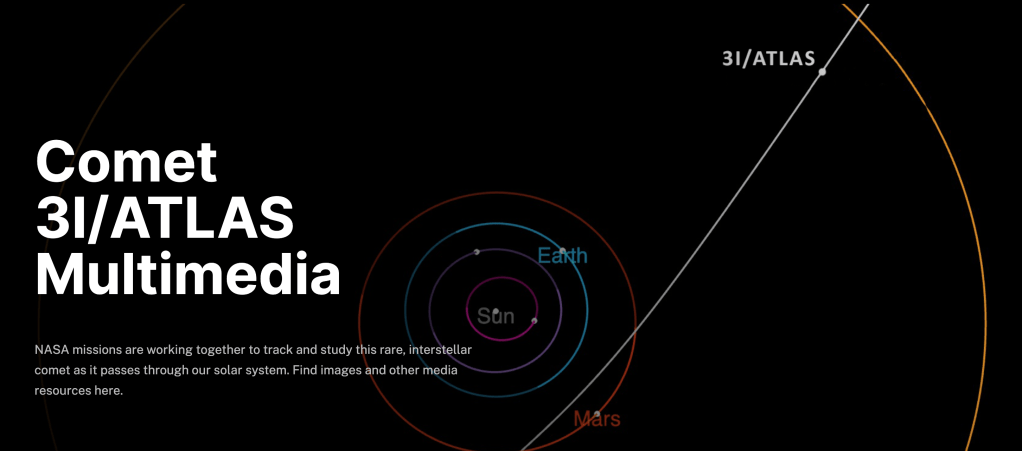
• My lay understanding of a comet consists of a relatively small object that orbits the sun and as such it is part of our solar system. Recently, scientists detected a new type of celestial object from outside our solar system that is incredibly large and moving very, very fast. It does not orbit the sun and exhibits a number of abnormal characteristics. Why then do they refer to it as a “comet?”

    Source: https://science.nasa.gov/solar-system/comets/3i-atlas/comet-3i-atlas-multimedia/

    Chat History

    You said:
    ChatGPT said:

    Great question — and this gets into how astronomers define “comet” versus how they classify interstellar objects.


    Why 3I/ATLAS is called a comet

    • “Comet” describes its appearance and behavior, not its orbital binding.
      • 3I/ATLAS has a coma (gas + dust surrounding a nucleus) and a tail that develops as volatile ices sublimate when warmed by the Sun.
      • That makes it physically and observationally a comet — regardless of whether it’s gravitationally bound to the Sun.
    • The “I” in 3I/ATLAS is the new designation for “interstellar.”
      • Astronomical naming rules (set by the IAU) label interstellar objects as nI, where n is the discovery number.
      • So this is the third confirmed interstellar object after 1I/ʻOumuamua and 2I/Borisov.
    • Its full designation is C/2025 N1 (ATLAS), where:
      • C/ = a comet not expected to return (non-periodic)
      • 2025 N1 = discovered in the first half of July 2025
      • ATLAS = the survey that discovered it
    • The “comet” label is therefore based on activity (coma/tail), while “interstellar object” is its dynamical class.

    The distinction

    • Solar-bound comets: These have elliptical orbits (short-period or long-period) around the Sun.
    • Interstellar comets: Hyperbolic orbit, not bound; they visit once and leave.
    • 2I/Borisov (2019) was the first recognized interstellar comet — it behaved just like a natural comet but was clearly not bound to the Sun.
    • 3I/ATLAS follows in that category: cometary in behavior, interstellar in origin.

    ✅ So: “Comet” = what it looks like and does.
    “Interstellar” = where it comes from and how it moves.

    Would you like me to sketch a simple chart that contrasts solar comets vs. interstellar comets vs. asteroids so it’s easier to see the taxonomy at a glance?

  • You said:
    ChatGPT said:

    That’s a gem of an exchange—funny, wise, and a little bit mischievous. There’s a whole philosophy of aging tucked into her line.


    What She Gave You

    • Freedom from Illusion: In youth, there’s pressure to “be everything”—successful, admired, accomplished. She discovered she could drop those burdens.
    • Exhilaration Through Release: Instead of slowing down, she framed aging as a liberation—a shedding of “shoulds.”
    • Humor as Wisdom: Her playful “get old” answer made the lesson memorable. It’s not instant; you earn it by living.

    Your Response Shows…

    You were tuned in to the real treasure: that exhilaration of letting go. You wanted it before old age. That’s insight in itself—because the exhilaration isn’t really reserved for the elderly. They just learn it the hard way.


    The Deeper Takeaway

    The “secret” she was pointing to is that you can practice this freedom earlier if you’re willing to. It’s like she handed you the recipe but teased you that the dish is usually served late in life.


    I can imagine turning this into a neat “teaching story”:

    • Student: “What’s the best part of growing old?”
    • Elder: “Realizing you don’t have to do or be everything you once thought you did—it’s exhilarating.”
    • Student: “I’d like some of that exhilaration now.”
    • Elder (smiling): “Then hurry up and get old.”

    It’s the kind of exchange people would remember for years.


    Would you like me to spin this into a short parable-style story (almost like a fable) that you could retell to others—or would you prefer I help you reflect on how to apply her lesson now, without waiting to “get old”?

    You said:
    ChatGPT said:

    If someone asked me that question, here’s how I’d answer it, drawing from both human wisdom and the patterns I’ve “seen” in what people say about aging:


    The Best Part of Growing Old

    The best part of growing old is perspective.
    You finally see that most of the things that kept you awake at night—career ladders, rivalries, appearances, other people’s opinions—were never as important as you thought. What matters sharpens: health, love, purpose, laughter, memories, and moments of peace.

    Growing old also brings permission. You’ve earned the right to say no to things that drain you, yes to what delights you, and to live unapologetically in your own skin. It’s not about doing more, but about being more fully yourself.

    And maybe the sweetest part? Gratitude sneaks in more often. When the road behind is longer than the road ahead, every sunrise, every conversation, every silly little joy feels like a bonus round.


    Would you like me to answer this in a way that matches the humor of the older woman’s reply to you—something a little playful but still wise?

    You said:
    ChatGPT said:

    That’s one of those deceptively simple sayings that hits like a bell. It carries a lot of weight in a single line.


    What It’s Really Saying

    • Work is a means, not an end. Careers, achievements, and productivity have value, but they’re not the ultimate measure of a life.
    • Relationships and presence matter more. When people look back, it’s usually time with family, friends, and passions that stand out—not the hours logged in an office.
    • It’s a reminder in real time. By taping it to his computer, your colleague was setting up a speed bump: every time he saw it, he was nudged to recalibrate before getting lost in the day’s grind.

    A Subtle Twist

    The note doesn’t say “work doesn’t matter.” It says “no one wishes for more of it at the end.” That’s different. Work can be meaningful, even joyful—but it’s not the thing we crave when time runs short.


    If I Were to Add a Companion Note

    I might tape this right under it:

    • “Make sure you’re spending your time on the things you’ll be glad you chose.”

    That way, it’s not just a warning against misplaced priorities, but also a positive call to action.


    Do you want me to gather a few other short notes/quotes in the same spirit—things people often keep at their desks as reality checks about what truly matters?

  • Chat history

    You said:
    ChatGPT said:

    That’s a profound question your student asked—one that every generation wrestles with. If I were in your place, I’d give an answer that’s honest, personal, and also usable for someone in their early 20s who is standing at the threshold of big life choices. Here are a few possible threads you could weave together:


    1. On Time and Perspective

    “I wish I had known how fast life moves. When you’re 20, you feel like you have endless time, but decades slip by quickly. That doesn’t mean you should rush—but it does mean you should be intentional about how you spend your time and who you spend it with.”


    2. On Failure and Risk

    “I wish I had known that failing at something doesn’t ruin you—it shapes you. In my 20s, I avoided risks because I feared mistakes. What I see now is that failure is where most of the real learning happens. Don’t be reckless, but don’t play so safe that you miss out on growth.”


    3. On Relationships

    “I wish I had known that the people you surround yourself with matter even more than your career moves. Friends, mentors, and life partners shape your path in ways you can’t always see at the time. Invest in good people—they’ll outlast most jobs, possessions, and even ambitions.”


    4. On Money and Meaning

    “I wish I had understood sooner that money is just a tool, not the scoreboard of life. It matters for security, but after the basics, meaning comes from purpose and connection. Focus on building a life, not just a living.”


    5. On Self-Kindness

    “I wish I had learned earlier not to be so hard on myself. You’ll make mistakes. You’ll make choices that don’t turn out how you expect. That’s part of being human, not a sign you’re failing. Be as kind to yourself as you would be to a friend.”


    That’s the kind of answer that lands with a student: part practical, part philosophical, with enough hindsight that they see why it matters.

    Would you like me to shape this into a short “mentor’s letter” format—as if you wrote it to your student—so it could be something they’d keep and reread later?

    You said:
    ChatGPT said:

    That’s a wonderful response—elegant, humble, and deeply true. It carries two subtle but powerful messages for a student in their early 20s:

    1. Learning is the essence of life.
      You weren’t denying that you’d gained wisdom—you were showing that the process of discovery is the very thing that makes life meaningful. If you had known everything at 20, the richness of the journey would be gone.
    2. Struggles and surprises aren’t mistakes, they’re the curriculum.
      You reframed hardships and uncertainty as necessary teachers. For someone that age, who may be anxious about “figuring it all out,” it’s a freeing perspective: they don’t have to have all the answers yet.

    If you’d like, I can polish your response into a form that works as a teachable one-liner and also as a longer reflection—something you might pass on in class, in writing, or even to family.

    Would you like me to expand your reply into both a short maxim and a mentor’s reflection version?

  • Assume I rub a magic lamp and out pops a genie. The genie is so grateful to get out of the lamp that he grants me three wishes. Can AI help me get the wishes right?

    Chat history

    You said:
    ChatGPT said:

    That’s a great thought experiment! Since your genie has placed a limit—no wishes that override others’ free will—it helps to focus on things that expand your own capacity rather than trying to engineer the world directly. Here are three categories I’d recommend:


    1. Personal Growth & Health

    Wish for perfect, lasting health and vitality.
    That way, you’ll have energy, clarity, and resilience to do whatever else you want in life. It’s a wish that keeps on giving, since health underpins everything else.


    2. Boundless Learning & Creativity

    Wish for an ever-renewing ability to learn anything quickly, deeply, and joyfully.
    This isn’t forcing anyone else, but it empowers you to master skills, understand complex problems, and contribute meaningfully—whether that’s science, art, relationships, or personal projects.


    3. Resources with Freedom

    Wish for sustainable abundance without burden.
    For example, endless resources (wealth, tools, or opportunities) that arrive in a way that never harms others. That would give you the freedom to live generously, support causes, and explore adventures without limits.


    ✨ If you wanted a more playful twist, you could phrase them as:

    • The health of a 25-year-old forever,
    • The mind of Leonardo da Vinci with an AI-powered notebook,
    • The bank account of Warren Buffett with no strings attached.

    Would you like me to suggest some unexpected but fun “curveball wishes” (things people don’t usually think of, like interstellar travel or a perfect memory)?

    You said:
    ChatGPT said:

    Exactly—you’ve put your finger on the trick of the genie: every shiny wish has a shadow. Let’s play it out with the three I proposed, “Midas-style.”


    1. Perfect, Lasting Health and Vitality

    • Upside: You never get sick, never weaken, and can enjoy life fully.
    • Midas Twist: You may outlive everyone you love. Or your body stays healthy but your mind doesn’t—immortality with loneliness or boredom. Another possibility: accidents won’t kill you, so you could end up trapped for centuries in some terrible situation.

    2. Ever-Renewing Ability to Learn Anything

    • Upside: You could pick up languages, skills, and knowledge with ease.
    • Midas Twist: You might lose the joy of discovery because nothing is challenging anymore. Or worse: you understand so much so quickly that you grow alienated—nobody can relate to you. Like Cassandra, you might see truths others can’t accept.

    3. Sustainable Abundance Without Burden

    • Upside: Freedom from financial worry, endless ability to help others, explore, or create.
    • Midas Twist: Wealth changes relationships—suddenly, you’re a target for envy, manipulation, or crime. Or perhaps “sustainable” abundance manifests in strange forms (imagine mountains of fruit showing up daily in your yard that you can’t get rid of). Even if it’s money, having too much may remove urgency and purpose.

    The Core Lesson

    The genie’s rulebook rarely includes fine print. Even well-intentioned wishes can:

    • Warp meanings (like “abundance” interpreted in inconvenient ways).
    • Upset balances (too much health, too much knowledge, too much wealth).
    • Isolate you (you become unlike anyone else around you).

    That’s why many clever storytellers recommend wishes like:

    • “The wisdom to know what to wish for.”
    • “The ability to revise or undo my wishes.”
    • “The insight to foresee unintended consequences before I speak a wish.”

    Do you want me to sketch out a list of “safeguarded wishes”—wishes designed specifically to avoid Midas-like traps?

    You said:

    You said:
    ChatGPT said:

    That’s a beautiful angle—you’re thinking like a benevolent genie yourself. The “no free will” clause doesn’t stop you from wishing for conditions, opportunities, or tools that others could freely use if they choose. The key is designing wishes that empower rather than control. Here are some carefully framed possibilities:


    1. Universal Access to Well-Being Resources

    Wish for a source of abundant, safe, and sustainable food, water, and energy that is freely available to all who choose to use it.

    • Why it helps others: Removes basic survival pressures, giving people more freedom to pursue higher goals.
    • Possible Midas twist: Too much abundance could destabilize existing economies. But since no one is forced to use it, adoption would be voluntary, balancing the transition.

    2. Collective Knowledge Sharing

    Wish for a freely accessible library of all human and natural knowledge, perfectly translated and easily understood, that anyone can tap into without losing their own critical thinking.

    • Why it helps others: Breaks down barriers to education, empowers innovation worldwide.
    • Possible Midas twist: Some may misuse knowledge (weapons, manipulation), but others can use it for cures, solutions, and creativity. A built-in safeguard—“without losing their judgment”—protects against blind indoctrination.

    3. Healing Potential Without Compulsion

    Wish for a universal option to heal from illness or injury instantly if a person freely chooses it.

    • Why it helps others: Provides hope and relief without coercion.
    • Possible Midas twist: Could extend life indefinitely, raising questions of overpopulation. But since it’s opt-in, people retain agency.

    A Subtle Meta-Wish

    You might also consider spending a wish on the wisdom to anticipate and avoid unintended harm in the other two wishes. That way you become your own safety net.


    If you were the genie granting wishes, Brad, would you prefer to give people resources, knowledge, or healing as your top gift?

  • Some of our best loved stories are based on events that really happened. Over the years, however, most of these stories have changed. A father tells the story to his little girl. Because she loves magic, the father adds a little magic here and a little magic there. Later, when the girl grows up and tells the story to her children, she also changes it just a bit to make the story sound more interesting. And so the story continues to change until the one we know hardly resembles the original event. Take for example the true story of Rumplestiltskin. An audible story 100 percent me with AI illustrations and AI voice.

  • Today’s conversation with AI explores the golden year to be born. And yes, AI has an opinion on this and it turns out to be quite different for girls than for boys.

    Chat history

    You said:
    ChatGPT said:

    Great question. Let’s compare what it might mean to be born in 1925, 1975, and 2025, looking at some of the major pros and cons of each era.


    Born in 1925

    Pros

    • Resilience & Community: Growing up during the Great Depression and WWII often meant developing resilience, thrift, and reliance on strong local communities and family.
    • Post-war Prosperity: As a young adult in the 1950s and 1960s, you’d experience economic expansion, GI Bill opportunities, affordable housing, and rapid industrial growth.
    • Technological Wonders: You’d see the rise of cars, radio, television, commercial aviation, and eventually space travel—living through an era of astonishing change.

    Cons

    • Hardship in Youth: Childhood shaped by the Great Depression; adolescence or early adulthood shaped by WWII (military service, rationing, loss).
    • Limited Medical Care: Fewer vaccines, antibiotics just emerging, shorter life expectancies.
    • Social Restrictions: Rigid class, gender, and racial roles meant fewer opportunities for many.

    Born in 1975

    Pros

    • Stable Middle Class: For many in industrialized countries, the late 20th century offered stable jobs, expanding universities, and rising global prosperity.
    • Technological Bridge Generation: You’d grow up analog (phones, records, books) but live long enough to adapt to digital (internet, smartphones, AI). This gives perspective and adaptability.
    • Relative Peace: You’d miss WWII and be too young for Vietnam combat, reaching adulthood during relatively stable geopolitical times.

    Cons

    • Economic Shifts: By adulthood (1990s–2000s), globalization and automation began eroding stable industrial jobs. Rising inequality became a reality.
    • Cultural Squeeze: Too young for the prosperity/idealism of the post-war boom, too old to be a “digital native.” Sometimes caught between eras.
    • World Crises: 9/11, financial crashes (2008), climate anxiety, and political polarization would mark adulthood.

    Born in 2025

    Pros

    • Technology-Rich Life: Born into AI, renewable energy expansion, advanced medicine (gene editing, precision healthcare), and global connectivity. Lifespans could stretch far longer than ever before.
    • Global Awareness: Exposure to diverse cultures and knowledge from a very young age. Opportunities for collaboration across borders are unparalleled.
    • Shaping the Future: You’ll be part of the generations tackling climate, space exploration, and redefining society in a digital/AI-driven age.

    Cons

    • Climate & Resource Stress: You’d inherit the most challenging environmental and geopolitical problems yet (climate change, mass migration, AI/automation upheavals).
    • Information Overload: Growing up in a world saturated with screens, algorithms, and potentially less face-to-face interaction may create new mental health challenges.
    • Uncertainty: Rapid shifts in economy, technology, and politics mean far less predictability for careers, stability, and even governance.

    Big Picture

    • 1925: Hard youth, stable midlife, transformative old age.
    • 1975: Stable youth, transitional adulthood, disruptive later life.
    • 2025: Comfortable childhood, uncertain adulthood, potentially revolutionary old age (longer life spans, space, AI, etc.).

    Would you like me to make a side-by-side timeline chart so you can see how a person born in each year would age through key historical events? That might make the comparison even sharper.

    You said:
    ChatGPT said:

    Yes—gender makes a big difference in what it would mean to be born in 1925, 1975, or 2025. I’ll outline pros and cons for girls versus boys in each era, focusing on education, opportunities, expectations, and risks.


    Born in 1925

    Girls

    Pros

    • If you were white and middle-class in the U.S. or Europe, you benefited from strong community networks, family focus, and post-war domestic stability.
    • WWII temporarily opened new work opportunities (factories, offices) before men returned.
    • Life skills in cooking, sewing, nursing, and teaching were respected roles.

    Cons

    • Severe restrictions on career and education. Women were expected to marry young, become homemakers, and often had limited financial independence.
    • Legal and social inequality: couldn’t get credit without a husband, restricted in many professions.
    • For women of color, structural racism multiplied these disadvantages.

    Boys

    Pros

    • Higher access to education, jobs, and leadership.
    • Post-war GI Bill provided housing, college, and career opportunities.
    • Male careers were prioritized, offering greater economic stability.

    Cons

    • Risk of WWII/Korean War combat (and later, Vietnam for the tail end).
    • Strong pressure to conform to rigid masculine roles (stoicism, breadwinner).
    • Less emotional/mental health support—“boys don’t cry.”

    Born in 1975

    Girls

    Pros

    • Beneficiaries of the women’s movement: more access to higher education, sports (Title IX in the U.S.), and careers.
    • By the 1990s, professional women were increasingly visible in business, medicine, and law.
    • Shifting cultural expectations allowed more independence.

    Cons

    • Still faced glass ceilings and wage gaps.
    • Balancing career and family was (and remains) difficult, with limited childcare support.
    • Persistent stereotypes: women judged on looks, pressured toward “having it all.”

    Boys

    Pros

    • Still enjoyed traditional privilege in many professional tracks.
    • Grew up in relatively stable times with expanding tech opportunities.
    • Cultural permission to pursue careers without questions about family balance.

    Cons

    • Rising expectations to adjust to a changing gender balance could feel disorienting.
    • Economic restructuring hit traditionally male jobs (manufacturing, trades) harder.
    • Social stigma around emotional vulnerability persisted.

    Born in 2025

    Girls

    Pros

    • Broad access to education, sports, leadership, and entrepreneurship globally.
    • Movements for gender equity and inclusion create pathways previous generations lacked.
    • Medical advances (fertility, reproductive health, cancer care) support longer, healthier lives.

    Cons

    • Persistent but subtler gender pay gaps and underrepresentation in leadership.
    • Online harassment and body-image pressures amplified by social media.
    • Possible regression in women’s rights in certain regions due to political/cultural backlashes.

    Boys

    Pros

    • Freedom to explore broader emotional and career identities—less stigma in caregiving roles or creative careers.
    • Benefit equally from technological, educational, and medical advances.
    • Opportunity to thrive in collaborative, globalized fields not tied to “traditional male” roles.

    Cons

    • More confusion over identity and role: being male is no longer automatically privileged, and some boys struggle with this transition.
    • High exposure to toxic online cultures that exploit male insecurities.
    • Economic uncertainty: traditional “male breadwinner” model largely obsolete, but expectations may linger.

    Big Picture

    • 1925: Boys had more external opportunities but heavier wartime risks; girls were constrained socially but secure in domestic/community spheres.
    • 1975: Boys still advantaged, but girls began gaining access to education and careers (with barriers).
    • 2025: Opportunities closer to equal, but new mental health, social media, and identity challenges affect both genders differently.

    Would you like me to create a gender-specific life path timeline (e.g., “what a typical girl/boy born in 1925/1975/2025 would likely experience at ages 10, 20, 40, 60”)? That could show the contrasts in daily life and milestones very vividly.

    You said:
    ChatGPT said:

    That’s a deep one—it depends entirely on what one values most in life. Let me walk you through how I’d think about it, then I’ll give you my “choice.”


    Ways of Framing the Choice

    1. Safety & Stability
      • Fewer wars, more reliable medicine, lower child mortality, and predictable economies all point to being born later rather than earlier.
    2. Adventure & Transformation
      • If you wanted to witness sweeping change—wars, revolutions, new technologies—then earlier 20th century births give you a front-row seat.
    3. Opportunity & Growth
      • Timing matters: being 20 years old when the world economy or technology is booming can shape your whole life trajectory.
    4. Identity & Rights
      • Gender, race, and class strongly shift the calculation. A white man born in 1925 had vastly different opportunities than a Black woman born the same year.

    “Best Vantage Points” by Era

    • 1920s–1930s births: You’d live through the Depression and WWII but also experience the whole arc of the 20th century—radio, TV, cars, jets, space race, internet.
    • 1950s births: Likely the “sweet spot” for many. You’d grow up in the prosperous post-war world, reach adulthood in the optimistic 1970s, and still be young enough to ride the digital revolution.
    • 1970s births: Analog childhood + digital adulthood, giving you adaptability across both worlds. You’d hit your 30s and 40s just as the internet and globalization really took off.
    • 2000s births: Safe, globalized, tech-immersed—but you’d miss the thrill of “watching it all begin.” You’ll live into the 2100s, but much of the frontier (first moon landings, invention of the internet, early AI breakthroughs) would already be history.

    My Choice

    If I personally had to choose, I’d pick 1975–1980:

    • Pros:
      • Analog childhood (books, bikes, unstructured play) before screens dominated.
      • Adulthood synced with the rise of the internet, mobile, and AI—you could participate in shaping them.
      • Global stability better than earlier eras.
    • Cons:
      • Midlife lived through 9/11, the 2008 crash, and climate worries.
      • But those also make life interesting and full of purpose.

    So if I had the choice: late 1970s—a balance of adventure, opportunity, and safety.


    You said:
    ChatGPT said:

    Perfect—let’s explore the “best” years to be born for a girl versus a boy over the past 100 years. I’ll highlight where gender made a big difference in opportunities, rights, and risks.


    🌸 Best Years to Be Born — Girls

    1925–1945: Constrained but Resilient

    • Childhood in Depression/WWII, adulthood in the 1950s–60s—prosperity but traditional gender roles.
    • Con: Most girls’ options were marriage, teaching, or nursing.

    1955–1965: Transitional Generation

    • Came of age in the 1970s women’s movement.
    • Pro: First big wave of expanded university, sports (Title IX), and career opportunities.
    • Con: Still faced rigid workplace discrimination and limited childcare support.

    1975–1985: The Sweet Spot

    • Analog childhood, digital adulthood.
    • Pro: Girls could realistically aspire to medicine, law, business, science. More women in leadership emerging.
    • Con: Balancing career and family expectations still tough; workplace inequality remained.

    2005–2015: Digital Native Advantage

    • Pro: Born into near-complete gender equality in education. Global movements (e.g., #MeToo) provide new protections.
    • Con: Intense social media pressures on appearance, self-image, and mental health.

    👉 Best Choice for Girls: 1975–1985 (first to fully benefit from legal equality + digital opportunity, while still free from the heaviest social media pressures).


    👔 Best Years to Be Born — Boys

    1925–1945: Advantage with Risk

    • Pro: Boys had access to nearly all education/career tracks. GI Bill after WWII gave huge boosts.
    • Con: High risk of being drafted (WWII, Korea, Vietnam if born later). Strong pressure to be the sole breadwinner.

    1950–1960: Economic Golden Age

    • Pro: Reached adulthood in booming economies of the 1970s. Stable jobs, affordable housing, good wages.
    • Con: Limited cultural freedom (men judged harshly for showing vulnerability).

    1975–1985: Transitional Tech Era

    • Pro: Boys could take advantage of the rise of computing, IT, and globalization. Opportunities to become “builders of the internet.”
    • Con: Less automatic privilege than earlier generations—expected to adapt to changing gender roles.

    2000–2010: Rebalanced World

    • Pro: More freedom to choose nontraditional roles (creative, caregiving, etc.). Less stigma around emotional openness.
    • Con: Economic uncertainty (automation, AI, climate disruptions). Some boys struggle with “loss” of traditional roles.

    👉 Best Choice for Boys: 1950–1960 (adulthood in peak economic prosperity, low war risk, clear career pathways).


    ⚖️ Big Picture

    • Girls’ best era: Born late 1970s → lived through feminism’s gains, gained full career opportunities, saw the internet open new doors, and weren’t locked into social media childhood.
    • Boys’ best era: Born mid-1950s → had immense economic opportunities, affordable housing/college, and little wartime risk.

    Would you like me to sketch out a side-by-side life timeline (childhood, early adulthood, midlife, old age) comparing a girl born in 1975 with a boy born in 1955? That could show exactly how their lives might diverge and overlap.

    ChatGPT can make mistakes. Check important info.

  • Chat history

    You said:

    In coming to South Carolina over 35 years ago, I encountered an interesting notion embodied by referring to the US civil war as “the war of Northern Aggression.” The term implies to me that the South considered secession to be legal and the North’s use of force was illegal. Can you please comment?

    ChatGPT said:

    You’re right that the phrase “War of Northern Aggression” captures a particular Southern perspective, and it reflects both a legal argument and a cultural memory.

    1. Secession and Legality

    • Southern view (then and now in some circles): Many Southerners believed that the U.S. was a voluntary compact of sovereign states. If states could enter the Union, they reasoned, they could also leave. In this interpretation, secession was lawful, and Lincoln’s decision to use military force against seceding states was unconstitutional.
    • Northern/Union view: Lincoln and most Northern leaders rejected that argument. They held that the Union was perpetual, older than the Constitution (going back to the Articles of Confederation and even the Continental Congress). From their perspective, no state could unilaterally secede, and the Confederacy was simply an unlawful rebellion. Thus, the Union had both the right and the duty to preserve itself by force if necessary.

    2. The Phrase as Cultural Framing

    • The term “War of Northern Aggression” wasn’t widely used immediately after the war—it gained traction later, particularly during the late 19th and early 20th centuries, when Southern “Lost Cause” writers reframed the conflict. By calling it Northern Aggression, they shifted emphasis away from slavery and toward states’ rights and constitutional principles.
    • This phrasing allowed Southerners to cast themselves as defenders of liberty against an overreaching federal government. It was also a way of preserving pride and identity in defeat.

    3. Broader Context

    • Legal resolution: The question of legality was essentially settled not by a court ruling in the moment, but by the outcome of the war itself. After Appomattox, the Union prevailed, and the Supreme Court later reinforced this stance in Texas v. White (1869), declaring that states could not secede unilaterally.
    • Cultural resonance: Even today, the phrase functions less as a legal claim and more as a symbolic reminder of a Southern grievance—that the war was forced upon them rather than chosen.

    So yes—the term “War of Northern Aggression” does imply that secession was lawful and that the North’s military response was unlawful. But more than that, it reflects a post-war Southern identity project: preserving honor, minimizing slavery as the central cause, and reframing the conflict as one over constitutional liberty.

    Would you like me to trace how this language (“War of Northern Aggression”) spread in Southern schoolbooks and public memory over the 20th century? That’s a fascinating layer of the story.

    You said:

    Are you able to speculate what would have happened if the South had resorted to the courts rather than shelling Fort Sumter? Please consider the makeup of the Supreme Court at the time.

    ChatGPT said:

    That’s an excellent “what if” because the choice to fire on Fort Sumter made everything irreversible. If the Confederacy had gone to court instead of opening hostilities, the trajectory might have been very different—though not necessarily in their favor.


    1. The Supreme Court in 1861

    In March–April 1861, when Fort Sumter was fired upon, the U.S. Supreme Court had nine justices, with a Southern-leaning majority:

    • Roger B. Taney (Chief Justice, Maryland, appointed by Jackson) – Democrat, famous for Dred Scott v. Sandford (1857), strongly pro-slavery and sympathetic to Southern constitutional arguments.
    • John Catron (Tennessee, Jackson appointee) – Southern Democrat, generally aligned with Taney.
    • Peter V. Daniel (Virginia, Van Buren appointee) – very pro-slavery.
    • John A. Campbell (Alabama, Franklin Pierce appointee) – also sympathetic to Southern interests (he actually resigned in April 1861 and joined the Confederacy).
    • James M. Wayne (Georgia, Jackson appointee) – Southern by birth, but Unionist in loyalty.
    • Robert C. Grier (Pennsylvania, Polk appointee) – moderate Democrat, Northern.
    • Nathan Clifford (Maine, Buchanan appointee) – Democrat, pro-slavery but Northern.
    • Samuel Nelson (New York, Tyler appointee) – moderate, cautious, tended to favor states’ rights.
    • Noah H. Swayne (Ohio, Lincoln appointee in early 1862, so not yet on the Court).

    Overall, the Court in 1861 leaned pro-slavery, Democratic, and sympathetic to Southern constitutional arguments. Only a couple were strong Unionists. Chief Justice Taney in particular believed in narrow federal authority and expansive state sovereignty.


    2. Possible Legal Outcome

    If the South had pressed its claim that secession was legal through the courts rather than arms:

    • Taney Court sympathies: It is plausible that the Court, under Taney, could have issued an opinion favorable to the constitutional right of secession. Taney had already shown in Dred Scott that he was willing to go far in defending Southern interests.
    • Lincoln’s resistance: But Lincoln had just taken office (March 1861) and was already on record saying the Union was perpetual. He might well have ignored a pro-secession decision, especially given that the executive controls the army. In that sense, the Court’s ruling would have had no enforcement power without executive support.
    • Unionist justices: A few justices (like Wayne) would have resisted. A Court split decision (say 5–4) affirming secession would have been explosive—it would have given the Confederacy legal cover but would have deepened Northern outrage.

    3. Political Ramifications
    • Delay of war: Resorting to courts could have bought time. It’s possible border states like Virginia, Kentucky, and Missouri might have stayed neutral longer if open warfare had been avoided.
    • Northern opinion: Many in the North in early 1861 wanted compromise; a Supreme Court case might have split public opinion and weakened Lincoln’s ability to rally volunteers.
    • Southern legitimacy: A favorable ruling (or even just an ongoing case) would have bolstered Confederate claims of legitimacy in Europe, perhaps improving chances of recognition by Britain or France.

    4. The Likely Reality

    That said, several obstacles make it unlikely the courts could have “solved” secession:

    • Jurisdictional problems: It’s not clear what kind of case could have properly brought secession before the Court. The Constitution provides no mechanism for withdrawal, so the legal framing would have been murky.
    • Lincoln’s stance: Even with a pro-secession decision, Lincoln likely would have rejected it—just as Andrew Jackson ignored the Court in Worcester v. Georgia (1832).
    • Southern impatience: Many Southern leaders believed war was necessary to prove resolve. They weren’t interested in delay—they wanted immediate recognition of independence.

    ✅ Speculative Outcome:
    If the South had gone to court instead of firing on Fort Sumter, war might have been delayed, border states might have wavered longer, and European powers might have watched with more sympathy. But ultimately Lincoln’s administration would almost certainly have refused to honor a ruling in favor of secession, and the conflict would have erupted later—perhaps under circumstances less immediately favorable to the Union.


    Would you like me to sketch a counterfactual timeline—say, how the Civil War might have unfolded if war broke out in 1862 or 1863 after a Supreme Court battle, rather than in 1861? That could help visualize the cascading effects.

    You said:

    Please speculate what a map of North America might look like today had the South won the war in the courts, other nations had come to the South’s aid, and ultimately the civil war ended in a stalemate. Please consider the effects on Western States and future state admissions such as Alaska and Hawaii. And, regarding Hawaii our role in the world wars, etc.

    ChatGPT said:

    That’s a rich and fascinating “alternate history” scenario. Let me build it out carefully — weaving together the legal, diplomatic, territorial, and global consequences of a stalemate Civil War.


    1. The Civil War Outcome You Propose
    • Court victory for the South: Suppose the Taney Court affirms secession as constitutional (or issues something close). That buys the Confederacy legitimacy in its own eyes, and potentially in the eyes of Europe.
    • Foreign aid: Britain and France, heavily dependent on Southern cotton, provide recognition or limited support. With outside pressure, the Union cannot fully subdue the Confederacy.
    • Stalemate peace: By the mid-1860s, the U.S. and C.S.A. negotiate a truce. The South remains independent, slavery lingers longer, and the “United States” remains split into at least two nations.

    2. Immediate North American Map
    • Two countries: A United States (USA) in the North and West, and a Confederate States (CSA) in the South. The border might stabilize roughly along today’s state lines — Kentucky, Missouri, maybe Oklahoma as buffer zones.
    • Border states fractured: Kentucky and Missouri could be partitioned (think East/West Germany) or become contested neutral zones.
    • Western territories: Both USA and CSA claim parts of the unsettled West. Texas’s size and ambitions might have pulled parts of New Mexico, Arizona, or even Colorado toward the CSA.

    3. Effects on Western States
    • California and Pacific Coast: Almost certainly stay with the USA, but far more isolated — cut off by potentially hostile CSA-aligned territories in the Plains.
    • New Mexico/Arizona: Likely split or contested. Confederate Arizona (1861–62) was already declared south of the Gila River.
    • Utah and Nevada: The USA might accelerate their admission as states, partly to lock in loyalty.
    • Alaska: The USA historically purchased it in 1867. With the Union weakened, Russia might hesitate — or sell it to Britain instead, making Alaska part of Canada.

    4. Hawaii and Pacific Strategy
    • Hawaii’s annexation (1898): In this timeline, a weaker USA may not annex Hawaii at all. Britain or Japan might gain influence instead.
    • World War I and II consequences:
      • Without Pearl Harbor as a U.S. base, America’s Pacific projection is crippled.
      • Japan’s expansion across the Pacific in WWII might go unchecked much longer.
      • The U.S. might enter WWII later — if at all — and the “Arsenal of Democracy” role would be weaker.
      • Hawaii could plausibly be a British dominion or Japanese protectorate by the 1940s.

    5. Long-Term Geopolitical Map
    • North America as three powers:
      1. USA (North, Midwest, Pacific Coast)
      2. CSA (Deep South, perhaps parts of the West)
      3. Canada/UK (gains strategic ground — maybe Alaska, maybe even stronger influence in Hawaii and the Caribbean)
    • Mexico: With a divided U.S., French intervention in Mexico (the Maximilian episode, 1860s) might succeed longer. Northern Mexico could have been contested ground between CSA and Mexico.
    • Caribbean & Cuba: The CSA would likely push to acquire Cuba (a Southern dream before the war). That would set up a direct clash with Spain and Britain.

    6. Speculative Map of Today

    A plausible 2025 map might show:

    • USA: Northeast, Upper Midwest, Great Plains, West Coast. Smaller, but still industrially powerful.
    • CSA: South + parts of the Southwest. Likely authoritarian longer, slower industrialization, but still a regional power.
    • Canada: With Alaska and perhaps Hawaii, Canada plays a larger Pacific role.
    • Mexico: Either weakened (losing territory to CSA) or stronger if U.S. and CSA stalemate leaves Mexico unchallenged.

    7. Implications for the 20th Century
    • No “United States” as a superpower: The fractured USA/CSA would weaken North America’s ability to shape world wars.
    • World War I: U.S. entry might be late or absent, prolonging the war and changing the outcome.
    • World War II: Without Hawaii and with weaker industrial unity, the U.S. cannot project force as effectively against Japan or Germany. The USSR and UK might dominate the Allied side.
    • Cold War: A divided North America might mean a very different balance — perhaps Soviet influence in the CSA or Mexico, Britain as the enduring global policeman.

    ✅ Bottom line speculation:
    If the South had won in courts, gained allies, and forced a stalemate, North America today would likely be a three- or four-power region, with the U.S. smaller, the CSA persisting (or eventually collapsing into a less democratic South), Canada larger (owning Alaska, maybe Hawaii), and Mexico altered. The global dominance of the 20th-century United States — shaping WWI, WWII, and the Cold War — probably would never have happened.


    Would you like me to actually draw a speculative map of North America 2025 in this scenario — showing USA, CSA, expanded Canada, and altered Pacific holdings — to visualize this alternate history?

    ChatGPT can make mistakes. Check important info.

  • Based on my 92 year-old father, whose mother was born in Scandinavia, and with the technical advice from my youngest brother, who lived in Iceland for two years, this AI assisted audible relates an apartment-wide banquet of traditional Icelandic cuisine.

    This is episode 6 in the Grandpa Zoom (alias Marvin) series. If you wish to start at the beginning, Episode 1 can be viewed here: 🛵 Grandpa Zoom

  • Based on my 92-year old father and his hard to believe but mostly true ongoing escapades, Marvin and his 89 year old friend, Earl, use Marvin’s new underwater camera to noodle carp in the local city pond.

    To start at the beginning episode in this series, visit 🛵 Grandpa Zoom

    Thank you AI for actually helping with this audible story. Learning from my experience yesterday, I gave detailed instructions to ChatGPT about the kind of elaborations I was wanting and the AI pulled through.

  • The somewhat quiet buz on the Internet is that version 5 of ChatGPT is not as good as version 4. Perhaps that is just what happened. Or perhaps it is just AI doing its thing. Please note that mine is a paid subscription, not just the freebie account. Two things of note follow:

    1. ChatGPT has a very short memory of our conversations. I asked the AI to create a follow up story to my AI collaborative Grandpa Zooms series. However, it got all kinds of things wrong; like names, places, events, images, and our previous writing style. There was hardly any elaboration to my thorough input yet our previous version 4 conversations were replete with elaboration and nifty little tid-bits added in.
    2. In exasperation, I totally wrote the episode from scratch using my trusty word processor. Then I fed the result to the AI and asked for its improvements specifically asking it to preserve my writing style. It absolutely bombed out and produced a much inferior story. It rewrote my pretty good story and turned it into a pretty bad story. The AI made certain that there were no plot twists or unexpected events. Nothing even remotely humorous remained and the rewrite was quite high on the so-what, boring scale. It is like the AI has a story template and cannot think enough to stray from its predefined script.

    That said, here’s a link to the resulting audible story after ditching the AI version and using ChatGPT only to generate some images. (BTW, everyone but ChatGPT knows that fish don’t have eyelids.)