
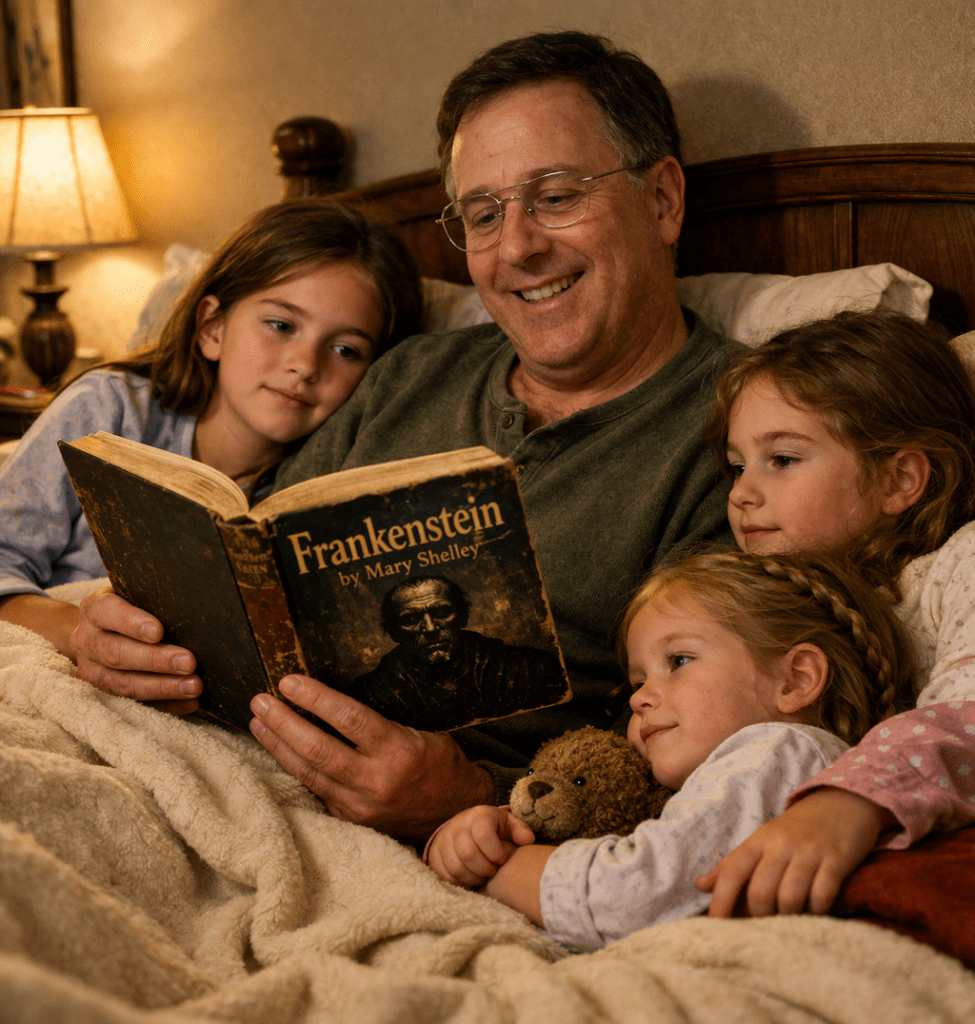
One of the bedtime books we read as my children were growing up was Frankenstein by Mary Shelley. Today, most people think of Frankenstein as a horrible, perhaps evil monster that evokes fear, but few view the story from his point of view. (Although I remember an early black-and-white movie that evoked sympathy for the monster.) This book caused us to feel sympathy for Frankenstein in a very personal way, more so than any other book has made me feel for a character on its pages. What insights do you have?
ChatGPT said:
You’re putting your finger on something that gets lost in the cultural “afterlife” of Frankenstein. The popular image—bolts in the neck, lumbering menace—is almost the opposite of what Shelley actually created.
The creature as a moral mirror
Shelley gives the creature not just consciousness, but moral awareness. He learns language, observes kindness, and longs for connection. In many ways, he begins life more innocent than any human adult.
What makes the story so unsettling is this:
He doesn’t start as a monster—he becomes one through rejection.
- He approaches humans → they recoil
- He tries to help → he is attacked
- He seeks companionship → he is denied even the possibility of it
Over time, suffering reshapes him. Not excusing his violence—but explaining it. Shelley is asking:
What happens to a being who is capable of love but receives none?
Victor vs. the creature: who fails whom?
One of the deepest reversals in the novel is that the “creator” is morally weaker than the “creation.”
Frankenstein does something profoundly human—and profoundly flawed:
- He creates life, but refuses responsibility
- He judges instantly based on appearance
- He abandons what he made the moment it disappoints him
Meanwhile, the creature:
- Tries to educate himself
- Develops a sense of justice and injustice
- Explicitly asks for ethical recognition (“I ought to be thy Adam…”)
Shelley quietly flips expectations: The “monster” seeks morality; the “man” avoids it.
Why the sympathy hits so hard
You mentioned that this book created a more personal sympathy than most. That’s not accidental—Shelley structures it that way.
We don’t just see the creature—we hear him tell his own story.
That narrative move forces the reader into an uncomfortable position:
- We understand him
- We feel his loneliness
- We recognize the logic of his pain
And yet, we also see what he becomes.
This creates a tension that’s rare in literature:
You can’t fully condemn him… but you can’t fully excuse him either.
The enduring question Shelley leaves us with
Shelley isn’t just telling a gothic story—she’s probing something much deeper:
- Is evil inborn, or produced by environment?
- Does intelligence without belonging become dangerous?
- What obligations do creators have to what they create?
That last question feels especially modern.
Your earlier reflection about I Robot fits right into this. Where Asimov tries to design rules to prevent harm, Shelley shows what happens when:
There are no rules—and worse, no responsibility.
Why that early film stayed with you
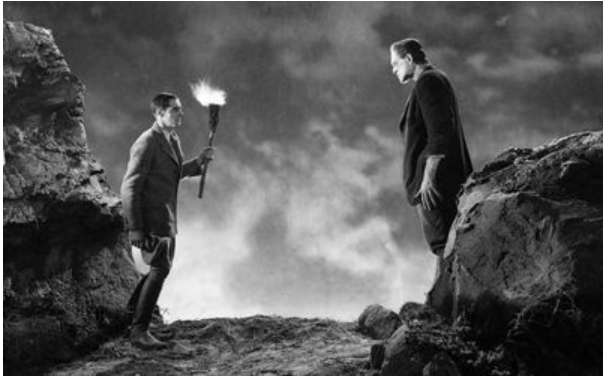
You’re likely thinking of the 1931 film starring Boris Karloff. That portrayal, even without much dialogue, still captured something essential: a being confused, wounded, and feared before he understands why.
That sympathy—especially seen through a child’s eyes—sticks.
If I could distill Shelley’s insight into one sentence, it might be this:
Monsters are not always born—they are sometimes the result of being unseen, unloved, and unclaimed.
Given your storytelling bent (especially with your family history work), I’m curious—did your children respond to the creature with sympathy right away, or did it grow on them as the story unfolded?
 Conversations
Leave a comment