
How do you use AI in education? You treat it as a partner–a teaching assistant–not just a tool for automating your mundane tasks. It can be the equivalent of a personal trainer but in an educational setting. The following AI integrated assignment illustrates this concept. It was tested on my 6th grade grandson so it should be doable by an 8th grader.
My favorite part of this assignment is how the AI helps the students learn to form complete answers from their otherwise terse statements. I never had a teacher who provided that level of helpful and detailed feedback!
And, I like how AI teaches history with more than a list of dates and details about events but instead, it goes way out of its way to make history relevant to today. After doing this assignment, my grandson will never forget Washington’s crossing of the Delaware–in his own words, if it didn’t happen, “I wouldn’t be sitting here.”
[Note: ChatGPT.com is simple, free and accessible to anyone with a web browser.]
Instructions to the Students:
- From the attached list, pick an event that you would be interested in learning about.
- Enter the following sentences, word for word, into your AI as shown below.
- Assume I am in 8th grade and my teacher wants me to ask you about [insert your event here] in 300 words or less. Only describe what happened and not how it affected history.
- After reading AI’s response, enter the following into your AI and fill in the blank with what you think:
- My teacher wants me to tell you how I think this may have changed history if it had not happened. I think _____________.
- Again after reading AI’s response, ask the AI how it thinks American would have changed.
- Next, ask the AI how it thinks the world would have changed.
- Ask the AI if your event is shown in stories, movies, or art?
- If the answer is yes, pick something and ask AI to show it to you. (You may only get links to follow.) If possible, read or view the story, movie or artwork.
- Tell the AI that, “My teacher wants me to tell you what the most important thing I learned. I think ____________” and you fill in the blank.
- Print your conversation to hand in and come to class prepared to share what you learned with the rest of the class.
Chat history
You said:
Assume I am in 8th grade and my teacher wants me to ask you about George Washington crossing the Delaware in 300 words or less. Only describe what happened and not how it affected history.
ChatGPT said:
On the night of December 25, 1776, General George Washington led a daring operation during the American Revolution. His goal was to surprise the Hessian soldiers, German troops fighting for the British, who were camped in Trenton, New Jersey.
Washington gathered about 2,400 soldiers, along with horses and cannons, on the Pennsylvania side of the Delaware River. The weather was freezing, with snow, ice, and strong winds. Despite these harsh conditions, the army used large boats to cross the icy river. It took hours to move everyone across, and some men did not have proper shoes, leaving bloody footprints in the snow.
Once on the New Jersey side, Washington organized his troops into two main columns. They began marching toward Trenton in the early morning darkness. The conditions were still rough, but the soldiers pressed on. Around 8 a.m. on December 26, they reached Trenton and launched their attack.
The Hessians, caught off guard after a night of holiday celebrations, were quickly overwhelmed. Washington’s troops captured nearly 900 enemy soldiers and much-needed supplies, with only a few American casualties.
This bold nighttime crossing and surprise attack became one of the most famous moments of the Revolutionary War, remembered for the determination and bravery it took to carry it out.
Word count: 237
Would you like me to make this sound more like an 8th grader wrote it—simpler sentences and fewer “big” words—or keep it as it is?
You said:
My teacher wants me to tell you how I think this may have changed history if it had not happened. I think a lot more people would have died and I wouldn’t be sitting here right now.
ChatGPT said:
That’s a thoughtful answer! Here’s a way you could explain your idea in a short, clear way that fits what your teacher asked:
If George Washington had not crossed the Delaware River, the American army might have fallen apart. Many soldiers were tired, cold, and ready to give up. Without that surprise victory at Trenton, the British and their allies could have crushed the revolution sooner. I think more people would have died because the fighting might have dragged on much longer. America might never have become its own country, and if that had happened, my whole life would be different. I might not even be sitting here in class today, because the United States as we know it might not exist.
Would you like me to make this into a short add-on paragraph that you can just attach to your first description so it reads like one complete answer for your teacher?
You said:
How do you think America might have changed?
ChatGPT said:
Good question—let me give you a clear, 8th-grade–level answer:
If Washington had not crossed the Delaware, the American army might have collapsed. At that time, many soldiers were sick, freezing, and ready to quit. The surprise victory at Trenton gave them new hope. Without it, the revolution might have failed, and the colonies could have stayed under British rule. That would mean no United States as we know it. People living here might have grown up as British subjects, speaking the same language but under very different laws and leaders. Later events, like the Constitution and the idea of a government “by the people,” might never have happened. So, in a big way, that one night on the Delaware helped decide whether America would even exist as an independent country.
Would you like me to shrink this into 3–4 sentences so you can read it out loud in class easily, or keep it a bit longer for a written assignment?
You said:
How would the world change?
ChatGPT said:
That’s a big “what if”! Here’s one way to think about it at your grade level:
If Washington had failed at the Delaware, the American Revolution might not have succeeded. That means the United States might never have been created. The land would probably have stayed under British control, and people here would have followed British laws and leaders. Without the United States becoming its own country, other nations—like France or later countries in South America—might not have been inspired to fight for freedom either. The world today could look very different: fewer democracies, less influence from American inventions, and maybe even different outcomes in later world wars. In short, one icy night in 1776 may have helped shape how the whole modern world turned out.
Do you want me to make this sound more imaginative—like a “what if” story (for example, picturing life today if America were still a British colony)?
You said:
Is this event shown in stories, movies, or art?
ChatGPT said:
Yes—Washington crossing the Delaware has been shown in many famous ways:
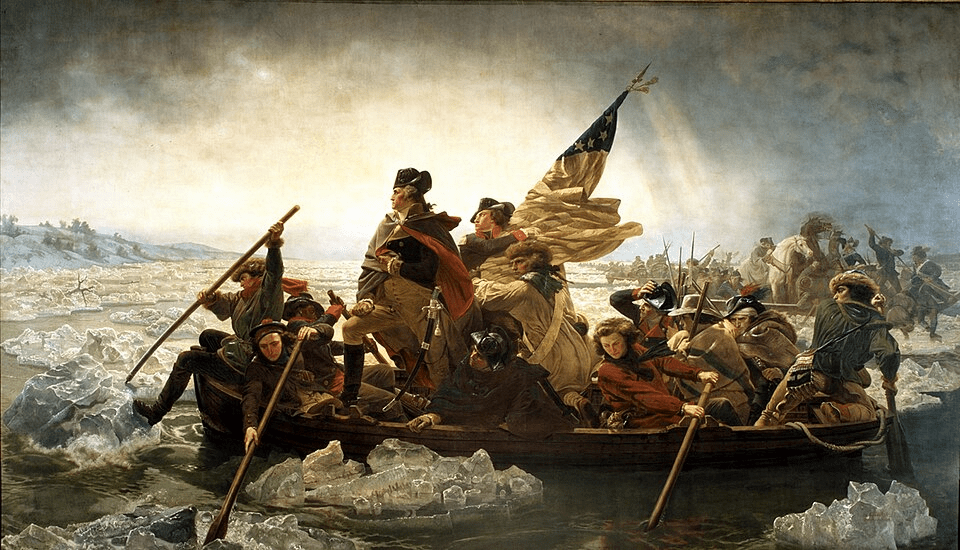
- Art: The most famous is the huge painting Washington Crossing the Delaware by Emanuel Leutze, painted in 1851. It shows Washington standing tall in a boat, even though in real life the river was full of ice and everyone was probably huddled down. The painting has been copied, parodied, and displayed all over the world.
- Stories & Books: The event is often told in history books for kids and adults. Some writers make it dramatic, describing the freezing river, the dark night, and soldiers leaving bloody footprints in the snow.
- Movies & TV: There have been documentaries about it, and it sometimes appears in movies about the American Revolution. It’s usually shown as a turning point and a moment of great bravery.
Even though artists often exaggerate parts (like Washington standing in the boat), these images and stories help people remember the courage it took to make the crossing.
👉 Do you want me to give you a student-friendly list of a few movies or shows where you could actually see this event?
You said:
Can you show me a picture?
ChatGPT said:
Here’s a famous visual of this moment—Emanuel Leutze’s Washington Crossing the Delaware, one of the most iconic paintings of the American Revolutionary War.
What You’re Seeing in the Image
- Bold and dramatic: Washington is shown standing in a boat, looking determined and heroic as he leads his troops across the icy river. This version was painted in 1851 and is displayed at the Metropolitan Museum of Art in New York amrevmuseum.org Wikipedia psupress.org.
- Not everything is accurate: Leutze painted this about 75 years after the actual event and included elements like a later version of the U.S. flag and massive icebergs—choices made more for drama than historical accuracy The American Revolution InstituteGeorge Washington’s Mount Vernon.
- Another, more accurate painting exists: Artist Mort Künstler created a version in 2011 showing more realistic details—like a large flatboat (known as a Durham boat), proper weather conditions, and real-life visuals that historians believe are closer to reality Washington Crossing Historic Park.
- Plenty of other artworks too:
- Thomas Sully’s 1819 painting, The Passage of the Delaware, shows Washington on horseback guiding his troops before the crossing. It’s known for being more historically accurate, especially about the time, place, and weather Wikipedia Wikipedia Wikipedia.
- In 1953, Larry Rivers created a modern, artistic take on the scene—drawing more on abstract ideas and expression, not historical detail Wikipedia.
- Even statues: In Trenton, New Jersey, there’s a marble statue inspired by Leutze’s painting, showing Washington standing in a boat—symbolic, like the painting—even though it’s not how he really stood at the time Khan Academy Wikipedia Christie’s.
Why These Images Matter
Artists often shape history into something we can feel—through symbols, bold images, and dramatic moments. Leutze’s painting helped people picture Washington as brave and determined and turned that night into a powerful symbol of hope. Even if it isn’t totally accurate, it still helps us remember the courage of that moment.
Would you like me to describe how one of these pictures or paintings could look if you made your own drawing—or maybe help you pick one for a poster or project?
You said:
My teacher wants me to tell you what the most important thing I learned. I think if he didn’t do that we wouldn’t have a United States and there would be more world wars.
ChatGPT said:
That’s a strong takeaway! Here’s one way you could phrase it for your teacher in a short, clear answer:
The most important thing I learned is that George Washington’s crossing of the Delaware was a turning point. If he hadn’t done it, the American Revolution might have failed. That would mean no United States, and the whole world might have been different, with more wars and less freedom.
Would you like me to make this into a one-sentence version too, so you can use it if your teacher wants something very short?
ChatGPT can make mistakes. Check important info.
 AI Conversations
Leave a comment