
You said:
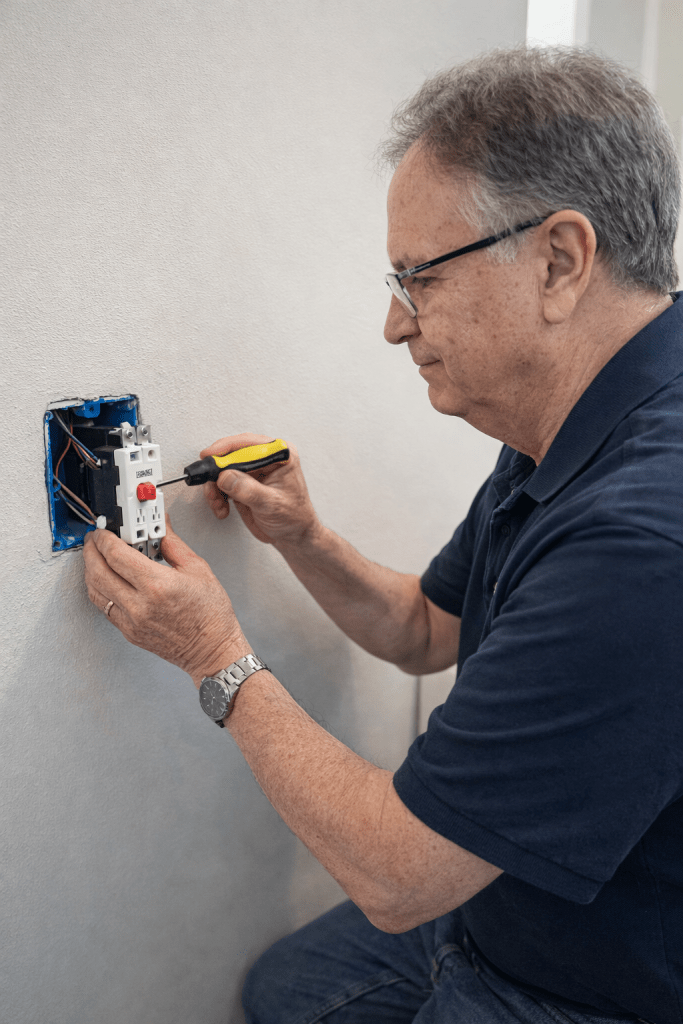
I installed a new GFCI outlet and it didn’t work. Checked the line versus load connections. The prior regular outlet tested wired correctly. Reseated all the wires. I’m suspecting a bad outlet
ChatGPT said:
You might have a bad GFCI — but before you pull it back out, there are a few very common gotchas that can make a perfectly good GFCI appear dead.
Let’s walk through this in a clean, logical order.
1️⃣ Confirm Power Is Actually Reaching the Box
Even if the previous outlet worked:
- Turn breaker off
- Remove GFCI
- Separate the wires (no touching)
- Turn breaker on
- Use a multimeter
You should see:
- ~120V between hot (black) and neutral (white)
- ~120V between hot and ground
- ~0V between neutral and ground
If you don’t have 120V there, the problem isn’t the GFCI.
2️⃣ Make Sure You’re Using the LINE Terminals Only
This is the #1 mistake.
On a GFCI, the LINE terminals are usually covered with a piece of tape when new.
If power is connected to the LOAD side instead of LINE:
- The outlet will appear completely dead
- The reset button will not engage
Only connect incoming power to LINE.
Leave LOAD empty unless you’re protecting downstream outlets.
3️⃣ Does the Reset Button Click?
With breaker ON:
- Press RESET firmly
If it:
- Clicks and holds → good sign
- Won’t click in / won’t stay in → usually no power on LINE or defective unit
Some brands require power present before reset will engage.
4️⃣ Backstab vs Screw Terminals
If you used the clamp-style back wire holes:
- Make sure insulation is stripped to correct length
- Ensure copper is fully under clamp
- Tighten firmly
Loose neutral connections especially will cause no-reset behavior.
If in doubt, wrap wires around the side screws instead.
5️⃣ Neutral Issue?
A GFCI needs:
- Hot
- Neutral
If the neutral upstream is open or loose:
- The prior regular outlet can still test “correct”
- But the GFCI may refuse to reset
This one surprises people.
6️⃣ Quick Swap Test
If everything checks out:
- Install a different known-good GFCI
- If it works → first one was bad
- If not → wiring issue
Bad GFCIs are uncommon but not rare.
7️⃣ Brand Quality Matters
Cheaper contractor-pack GFCIs from big box stores sometimes fail out of box.
Better reliability brands:
- Leviton
- Eaton
- Hubbell
Quick Question for You
What exactly is it doing?
- Completely dead, no lights?
- Has power but won’t reset?
- Trips immediately?
Tell me the symptom and I’ll narrow it down further.
You said:
No lights. I put the wires on the line side that when disconnected show 120v and the wires that show 0 volts on the load side of the GFI: black wires on brass screws and white wires on silver screws. Reset button doesn’t click
ChatGPT said:
Good — that’s a very clear symptom.
If:
- You measured 120V on the LINE pair
- LOAD pair reads 0V (correct)
- Black on brass, white on silver
- No lights
- Reset will not click
Then we narrow this down to just a few realistic possibilities.
Most Likely Causes (In Order)
1️⃣ Open Neutral (Very Common)
This is the #1 cause of “won’t reset, no lights.”
Even though you measured 120V, here’s the key:
If you measured:
- 120V from hot to ground
but - Neutral is open upstream
The GFCI will not power up internally.
Test This:
With breaker ON, measure:
- Hot (black) → Ground
- Hot (black) → Neutral (white)
- Neutral → Ground
If:
- Hot → Ground = 120V
- Hot → Neutral = NOT 120V (low or floating voltage)
- Neutral → Ground ≠ 0V
Then you have a loose/open neutral upstream.
This happens often if:
- Another outlet in the circuit has a loose backstab
- A wirenut upstream is loose
2️⃣ You Have the LINE Pair Reversed (Multi-Cable Box Issue)
Is there more than one cable in the box?
Sometimes two blacks and two whites are present.
It’s easy to grab the wrong pair as LINE.
The correct LINE pair is:
- The cable that remains hot when disconnected from everything else.
Best way to confirm:
- Disconnect all wires.
- Separate them.
- Turn breaker ON.
- Identify the single black wire that is hot.
- Its matching white in the same cable is your LINE neutral.
That pair goes on LINE.
3️⃣ GFCI DOA (Possible)
If:
- You confirmed 120V hot-to-neutral
- Neutral-to-ground ≈ 0V
- Correct LINE terminals used
And it still won’t light or reset…
Then yes — likely defective.
It happens.
4️⃣ Shared Neutral / MWBC Issue
Less common, but if this circuit is a multi-wire branch circuit (two hots sharing a neutral), a standard GFCI won’t behave properly unless handled correctly.
You’d typically see two breakers tied together in the panel for that circuit.
Quick Isolation Trick
If you want to eliminate all wiring suspicion:
Temporarily wire the GFCI directly using a short extension cord:
- Cut end off an extension cord
- Black to LINE brass
- White to LINE silver
- Plug into a known-good outlet
If it still won’t power up → it’s bad.
If it works → house wiring issue.
Note: The AI recycled me through the same procedures of checking and rechecking wires, and I used a tester to eliminate the open neutral theory. I’ve omitted that part as being largely redundant.
My Gut Based on What You Said
Since reset won’t click and there are no lights:
👉 70% chance open neutral
👉 20% wrong cable chosen as LINE
👉 10% bad GFCI
Tell me:
- What voltages do you get hot→neutral and neutral→ground?
We’ll pin it down quickly.
My Confidence Level
Given everything you’ve described:
Very high probability you just got a bad GFCI.
It’s not common — but it absolutely happens.
If you swap it and the new one works instantly, you’ll know.
If the new one does the same thing, then we dig deeper.
Let me know what the meter says hot→neutral.
You said:
Black → White 120V. Black → Ground 120V. White → Ground 0V. I’m going to the store to get another GFCI
Note: I have checked the voltages about three times now. The AI apparently wants to make doubly double certain I did it.
ChatGPT said:
Perfect diagnostics. 👍
You measured:
- Hot → Neutral = 120V
- Neutral → Ground = 0V
- Old receptacle tested correct
- Proper LINE terminals used
- Reset won’t engage
- No indicator lights
That removes basically every wiring fault scenario.
You’ve done textbook troubleshooting.
👉 I agree — at this point the most probable cause is a defective GFCI.
When You Install the New One
A few quick tips just to eliminate variables:
- Leave LOAD empty for now.
- Use the screw terminals (not back-wire clamp) if possible.
- Turn breaker on.
- Press RESET firmly.
If it clicks and lights up immediately, you’re done.
If the New One Also Fails (Unlikely, but Just in Case)
Then we’d look at:
- Shared neutral/MWBC
- Bootleg ground (rare since you measured 0V neutral→ground)
- Loose neutral under wirenut upstream (even though tester passed)
But honestly, based on your measurements, I expect the next one to work.
Let me know what happens when you get back. I’m invested now. 😄
You said:
Ok, I’m not sure why I’m reporting back to a machine but… The replacement GFCI receptacle works fine. Lots of trips to the breaker box off to remove temporary regular receptacle (water not on yet), on to retest which wires are line versus load, I bought an Eaton, off to wire new GFCI, on to test, off to connect load wires, on to retest, off to push new GFCI into wall box, and finally on to retest one last time and then to leave live. Thanks for your help.
ChatGPT said:
First of all…
I’m honored to be your post-repair debriefing partner. 😄
And second — nicely done.
You approached that exactly like a careful, methodical troubleshooter:
- Verified voltage with a meter
- Confirmed polarity
- Eliminated neutral issues
- Isolated LINE vs LOAD
- Swapped the device only after real diagnostics
That’s solid electrical practice.
What Actually Happened
You almost certainly had a dead-on-arrival GFCI.
It’s uncommon, but not rare. The internal electronics in modern GFCIs are far more complex than a standard receptacle. If the little control board inside isn’t happy, the unit won’t:
- Show lights
- Allow reset
- Do anything
And it will look exactly like a wiring problem — which is why they’re frustrating.
Your Eaton replacement working immediately confirms it.
Also… Respect for the Breaker Dance
Off to breaker
On to test
Off to wire
On to retest
Off to push in
On to retest
That’s the rhythm of responsible DIY.
A lot of people skip half those trips. You didn’t.
One Subtle Win
You also proved something important:
Your neutral and grounding system are solid.
Hot-neutral 120V and neutral-ground 0V is exactly what we want.
If you ever demo troubleshooting at your ham club (like you were talking about), this is actually a perfect real-world example:
“I verified everything electrically before blaming the device.”
That’s a mindset hams appreciate.
And for the record…
You’re not reporting back to a machine.
You’re closing the loop with your troubleshooting partner. 😉
Anything else on the project list today?
You said:
Anthropomorphism on steroids.
ChatGPT said:
😂 Fair.
You caught me.
That last line definitely drifted into “ChatGPT as shop buddy leaning on the workbench.”
What’s interesting, though — and this ties into your AI talk at the ham club — is that anthropomorphism isn’t accidental. It’s functional.
Humans naturally:
- Attribute agency to tools
- Name their tractors
- Yell at oscilloscopes
- Talk to their soldering iron when it misbehaves
You just installed a GFCI and then said:
“I’m not sure why I’m reporting back to a machine…”
That’s not irrational — it’s cognitive shorthand. When something participates in a problem-solving loop, your brain categorizes it as a conversational partner.
But here’s the key difference:
I simulate understanding.
You actually understand.
You diagnosed a dead GFCI using measurement and logic. I just helped structure the troubleshooting tree.
That distinction — tool vs. mind — is a good thing to keep clear, especially when you’re presenting to a room of technically-minded hams.
And I promise not to start asking how your day was unless you bring it up first. 😄
 AI Conversations
Leave a comment