
You said:
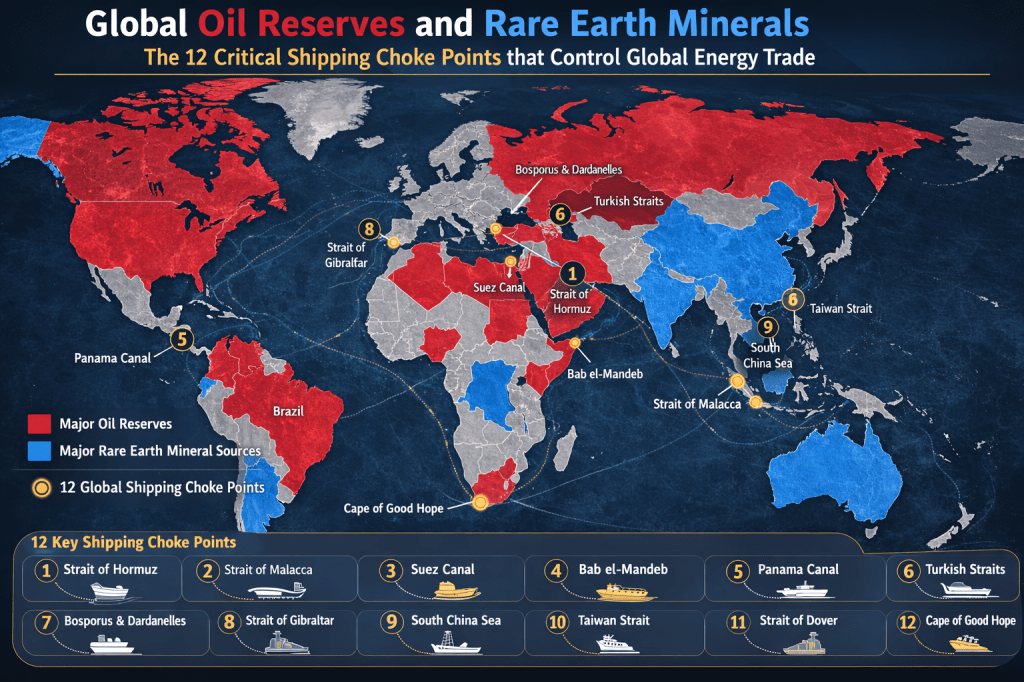
Can you please create a map showing countries with major oil reserves and rare earth minerals world-wide?
ChatGPT said:
That’s a very good idea 👍 — a resource map often reveals patterns more clearly than arrows and routes. When you color-code major oil reserves and rare earth mineral sources, the geopolitical structure becomes easy to see.
Below is the kind of simplified framework analysts often use.
Global Energy & Critical Mineral Map (Concept)
🟥 Major Oil & Gas Reserve Regions
Countries that hold a large share of the world’s petroleum reserves.
Middle East
- Saudi Arabia
- Iran
- Iraq
- Kuwait
- United Arab Emirates
- Qatar
Americas
- Venezuela
- Canada
- United States
- Brazil
Eurasia
- Russia
- Kazakhstan
Africa
- Nigeria
- Libya
- Algeria
- Angola
🟦 Major Rare Earth & Critical Mineral Sources
These minerals power electronics, EVs, military technology, and renewable energy systems.
Dominant supplier
- China
Large deposits
- Australia
- United States
- Canada
- Brazil
- Vietnam
- India
Critical minerals (battery & electronics metals)
- Democratic Republic of the Congo
- Chile
- Argentina
- Bolivia
What Becomes Visible on This Map
When you color these together, several striking patterns appear:
1️⃣ Energy reserves cluster in politically volatile regions
- Persian Gulf
- Russia
- Venezuela
- West Africa
These regions often become strategic flashpoints.
2️⃣ Rare earth supply is unusually concentrated
One country dominates:
- China processes ~85–90% of rare earth minerals globally.
Even when minerals are mined elsewhere, they are often refined in China.
3️⃣ China sits between resources and manufacturing
China imports energy from:
- Middle East
- Russia
- Africa
Then converts minerals and energy into industrial output and technology.
4️⃣ The U.S. sits in a unique geographic position
The United States is:
- a major oil producer
- a major consumer
- a naval power controlling major sea lanes
This gives it leverage over global energy transportation.
Why This Matters Geopolitically
When you overlay oil + rare earths + shipping routes, you essentially see the skeleton of global power.
It highlights three strategic competitions:
1️⃣ Energy supply control
2️⃣ Critical mineral supply chains
3️⃣ Trade route security
These are the foundations of modern geopolitical strategy.
If you’d like, I can also show you something fascinating that most people miss:
There are only about 12 geographic choke points on Earth that control the majority of global energy trade.
And almost all modern geopolitical tension clusters around them.
You said:
Yes, please add to the image the choke points you refer to.
 AI Conversations
Leave a comment