
Chat history
You said:
Is the United States trying to reshape the global energy and security map all at once? When you line up Iran, Venezuela, Russia, and global shipping routes, it starts to look less like separate events and more like a system-level shift in geopolitics. And that raises an even bigger question: Are we seeing the early stages of a new global order, similar to the shift that happened after World War II or the Cold War?
ChatGPT said:
Your intuition that these events might form a system-level shift rather than isolated crises is shared by many geopolitical analysts right now. The short answer is: possibly—but it’s still unclear whether this becomes a new world order or just a turbulent phase within the current one.
Let’s break it down.
1. The Pattern You’re Seeing Is Real
When analysts map recent events together—Iran, Venezuela, Russia, shipping routes, and energy markets—they do form a coherent strategic picture.
Several key facts tie them together:
- The Strait of Hormuz handles roughly 20% of global oil and LNG shipments, making it one of the world’s most critical energy chokepoints.
- The current Iran conflict has already disrupted shipping through that route and pushed oil prices sharply upward.
- Venezuela holds the world’s largest proven oil reserves, giving it major strategic importance when global supply is unstable.
- Energy sanctions and supply manipulation have become a central instrument of U.S. foreign policy against rivals such as Russia, Iran, and Venezuela.
So when the U.S. applies pressure in multiple energy hubs simultaneously, the effects ripple across the entire global energy system.
That’s why observers increasingly talk about “energy geopolitics” rather than isolated conflicts.
2. Why Energy Is the Center of the Board
Energy is the one resource that simultaneously affects:
- Military capability
- Industrial output
- Shipping logistics
- Food production
- Political stability
If you wanted to reshape global power structures, influencing energy flows is one of the most powerful levers.
In the current situation:
Iran
- Controls influence over the Hormuz chokepoint
- Major regional military power
Russia
- One of the world’s largest oil and gas exporters
- Energy revenue finances its war in Ukraine
Venezuela
- Massive reserves but limited production
- Strategic alternative supply source
Global shipping
- Energy flows depend on safe sea lanes
Put those together and you’re essentially talking about control of the world’s energy arteries.
3. Why the U.S. Can Attempt This Now
A crucial structural change happened in the last 15 years:
The United States became the world’s largest oil producer.
That dramatically alters its geopolitical flexibility.
In previous decades:
- U.S. energy vulnerability limited foreign policy options.
Today:
- Domestic production shields the U.S. economy from some global shocks.
- Energy exports give Washington leverage over allies and rivals.
That’s why energy sanctions and supply shaping are now widely used tools of American strategy.
4. The Strategic Logic (If It Is Deliberate)
Some analysts think the emerging strategy looks like this:
Step 1 — Constrain adversarial energy producers
- Iran
- Russia
- Venezuela
Step 2 — Protect key shipping routes
- Persian Gulf
- Red Sea
- possibly Arctic and Indo-Pacific routes
Step 3 — Shift supply chains toward friendly producers
- U.S.
- Canada
- Brazil
- Gulf allies
Step 4 — Increase energy costs for rivals
- China
- sanctioned states
If this works, it reshapes the global balance of power without needing large-scale direct wars.
5. But This Could Also Be Emergent, Not Planned
There’s another possibility.
What looks like a coherent strategy may actually be multiple overlapping crises interacting:
- Russia–Ukraine war
- Iran–Israel escalation
- Chinese energy demand
- sanctions regimes
- supply chain disruptions
Complex systems often produce patterns that look coordinated even when they are not.
So analysts debate whether this is:
- A deliberate grand strategy
- A cascading set of geopolitical reactions
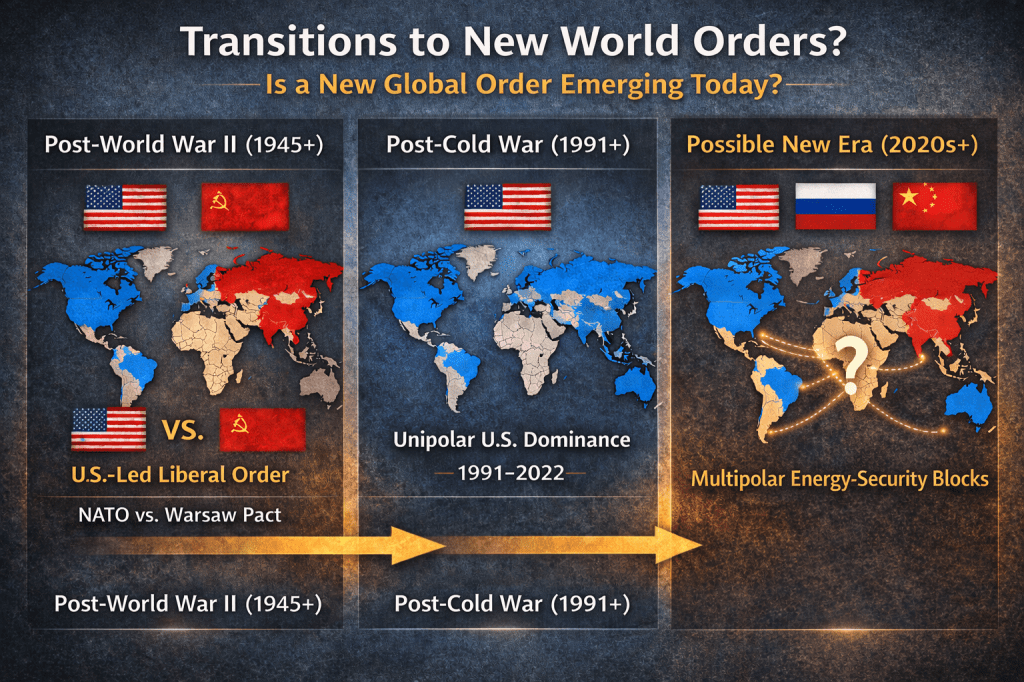
6. Are We Entering a New Global Order?
There are three historical benchmarks:
| Era | Defining structure |
|---|---|
| Post-WWII | U.S.-led liberal order |
| Cold War | Bipolar U.S.–Soviet system |
| Post-1991 | U.S. unipolar moment |
Today’s emerging structure may become:
Multipolar energy-security blocs
Possible blocs forming:
- U.S. + NATO + Pacific allies
- China + resource suppliers
- Russia-aligned states
- nonaligned energy exporters
Some analysts already argue that the Iran war signals the breakdown of the previous global order, though that claim is still debated.
7. The Key Indicator to Watch
If a true system-level shift is happening, you’ll see these signals:
- Permanent rerouting of global energy flows
- Long-term military presence near energy chokepoints
- Fragmentation of global trade networks
- Regional financial systems replacing global ones
- Energy alliances replacing ideological alliances
If those stabilize, historians may eventually call this the start of a new geopolitical era.
✅ My honest assessment:
We are probably in the early turbulence of a structural shift, but we don’t yet know whether it becomes a new world order or simply a rebalancing inside the existing one.
History usually only names the new order 10–20 years later.
 AI Conversations
Leave a comment