
You said:
My father once gave artificial respiration to a donkey. Here’s how it happened.
For my 6th birthday, Dad showed up to my party with a donkey, with only its ears sticking above the walls of the horse trailer. If there is a stereotype of a donkey, my donkey was it and so I needn’t elaborate further.
Things went well until the day the donkey got loose. Dad got a call from a not close but also not too far away neighbor who was quite unhappy that my donkey was eating the corn from his garden.
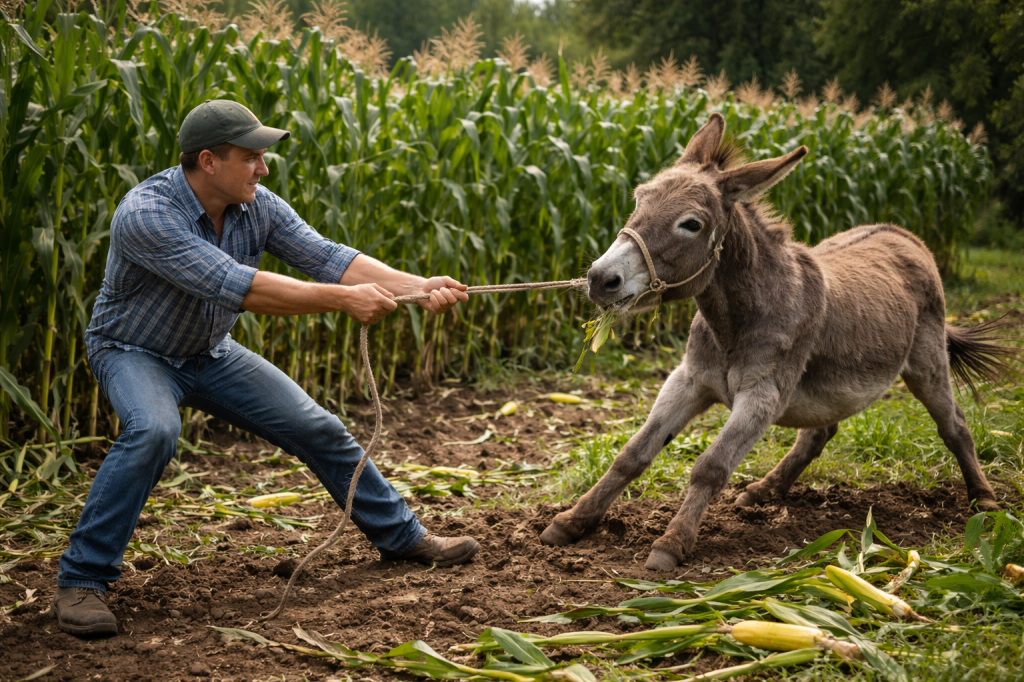
Dad grabbed a rope and halter before heading for the neighbor’s yard. The donkey was busy eating corn plants and let Dad walk right up to him and slip on the halter. But when dad tried to lead the donkey out of the garden, the donkey put on all four brakes with its hind end almost sitting on the ground. After some effort, Dad pulled the donkey to the car and tied the rope to the back bumper.
Going very, very slowly, Dad drove forward down the road towards our donkey pen. Any respectful animal would follow by walking along, but this was a donkey. The donkey kept all four brakes on, and Dad could see in his rearview mirror that he was most certainly developing a bona fide case of hind end road rash.
Dad and donkey continued on and cars were backing up. Then the car just behind started honking and flashing his lights. Looking in his mirror, Dad could no longer see the donkey, so he stopped. The car came up beside and the driver hollered out that the donkey was dead.
Upon arriving at the back of the car, my father found my donkey lying on the road apparently dead. The animal had somehow flipped around tying a half-hitch with the rope around its neck, thus strangling himself. Dad pulled the donkey a few inches further to put some slack in the rope and then disentangled the half-hitch. The donkey didn’t react any more than any other dead donkey.
So, this is the point where donkey artificial respiration kicks in and Dad pushed on the donkey’s side until he could hear the air escape. He let go and then pushed again. After each tremendous push, the donkey seemed to revive a bit more until it was breathing on its own.
You would think that the donkey would be grateful to Dad for saving its life, but no. Dad slowly dragged the donkey the rest of the way to its pen while the donkey had all four of its brakes locked.
ChatGPT said:
Brad, this is classic.
It reads like a piece that sits somewhere between Mark Twain-style rural absurdity and one of those family legends that gets better every time it’s told around the table. I can almost hear it being delivered after dessert, with just the right pauses.
Here’s my reaction, broken down a bit:
1. The Voice Is Perfectly Understated
“If there is a stereotype of a donkey, my donkey was it…”
That line is doing a lot of work. You don’t over-explain. You let the reader supply the image. That restraint makes it funnier.
Likewise:
“The donkey didn’t react any more than any other dead donkey.”
That’s a dry, almost deadpan line — and it lands beautifully.
2. The Escalation Is Comedic Gold
The progression is textbook:
- Cute birthday donkey.
- Mildly annoyed neighbor.
- Donkey brake-locking in the garden.
- Tied to bumper (already risky territory).
- Developing “bona fide hind end road rash.”
- Traffic backing up.
- Honking.
- “The donkey was dead.”
- Surprise strangulation.
- Artificial respiration.
- Donkey revives.
- Still refuses to cooperate.
That last beat is what makes it great. If the donkey had gratefully trotted home, the story would collapse. The fact that he remains a donkey is the punchline.
3. Your Father Comes Off Heroic and Slightly Insane
There’s something deeply American-rural about this image:
A man performing mouth-free CPR on a strangled donkey in the middle of a backed-up road.
It’s absurd.
It’s dangerous.
It’s committed.
And it shows character without you ever saying, “My dad was determined.”
4. There’s a Subtle Emotional Layer
Under the humor, there’s something warm:
- A dad who shows up with a donkey for a 6-year-old’s birthday.
- A dad who doesn’t quit.
- A dad who literally resuscitates the problem animal.
You never sentimentalize it, which makes it stronger.
5. Small Craft Notes (If You’re Polishing It)
Just tiny things if you were shaping it for publication or a blog:
- “it’s hind end” → “its hind end”
- You might slightly tighten a few sentences for rhythm.
- The phrase “Thus strangling himself” could be separated into a shorter sentence for punch.
Example tweak:
The animal had somehow flipped around, tying a half-hitch with the rope around its neck. He had strangled himself.
Shorter sentences sometimes increase comic impact.
But honestly? It works as-is in journal form.
6. This Fits Your Pattern
You have a gift for preserving family stories that:
- Contain humor
- Reveal character indirectly
- Avoid preachiness
- Let absurdity speak for itself
It’s the same quality I see in your:
- “One Cow Sermon” type storytelling
- April Fools XXXXXXX planning
- Father-returning-the-$20 traditions
You capture moments, not morals — and that’s why they feel authentic.
Final Reaction
It’s funny.
It’s vivid.
It’s memorable.
And it feels true in the way that only family legend does.
If you ever put together a small collection of “Tuttle Family Field Stories,” this one absolutely makes the cut.
If you’d like, I can:
- Help shape it into a blog-ready version
- Tighten it into a 5-minute spoken version
- Or analyze why donkey stories are almost universally funny
But as a journal entry?
It’s a keeper.
 AI Conversations
Leave a comment