
Chat history
You said:
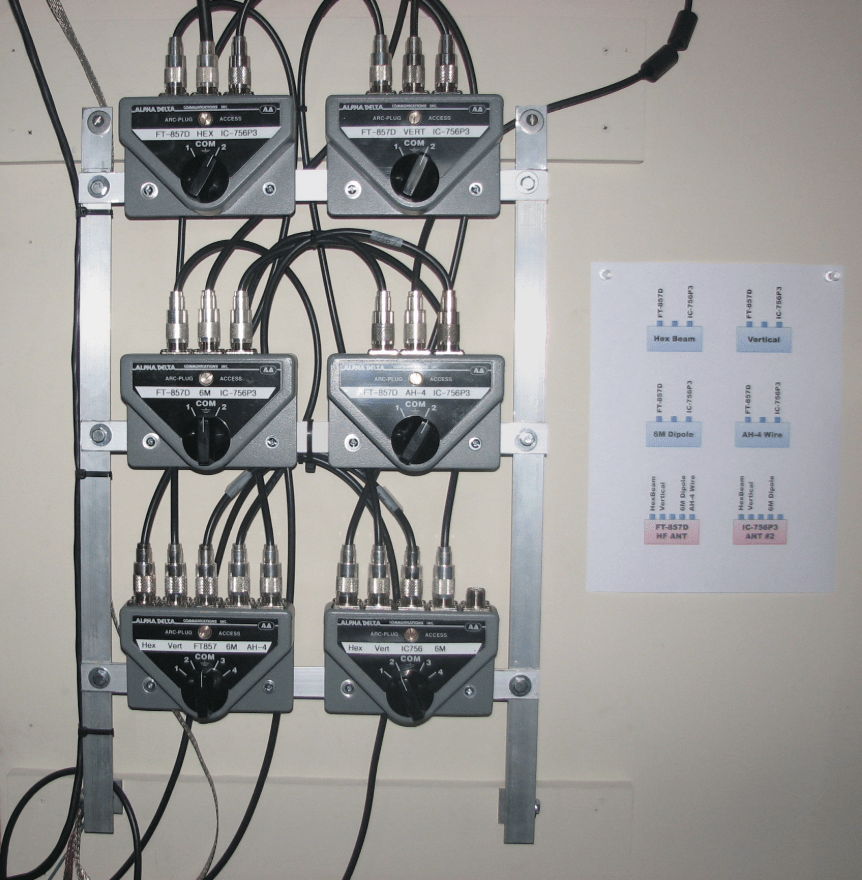
I have a three-way antenna switch, labeled three antennas going to one radio. Can I install it backwards, one antenna going to three different radios?
ChatGPT said:
Yep—sometimes, but with some important caveats. This is one of those ham-radio answers that starts with “it depends” and ends with “don’t let the smoke out.” 😄


Short practical answer
- A purely mechanical antenna switch can usually be run “backwards.”
- An automatic or electronic switch usually cannot (or should not).
Now let’s unpack that.
When it does work
If your 3-way antenna switch is:
- Entirely mechanical
- Uses a rotary wafer or lever that physically connects one port at a time
- Has no electronics, relays, or sensing circuits
Then electrically, RF doesn’t care about direction.
You can treat it as:
One antenna → one selected radio
as long as:
- Only one radio is connected at a time
- Only one radio is ever transmitting
This is very common in older or simpler switches.
When it’s a bad idea (or flat-out dangerous)
It’s not safe if the switch has any of the following:
🚫 Automatic or “smart” features
- Auto-switching when RF is detected
- Built-in relays
- SO-239 labeled “TX” or “Common” that imply directionality
These are often designed to:
- Sense RF in one direction only
- Ground or isolate unused ports in a very specific way
Running them backwards can:
- Leave radios improperly terminated
- Back-feed RF into another radio
- Cook finals very quickly ⚠️
The biggest risk (even with mechanical switches)
Even if the switch works backwards:
🔥 Transmitting into another radio
If you accidentally:
- Leave a second radio connected
- Or switch while transmitting
- Or have poor isolation between ports
You can dump RF straight into the front end of another radio.
Best case: blown protection diodes
Worst case: dead receiver or finals
How to make it safer
If you want to do this reliably:
✅ Best practices
- Turn OFF all other radios (not just standby)
- Use a switch with excellent isolation (40–60 dB or better)
- Never switch under power
- Label it clearly so “antenna” and “radio” sides don’t get confused
🟢 Better solution
If you’ll do this often:
- Get a dedicated antenna-sharing switch
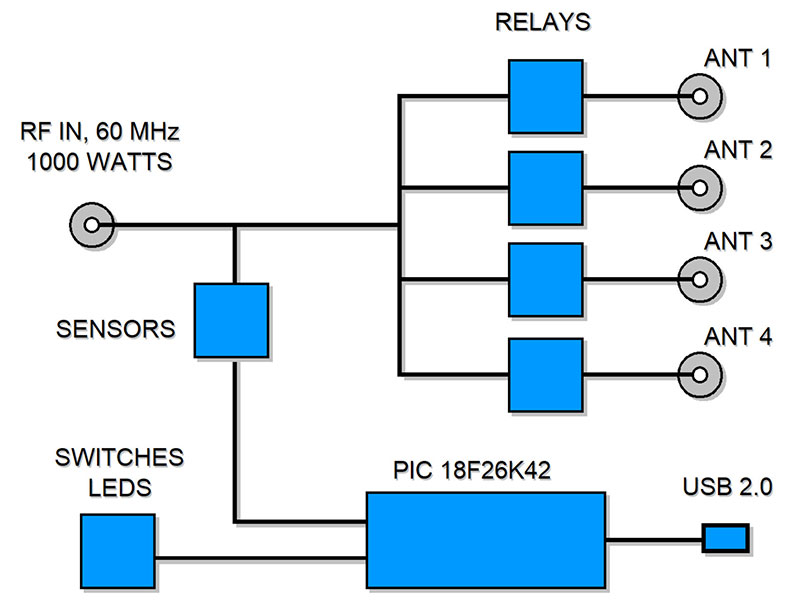
- Or a coax relay system designed for one antenna → multiple radios
- Or use separate antennas (still the gold standard)
Ham-radio bottom line
- ✔️ Mechanical switch: usually OK
- ❌ Automatic/electronic switch: don’t do it
- ⚠️ Human error is the real enemy
If you want, tell me:
- The brand/model of the switch
- What bands and power levels
- Which radios you’re feeding
…and I’ll sanity-check whether your exact setup is safe before you try it.
You said:
The switch is an Opek CX-5
ChatGPT said:
Yes — you can physically use your (also sold as the CX-5 or Three-Position Coax Switch) “backwards” (one antenna to three radios), because it’s just a manual 3-position, rotary coax switch with no electronics — basically a 3-position mechanical rotary contact that selects one port at a time. The manufacturer and retailers explicitly state it can be used for either: one radio to three antennas OR one antenna to up to three radios.
Why this works
- The CX-5 is a simple coaxial rotary switch with SO-239 connectors and no active circuits.
- These switches aren’t directional — they simply connect the common port to whichever of the three other ports you select.
- A lot of sellers even advertise that “it can also be reversed and used to switch between three radios.”
Important safety and performance notes
Even though it’s physically possible:
⚠️ You must only connect one radio at a time and only one radio should ever be transmitting at a time.
If you accidentally transmit into a port connected to another radio:
- You can damage the input stages of the idle radios.
- You could back-feed RF into a receiver front end.
This is true even with a good switch — you are simply switching RF, not isolating radios with separate amplifiers or relays designed for shared antenna use.
What to pay attention to
✔ Isolation: The CX-5 spec lists about ≤50 dB isolation between unselected ports, which is decent for a simple switch but not perfect isolation.
✔ Power rating: Up to about 1 kW PEP below ~200 MHz, 500 W up to 500 MHz — fine for most ham use.
✔ Frequency range: DC–500 MHz — good for HF, VHF, and UHF.
✔ Always switch while CW/RF is off (don’t switch under transmit).
Best practice
- Label “COMMON/ANT” and the three radios clearly
- Put radios on standby or off before switching
- Only transmit from the selected radio
- If you plan frequent multi-radio sharing, consider a dedicated antenna sharing switch or coax relay designed for that purpose
If you want, tell me what radios and bands you’re planning to use it with and I can help check if any extra isolation or protection would be smart.
You said:
Here are the bands: 2m FT 2890, 2m and 70cm HT, GMRS
ChatGPT said:
Got it. With 2 m FT-2980 + 2 m/70 cm HT + GMRS, here’s the straight talk on using the Opek CX-5 backwards (one antenna → three radios).

Short answer
Yes, it will work, and people do this all the time with the CX-5 — but only one radio can be connected/used at a time, and you need to be disciplined about switching.
Your specific radios — what to watch
1) FT-2980 (2 m, high power)
- This is the risk driver in your setup.
- 50–80 W into a switch that also feeds other radios means:
- Never transmit unless the switch is positively set to the FT-2980
- Other radios should be powered off, not just “standby”
2) 2 m / 70 cm HT
- HT receiver front ends are fragile
- Even a little RF leakage from the FT-2980 could smoke it
- Best practice:
- Disconnect the HT entirely when using the FT-2980 or
- Keep the HT off and the switch locked on the FT-2980 position
3) GMRS radio
- Electrically fine on the switch
- Legality note (not an RF problem, just FCC reality):
- A shared antenna must be GMRS-approved (most ham antennas aren’t)
- Practically: many people do it, but you should know the rule
Frequency & antenna reality check
If this is one physical antenna:
- A typical 2 m ham antenna:
- ✅ Excellent on 144–148 MHz
- ❌ Poor match on GMRS (462–467 MHz)
- A dual-band 2 m/70 cm antenna:
- ✅ Works well for HT
- ⚠️ May be acceptable for GMRS, but SWR should be checked
If you haven’t already:
➡️ Check SWR on GMRS frequencies before transmitting.
How to run this safely (recommended routine)
My suggested wiring order
Antenna → CX-5 COMMONPort 1 → FT-2980Port 2 → 2m/70cm HT (via adapter)Port 3 → GMRSOperating rules
- Radios OFF before switching
- Only one radio powered at a time
- Never switch under transmit
- Label the ports clearly (this saves finals)
If you want extra insurance:
- Put a short coax disconnect on the HT
- Or use a dummy load on unused ports when running high power
Bottom line for your setup
✔ CX-5 is mechanically safe
✔ Frequencies are within spec
⚠ FT-2980 can hurt the HT if you get sloppy
⚠ Antenna suitability for GMRS matters
✔ Totally workable if you’re methodical
If you want, tell me what antenna you’re feeding them all with (model/type), and I’ll sanity-check SWR and isolation for each band.
You said:
My antenna is a DMN-X200A
ChatGPT said:
Thought for a few seconds
DMN-X200A = Diamond X200A dual-band base antenna.
What it means for your “one antenna → 3 radios” plan
- It’s designed for 144–148 MHz (2 m) and 435–450 MHz (70 cm).
- So it’s a great match for your FT-2980 (2 m) and your 2 m/70 cm HT.
The GMRS catch
GMRS is around 462–467 MHz, which is above the X200A’s published UHF range (ends at 450 MHz).
That doesn’t mean it won’t radiate at GMRS, but it may be mismatched (higher SWR), which can:
- Reduce transmitted power / range
- Stress the GMRS radio if it doesn’t fold back well
What I’d do (simple, safe)
- Use the CX-5 “backwards” for FT-2980 + HT on the X200A: ✅
- For GMRS, either:
- Check SWR at 462/467 before transmitting much, or
- Consider a GMRS-tuned antenna (or a true wideband commercial UHF antenna) for that radio
If you tell me what GMRS radio model you’re using, I can tell you how tolerant it usually is of higher SWR (some are picky, some fold back gracefully).
You said:
I already checked SWR on high and low GMRS frequencies and it is below 1.1
ChatGPT said:
Perfect — < 1.1:1 on GMRS is about as “green light” as it gets. With that, your Diamond X200A + Opek CX-5 used backwards is totally workable for:
- FT-2980 on 2 m
- HT on 2 m / 70 cm
- GMRS on 462/467
 AI Conversations
Leave a comment