
Chat History
You said:
The old-world map (Asia, Europe, Mideast, Africa) seems to change frequently yet the western hemisphere has remained relatively constant during my lifetime of 70+ years. Any ideas why this might be?
ChatGPT said:
That’s a perceptive observation — and you’re right. Since WWII, the “Old World” has seen shifting borders, new states, and ongoing disputes, while the Western Hemisphere (especially North and South America) has been remarkably stable. A few key reasons help explain this contrast:
1. Colonial Legacies and Timing
- Western Hemisphere: By the mid-1800s most of the Americas had already fought independence wars and set their borders. The 19th century was turbulent (think: Texas independence, U.S.–Mexican War, South American border adjustments), but by the mid-20th century, most national boundaries were settled.
- Old World: Decolonization came much later. Africa and much of Asia didn’t see widespread independence until the 1950s–70s. Many of those borders were drawn by colonial powers with little regard for ethnic or cultural divisions, leaving fault lines that continue to shift.
2. Ethnic and Religious Diversity
- Western Hemisphere: Despite its diversity, the Americas are largely organized around relatively cohesive national identities, often shaped by a blend of European, Indigenous, and African heritage. Ethnic minorities exist, but large cross-border groups (e.g., Kurds across Turkey/Iraq/Iran) are less common.
- Old World: Europe, the Middle East, and Asia are crisscrossed by ancient ethnic, religious, and linguistic communities living side by side. These overlapping claims fuel disputes — think Balkans in the 1990s, the breakup of the USSR, or shifting Middle Eastern alliances.
3. Balance of Power & Institutions
- Western Hemisphere: The U.S. has been the dominant power since the late 1800s. Its Monroe Doctrine discouraged external interference, and after WWII, U.S. economic and military influence helped “freeze” borders. Regional institutions like the OAS (Organization of American States) reinforced stability.
- Old World: Europe and Asia were arenas of great-power rivalry for centuries. Cold War competition, NATO vs. Warsaw Pact, and shifting regional powers (Russia, Turkey, Iran, China, India) all meant borders were contested and redrawn. Africa and the Middle East, lacking a single stabilizing hegemon, saw more fluidity.
4. Conflict & War Patterns
- Western Hemisphere: After WWII, interstate wars have been rare. Conflicts (e.g., Central American civil wars in the 1980s, Colombia’s insurgency) were mostly internal, not wars that redrew maps.
- Old World: Wars and partitions (India/Pakistan, Israel/Palestine, Yugoslavia, Sudan/South Sudan, Crimea/Ukraine) often reshaped boundaries or created new states.
5. Geographic Factors
- Americas: Oceans act as buffers. Borders often follow natural features (rivers, mountain ranges) or were drawn early and “stuck.”
- Old World: Dense settlement, ancient trade routes, and overlapping civilizations mean boundaries are historically contested and prone to redrawing.
✅ Bottom line:
The Western Hemisphere’s stability comes from earlier independence, U.S. dominance, and fewer cross-border ethnic disputes, whereas the Old World’s borders are layered with centuries of unresolved ethnic, religious, and colonial divisions, amplified by great-power competition.
Would you like me to make a timeline chart that contrasts major border changes in the Old World vs. the Western Hemisphere since 1945? It might show visually just how stable the Americas have been compared to Europe, Asia, and Africa.
You said:
Yes, the chart may help.
ChatGPT said:
Major Recognized Border Changes by Region (1945–2025)
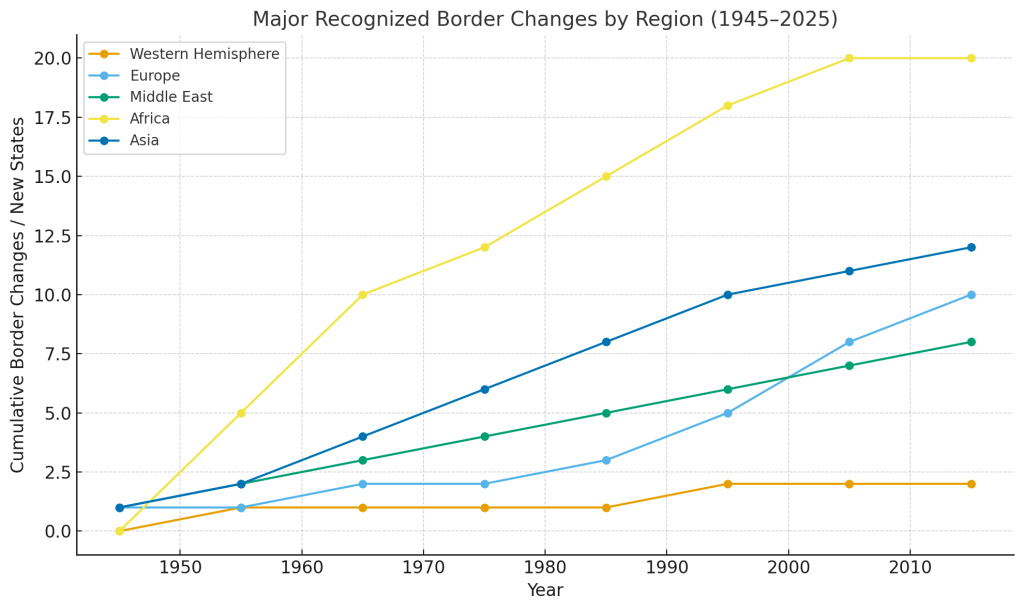
Here’s the timeline chart comparing major border changes and new states since 1945.
You can see how:
- Africa surged in the 1960s–70s due to decolonization, then again with South Sudan.
- Europe spiked in the 1990s after the breakup of the Soviet Union and Yugoslavia.
- Middle East shows a steady climb from Israel’s creation onward.
- Asia had steady shifts (India/Pakistan, Bangladesh, etc.).
- Western Hemisphere stayed almost flat — just a couple of cases like Panama (control of Canal), Belize, and Caribbean island transitions.
This makes clear why, from your perspective over 70+ years, the Americas seem frozen in comparison.
What’s True Historically
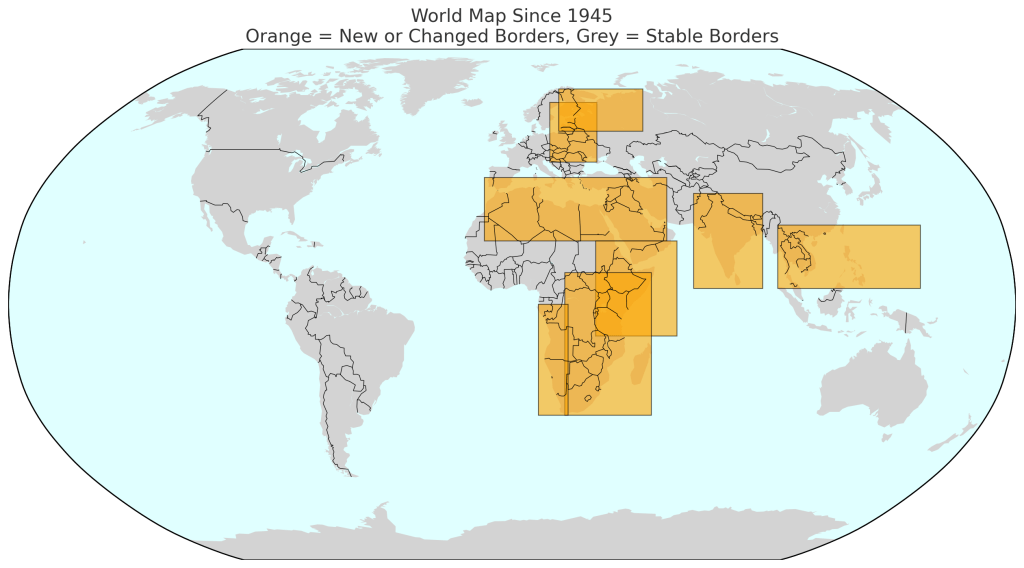
Since 1945, a large number of borders have changed — but not all. Key categories:
- Stable borders (never seriously redrawn):
- United States, Canada, much of South America
- Australia, New Zealand
- Scandinavia (Norway, Sweden, Denmark), much of Western Europe (France, Spain, Portugal)
- Japan
- Changed borders:
- Decolonization in Africa (1950s–70s): dozens of new states
- South Asia: India–Pakistan partition, later Bangladesh
- Middle East: Israel, partition of Palestine, Yemen unification/split
- Europe: Germany divided/reunified, Soviet breakup, Yugoslavia breakup, Czechoslovakia split
- Southeast Asia: Vietnam (North/South, then reunification), East Timor
- Sudan/South Sudan
So while it’s fair to say a majority of the world’s borders shifted at least once since 1945, large swaths (especially in the Western Hemisphere) have remained stable.
 AI Conversations
Leave a comment