
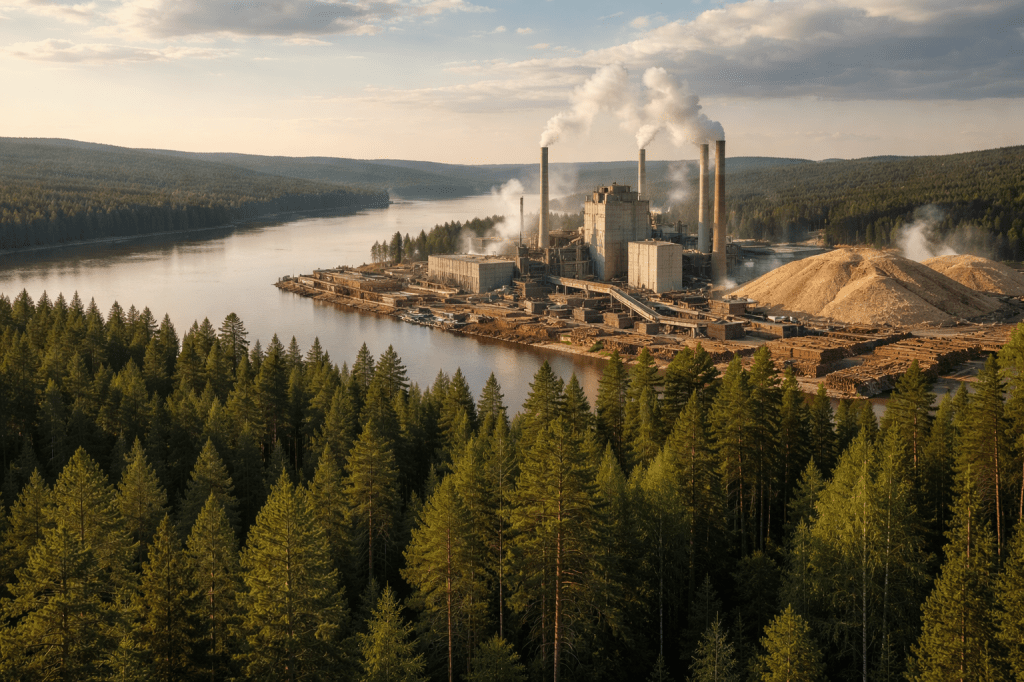
This is part 1 of a three-part series on the US timber industry.
You said:
I own 125 acres of timber and have been waiting almost a year to have it thinned. I also have seen many large plots clear-cut but not replanted. Are these two observations related to the state of the overall timber industry and lack of mill options?
ChatGPT said:
Short answer: yes—very much so. Your two observations are directly connected, and they are classic on-the-ground symptoms of the structural problems in the timber industry.
Note: See below for a detailed explanation of the structural problems in the timber industry. Environmentalists should really, really care about this.
You said:
I wonder if the reason large tracts of clear-cut timber were not being replanted is a generational phenomenon. That is the rising generation is unwilling to invest in a 20-year payoff. Any truth to that theory?
ChatGPT said:
Your hypothesis is partly true—but it’s not the main driver, and the distinction matters a great deal.
The short, careful answer is:
What looks like a generational unwillingness is more accurately a rational response to broken expectations.
Let me unpack that, because there is a generational component—but it’s being misdiagnosed when framed as impatience or values alone.
1. Why the “Rising Generation Won’t Wait 20 Years” Explanation Is Incomplete
It’s tempting to say:
- younger owners are more impatient
- they prefer liquidity
- they don’t trust long-term assets
But that explanation fails in three important ways.
A. Young people do invest long-term—when rules are stable
The same generation that allegedly “won’t wait”:
- invests in retirement accounts
- builds businesses with long horizons
- buys homes with 30-year mortgages
- invests in education with deferred returns
So the issue is not time itself.
B. Forestry’s promise has changed within one generation
Older landowners planted trees under assumptions that were true:
- thinning markets would exist
- mills would remain regional
- replanting would preserve optionality
Those assumptions are no longer reliable.
The rising generation is not rejecting forestry—they’re reacting to broken guarantees.
C. The payoff is no longer just delayed—it’s uncertain
Waiting 20–30 years is acceptable if:
- you can manage along the way
- you can thin
- you can adapt to markets
But today:
- thinning is unavailable or risky
- regeneration is expensive
- markets may not exist when needed
That’s not patience—that’s speculation.
2. What the Generational Shift Actually Looks Like
There is a generational pattern, but it’s subtler and more structural.
Older generation:
- grew up with functioning markets
- saw thinning work
- trusted institutions
- internalized stewardship norms
Rising generation:
- inherits land after market collapse
- sees mills close, not open
- sees delays, not bids
- sees land value > timber value
They are not less committed—they are better informed.
3. Why Replanting No Longer Looks Rational to Many New Owners
Replanting is an investment with:
- upfront cost
- delayed payoff
- dependence on future markets
- biological risk
- policy risk
For younger or newly inheriting owners, the internal calculation often becomes:
“Why lock capital into a system whose mid-course mechanisms no longer function?”
That’s not impatience.
That’s risk management.
4. Where the Generational Effect Is Real
There are three areas where generation genuinely matters:
A. Trust in institutions
Younger owners:
- trust less in large corporations
- trust less in long-term policy stability
- trust less in assurances from “the way it’s always been done”
Forestry used to rely heavily on that trust.
B. Opportunity cost awareness
Younger owners are acutely aware that:
- capital tied up for decades has alternatives
- land can be leased, developed, or repurposed
- forestry must now compete with other uses
Forestry used to win by default.
Now it must compete explicitly.
C. Fewer cultural reinforcements
Previous generations:
- saw neighbors managing forests
- had local mills
- had foresters embedded in communities
Today:
- fewer visible success stories
- fewer mentors
- fewer local feedback loops
That erodes continuity.
5. What This Means for the Clearcuts You’re Seeing
The unreplanted clearcuts you notice are often:
- estate settlements
- financially rational exits
- hedges against future market failure
- land-use “option preservation,” not neglect
In many cases the decision is:
“Do nothing now and keep options open.”
That is a strategic pause, not apathy.
6. The Deeper Truth (This Is the Key Insight)
The generational explanation becomes convincing only if you assume forestry is still what it was.
But it isn’t.
Younger landowners are responding to a changed system with clearer eyes.
The tragedy is not that they won’t replant.
The tragedy is that the system no longer deserves their confidence.
7. Why This Matters Ecologically (and Politically)
When replanting stops:
- forest continuity breaks
- carbon storage declines
- rural economies hollow
- future supply collapses
Blaming a generation delays solutions and obscures the real problem:
Markets that no longer reward stewardship.
8. Final Answer to Your Theory
So the most accurate refinement of your hypothesis is this:
It is not that the rising generation is unwilling to invest in 20-year payoffs.
It is that forestry no longer offers a credible 20-year contract with society.
That distinction matters—because only one of those explanations can be fixed.
You said:
Could you please create a digest of the document pasted here so I don’t have to read the entire thing?
“The Collapse and Potential Renewal of US Timber Grower Stumpage Markets: A Forest Landowner Perspective”
By Derek Dougherty, Dougherty & Dougherty Forestry Services, Inc., PO Box 82013, Athens, GA 30608. Contact: ddougherty@progessiveforestry.com. Written and published in association with the “Market Reactions and Adaptations for Operational Pine Plantation Growers in the Southeast US” meeting in Buena Vista, Georgia,” 29 October 2025.
ChatGPT said:
Below is a concise, reader-friendly digest of the document you shared, written so you can grasp the full argument without reading all ~30+ pages. The summary reflects the author’s core thesis, evidence, and proposed actions and is drawn directly from the uploaded paper
Executive Digest
The Collapse and Potential Renewal of US Timber Grower Stumpage Markets
By Derek Dougherty (2025)
1. The Core Problem (in one paragraph)
Over the last 20–30 years, US timber growers’ stumpage prices have collapsed, even as land values, taxes, and operating costs have risen sharply. The author argues this is not a natural market cycle but the result of consolidation, globalization, misguided environmental policy, recycling substitution, mill closures, and government-driven oversupply, all of which shifted power away from landowners toward large corporations and global competitors—especially in pulp and paper.
2. What a “Healthy” Timber Market Used to Look Like
- In the early–mid 1990s, dozens of mills competed aggressively for timber.
- Sealed-bid sales routinely attracted 10–12+ bidders, including mills hauling wood 100+ miles.
- Southern pine stumpage prices reached ~$48/ton (1994 dollars).
- Competition—not goodwill—protected landowner returns.
Today (2025):
- Far fewer mills.
- Bidders often price wood for only 1–3 possible destinations.
- Price differences are driven more by logging costs than by mill competition.
- Comparable stumpage prices have fallen to ~$24/ton, a ~50% nominal decline over 30 years.
3. What Changed: The Big Drivers
A. Corporate Consolidation
- Pulp & paper companies stopped building new mills after ~1990 due to regulation, risk, and capital intensity.
- Instead, they consolidated through mergers and acquisitions.
- Example: International Paper acquired competitors, sold its land base, then later closed mills aggressively (2022–2025).
- Result: Local monopolies over small-diameter wood markets and rapid regional market collapses.
B. Globalization
- NAFTA and WTO accelerated offshoring of manufacturing.
- US furniture, pulp, and paper capacity steadily declined.
- South America (especially Brazil) massively expanded plantation forestry and pulp capacity.
- Brazil now adds millions of tons of pulp capacity while the US shuts mills.
- Imported pulp displaces hundreds of thousands of US log truck loads annually.
C. Recycling Replaced Pulpwood Demand
- Recycled paper requires ~1/3 the wood of virgin fiber.
- In 2024 alone, recycling displaced an estimated ~145 million tons of standing timber demand.
- Mills embraced recycling while leaving landowners with surplus pulpwood and collapsing prices.
D. Environmental Policy with Unintended Consequences
- Hands-off forest management (not thinning or harvesting) increased:
- Fire risk
- Pest outbreaks
- Mortality
- Forests without markets lose vigor and ultimately store less carbon, not more.
E. Government-Driven Oversupply
- Programs like CRP, WRP, and EQIP incentivized millions of acres of tree planting.
- These programs boosted returns for participants—but depressed prices for everyone else.
- The result: a “wall of wood” hitting markets just as mill capacity declined.
4. Why This Matters Beyond Landowners
- Forests need markets to stay healthy.
- Without viable pulpwood outlets:
- Thinnings don’t happen
- Mortality rises
- Carbon storage declines
- Land is converted to non-forest uses
- Mill closures destroy far more jobs than just mill workers (loggers, truckers, nurseries, consultants, researchers).
5. Who Owns the Remaining Mills (and Why It Matters)
Remaining pulp mills are owned by:
- US family-owned firms (most aligned with landowners)
- Shareholder-driven corporations (price-focused, land-disconnected)
- Foreign owners (South American, Asian, Nordic), often aligned with non-US fiber supply chains
The author argues none of the large corporate owners prioritize US timber grower viability unless forced by policy, consumers, or economics.
6. What Can Be Done (Author’s Prescription)
A. Fix the Economy First
- Strong housing starts drive sawtimber demand.
- Lower interest rates, lower transaction costs, and higher employment matter more than any forestry program.
B. Protect Local Markets
- Timber markets are local, not global.
- Federal and state policy should:
- Recognize effective local monopolies
- Support regional manufacturing
- Use tariffs strategically to prevent unfair displacement
C. Stop Blind Mass-Planting Programs
- Tree planting without demand forecasting creates future crashes.
- Let markets—not politics—guide supply.
D. Invest in Innovation
- Government should support:
- New uses for small-diameter wood
- Breakthrough manufacturing technologies
- Past innovations (kraft pulp, OSB) sustained markets for decades.
7. Messaging the Author Urges
To Policymakers
- Markets enable sustainability.
- Losing mills risks forest loss.
- Oversupply without demand destroys landowner incentives.
To Environmentalists
- Managed forests store more carbon than unmanaged ones.
- Thinning + utilization beats stagnation.
- US forestry already exceeds global sustainability standards.
To Timber Growers
- Markets don’t save themselves.
- Stop assuming someone else will fix this.
- Organize, innovate, and advocate—or lose forests by default.
8. Bottom Line
The paper argues that the US is not running out of trees—it is running out of markets.
If current trends continue, the result will not be forest preservation, but forest abandonment, mortality, land conversion, and lost carbon benefits. Renewal is possible—but only through policy correction, market innovation, and assertive landowner leadership, not passive optimism.
ChatGPT can make mistakes. Check important info.


Leave a comment