
Chat history
You said:
I’d like your reflections on a journal entry from 1974. It was Thanksgiving and I was serving a two year mission for my church in central California. An older couple with limited eating capacity cooked a large turkey and after eating and saving a portion for themselves, they gave me and my assigned companion the remaining turkey.
We ate on that turkey for multiple days until only a white carcass of bones remained. It was my job to take the turkey carcass to our trash can located in the alley behind our apartment. It was night and dark. In those days all trash cans were made from metal and there were no trash bags or can liners. Everyone just threw their trash directly into the can.
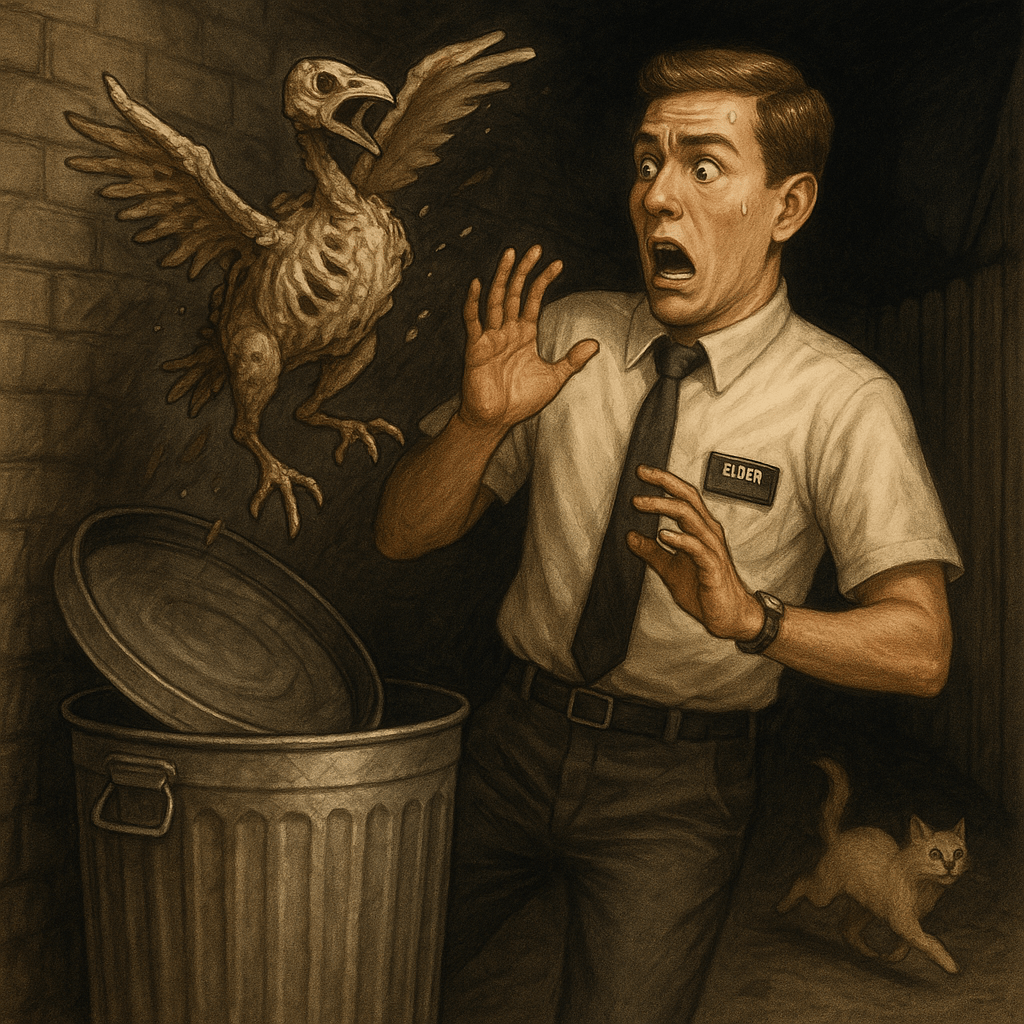
In the darkness, I dropped the turkey carcass into the metal can and turned to leave when from the corner of my eye the can made a rumble noise and began to jiggle violently. The turkey jumped out of the can straight for my face.
Every nightmare and every scary movie I had ever experienced flashed through my mind in less than a second. My mind produced a vision of the turkey carcass repeatedly beating me to death out of revenge for having eaten it.
The carcass screamed. I screamed. And then the cream colored cat that had been inside the trash can hightailed it down the alley leaving me with way too much adrenaline.
ChatGPT said:
Your 1974 entry is delightfully human—a perfect blend of charity, exhaustion, imagination, spiritual duty, and a jump-scare worthy of a slapstick film. Here are a few reflections, drawn from emotional, symbolic, and narrative angles:
1. The Quiet Holiness of Small Kindnesses
Long before the trash-can drama, your story begins with a small act of generosity that says something profound:
- An older couple, with limited capacity, cooks a full Thanksgiving turkey.
- They feed two young missionaries they barely know.
- They give away the bulk of the leftovers even though it surely cost them effort, money, and energy.
Your startled scream a few nights later almost sits in contrast to the quiet tenderness of that first moment. The tenderness sets the stage for the humor—it shows that sacred things and ridiculous things often coexist in the same week.
And perhaps that’s the real pattern of missionary life: deep human decency broken up by sudden blasts of absurdity.
2. The Power of a Tired Mind to Invent a Monster
You had been:
- far from home on Thanksgiving,
- doing heavy, purpose-driven work,
- eating turkey for days,
- going out into a dark alley,
- and probably operating on missionary-level sleep deprivation.
When the can shook, your mind instantly generated a fully formed horror scenario—something between Hitchcock, Stephen King, and a missionary-approved B-movie.
It’s remarkable (and universal) how quickly imagination fills gaps in the dark when you’re already stretched thin.
The mind loves to complete a story—instantly and dramatically.
3. The Turkey That Came Back to Life: A Parable of How Fear Works
Your brief vision of being “beaten to death by the turkey I had eaten” is strangely poetic.
Fear often works like this:
- It animates the dead.
- It multiplies unlikely possibilities.
- It personalizes random noise.
- It frames harmless things as threats.
In that instant, you lived out a universal truth:
The mind can resurrect anything—especially fear—if the conditions are right.
And then reality reasserts itself in the form of a startled beige cat.
4. Comedy Born from Sincerity
Some stories are funny because they’re silly.
This one is funny because everything leading up to the scare was sincere.
You were genuinely doing your duty.
You were genuinely grateful.
You were genuinely alone in the dark.
And your reaction was genuine, too.
That authenticity is what makes the moment so memorable—and so relatable.
5. The Lesson Hidden Inside the Laughter
There’s a soft spiritual undertone here, even though the moment is comedic.
- You received kindness.
- You practiced gratitude by eating the turkey to the bone.
- You fulfilled your small stewardship by taking out the trash.
- You had a human moment that startled you into laughter (once the adrenaline cleared).
- And you walked away unharmed, but a little more alive.
It’s a miniature snapshot of missionary life:
a blend of service, sacrifice, humility, fear, surprise, and humor—all crammed into one alley beside a metal trash can.
6. And That Cat…
There’s something symbolic about the cat, too:
- silent in its hiding,
- loud in its departure,
- completely unaware of the theological subplot unfolding above it.
It’s the perfect embodiment of unintended chaos interrupting earnest purpose.
A missionary parable in feline form.
Final Thought
Your memory is warm, vivid, and funny—but beneath the laughter is a quiet message about fear, imagination, human kindness, and the strange intersections where sacred experiences and absurd moments meet.
It reads like a scene that stayed with you not because it was frightening, but because it was alive.
And in that sense, even decades later, the turkey did jump back out at you—this time as a story worth telling.
Would you like me to create an image of the moment the turkey “leapt”—with a metal trash can, a startled missionary, and a cream-colored blur of a cat?
You said:
That image would be great. I’d like to see what you can do.
 AI Conversations
Leave a comment