
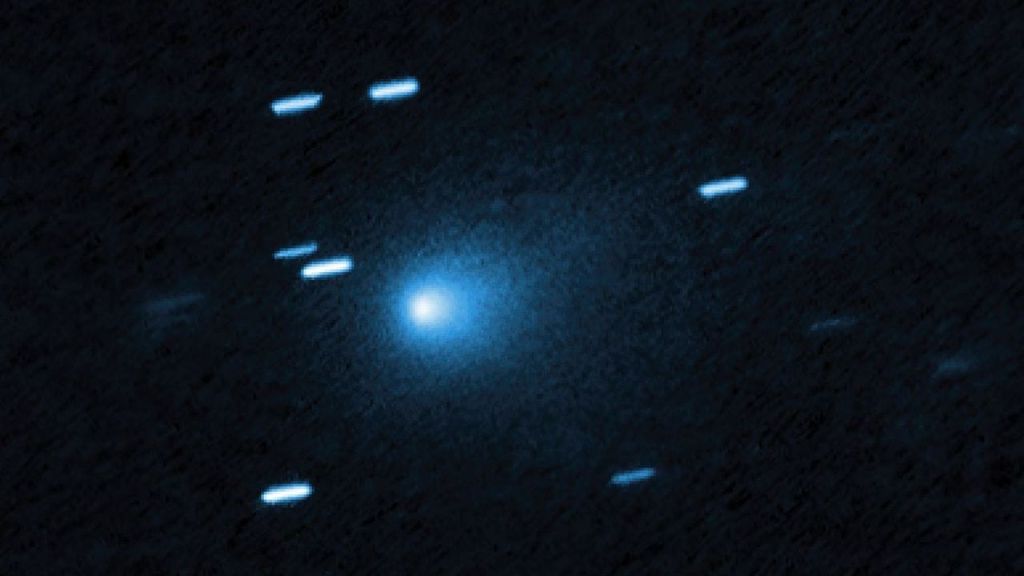
Source: livescience.com
You said:
Theories about 3I/Atlas continue to pop up in the news. For instance, the size of the nucleus keeps growing to gargantuan proportions and the fact that its closest point to Mars is when Earth is opposite the Sun so as to make this event unobservable suggests alien intent. Have there been any updates or changes since our last conversation that I should know about?
ChatGPT said:
Good call to ask — yes, there are a few noteworthy updates and a bunch of speculative claims with weak or no supporting data. I’ll break both down for you.
✅ Credible Updates
Here are some of the scientifically supported changes / clarifications on 3I/ATLAS:
- Size constraints on the nucleus are tighter
- Based on new imaging from the Hubble Space Telescope, the upper limit on the diameter of the nucleus is about 5.6 km (≈3.5 miles). ESA/Hubble NASA Science
- On the low side it could be as small as ~320 m (≈0.32 km) across, due to the difficulty of separating the coma’s brightness from the nucleus. Astronomy ESA/Hubble
- So although some early media/columns quoted very large sizes (10 km+), the peer-reviewed or at least researcher-driven values lean toward “≤ 6 km” for now.
- Composition refined
- Observations by the James Webb Space Telescope & the SPHEREx mission show strongly that 3I/ATLAS is unusually rich in CO₂ relative to H₂O. Medium NASA Science
- Imaging of the coma shows a notable “sun-facing plume” dust structure etc. European Space Agency
- Observational geometry / approach
- 3I/ATLAS will pass perihelion around 29 October 2025 at ~1.36 AU from the Sun, and at that time from Earth’s viewpoint it ends up near solar conjunction (i.e., behind or very near the Sun) making observation harder. Wikipedia
- The closest approach to Mars (~0.19 AU) is already or soon will be used by Mars orbiters/spacecraft to image the object. Wikipedia
- Clarification of earlier exaggerations
- Many earlier size claims (e.g., 10-46 km diameter) are now treated by experts as very speculative, because the coma dominates brightness and inflates apparent size if mis-interpreted. Penn State Sites
- The “largest interstellar object ever seen” tag is still being used in media, but its basis is the upper size limit, not a confirmed size.
⚠️ Speculative / Unverified Claims to be Wary Of
Here are some claims circulating that are not well supported by peer-reviewed data (at least as of now):
- Claims that the nucleus is “Manhattan‐sized” (~10 km or more) or “older than 3 billion years” with certainty — while possible, the “10 + km” size is not supported by the Hubble upper limit.
- Suggestions that the path near Mars + Earth being “behind the Sun at perihelion” implies “alien intent” or that 3I/ATLAS is a spacecraft. These are more speculative, opinionated, and not supported by direct observational evidence.
- Assertions that the object is “emitting a metal alloy never seen in nature” or “glowing from its own light rather than reflecting sunlight” — these are claimed by individuals in the media/blogosphere, but not widely accepted by the community or supported by peer-reviewed instrumentation results.
- E.g., a recent news claim: “emitting nickel tetracarbonyl” by a researcher claiming alien tech. (See news reference) New York Post
- The official datasets (Hubble, JWST, spectroscopy) don’t support abandoning the cometary natural model.
🔍 My Take / What to Watch
- The best current gist is: 3I/ATLAS remains a natural interstellar comet with some unusual features (large CO₂ content, active at large distance, sun-facing dust plume, retrograde low-inclination path).
- Its nucleus is not convincingly >10 km at present; the consensus upper bound is around ~5.6 km.
- The “alien spacecraft” scenario remains extraordinary and without extraordinary evidence; therefore by the adage “extraordinary claims require extraordinary evidence,” one should treat those claims as speculative until robust published data appears.
- Future observations (especially imaging from Mars orbiters, further JWST spectroscopy) are critical. If the nucleus is resolved or the composition reveals truly anomalous features (e.g., misleading isotopes, unnatural structure), the story may change.
- You should remain cautious of media headlines that jump from “unusual comet” → “aliens” without showing the underlying data.
If you like, I can pull the three most recent peer-review/preprint papers (from last month) on 3I/ATLAS so you can see exactly what data is fresh and what remains literature pending. Would you like that?
You said:
There are claims that the nucleus is hollow. Could you please review those claims, evidence for and against?
ChatGPT said:
Here’s a breakdown of the “hollow nucleus” idea for 3I/ATLAS — what claims are being made, what evidence supports or contradicts it, and how credible the idea is at this stage.
✅ What the claim is
Some commentators (mostly in the media or speculative venues) are asserting that 3I/ATLAS might have a hollow (or extremely low‐density) nucleus rather than a solid icy/rocky core. The logic behind the claim often involves:
- The object appears very large yet shows little non‐gravitational acceleration from outgassing (suggesting a heavier or less easily–moved core).
- Some trajectories or observational features (e.g., small coma size relative to brightness) are interpreted by these commentators as inconsistent with a typical solid comet nucleus.
- In some cases this feeds into the more extreme hypothesis that the object may be artificial or engineered.
For example, there are headlines quoting the object as “possibly hollow” and raising the suggestion of “alien intent.” The Guardian New York Post
🔍 What the evidence for (i.e., that could be consistent with “hollow”)
- The upper limits on nucleus size are still quite loose because of the bright coma. Observations note that nucleus size is uncertain. Wikipedia NASA Science
- The fact that 3I/ATLAS shows very high CO₂ / H₂O ratio and is active at relatively large distance might suggest its surface or interior structure is unusual relative to typical Solar System comets. (If it were more porous or less dense, maybe volatiles could escape more easily at lower heating). arXiv
- Some media claims note that observed non-gravitational motion is weaker than expected for the coma size — which could hint at a massive (or denser) nucleus. (Though note: this is a media claim, not confirmed peer-reviewed measurement). Chron
❌ What the evidence against (or at least not supportive of) the hollow claim
- Professional observers describe 3I/ATLAS as having a solid icy nucleus + coma in the standard cometary sense. For example: “3I/ATLAS is an active comet consisting of a solid icy nucleus and a coma…” according to its Wikipedia summary (which cites credible sources). Wikipedia
- There’s no peer‐reviewed publication (to my knowledge now) that presents measurements of density or interior structure showing “hollow” or “extremely low density” in the nucleus.
- The uncertainties in size and mass remain large. Because we don’t have a clear nucleus observation (it’s embedded in the coma), there isn’t enough precision yet to deduce interior voids or major hollowness.
- Many of the claims about “hollow nucleus” come from speculative commentary or media stories, not from traditional refereed scientific papers. For example, the Guardian article notes that NASA scientists dismiss the “artifact” interpretation. The Guardian
- Typical cometary nuclei are porous and may have significant internal voids, but that’s not the same as being uniformly hollow or artificial. Porosity in comets is expected and well‐studied, but the jump to “hollow shell” is big and needs strong evidence.
🔬 My assessment of credibility
Given the above, here’s how I’d grade the “hollow nucleus” hypothesis:
- Plausibility: Moderate. It’s not impossible that 3I/ATLAS has an unusual internal structure (higher porosity, layered interior, cavities) compared to known comets, given its interstellar origin and chemical oddities.
- Evidence strength: Weak. There is no definitive direct evidence for hollowness (e.g., resolved imaging showing emptiness, seismic/radar internal structure, or density measurement). Most of the “hollow” suggestion is inferred indirectly (or speculated) from behavior that might have alternative explanations.
- Most likely explanation currently: The object is a comet with a relatively large (for an interstellar object) nucleus and significant coma, but within the range of natural variability. The hollow interpretation is far less favored by mainstream experts at this time.
- Extraordinary claim caution: Because “hollow nucleus” is relatively extraordinary (especially combined with “alien probe” hypotheses), one must ask for high‐quality evidence. Until such evidence emerges, the natural comet scenario remains the default.
If you like, I can check all currently available preprints (arXiv) for any internal‐structure modelling or density estimations for 3I/ATLAS, and we can look for any credible “hollow nucleus” calculations (even if just upper‐limits) rather than unverified media claims. Would you like me to do that?
You said:
Yes, please check all currently available scientific preprints.
ChatGPT said:
Thought for 27s
Short answer: there’s no direct evidence that 3I/ATLAS has a hollow nucleus. The idea is speculative. The best current data are consistent with a normal (if chemically unusual) icy–rocky nucleus hidden by a very bright coma.
What solid data say
- HST imaging resolves only coma and sets an upper limit on the nucleus: effective radius ≤ 2.8 km (for typical dark-comet albedo). The paper explicitly notes the nucleus signal isn’t seen above the coma and warns against over-inflated size estimates. arXiv
- SPHEREx + IRTF find a huge CO₂ gas coma (≈3′ radius) and strong water-ice absorption in the coma; crucially, they show >99% of the continuum flux is coma dust, not the nucleus. (Their “23 km nucleus” is a what-if bound to illustrate that the flux cannot be coming from a bare nucleus.) arXiv
- A non-gravitational acceleration analysis (using MPC astrometry through late Sept 2025) reports a very small or undetected outgassing acceleration and, from assumed gas physics, infers model-dependent lower limits of ≳5 km diameter and ≳3.3×10¹⁶ g mass. This pushes against the HST upper limit but hinges on adopted production rates and outflow speeds—so it’s not a direct size measurement. arXiv
- Polarimetry finds an unusual, deep negative polarization branch (–2.7% at 7°), pointing to peculiar dust properties in the coma—not to hollowness of the core. arXiv
Evidence that’s been used to argue “hollow” — and why it doesn’t hold up (yet)
- “It looks large but shows little non-gravitational acceleration.”
- Low measured acceleration can arise from dust-dominated activity, anisotropic venting, large particles, or simply an overestimated gas production in the model. This does not imply an empty shell; it just weakens size/mass inferences from outgassing. arXiv
- “The coma is enormous; therefore the nucleus must be a big shell.”
- SPHEREx actually argues the opposite: the big continuum is almost entirely coma dust, making nucleus-size inferences from brightness invalid without separating coma vs core. arXiv
- Media op-eds linking geometry/timing to ‘artificial’ structure.
- These pieces present no internal-structure measurement (no mass from dynamics, no radar, no resolved shape). Astronomers caution that the nucleus hasn’t been seen directly and that upper limits reduce, not increase, the case for a gargantuan or engineered shell. arXiv
What would count as real evidence for (or against) hollowness?
- Direct nucleus detection/resolution (imaging that separates the core from coma). HST could not; Mars-orbiter or future JWST/HST geometries might help. arXiv
- Bulk density from size + mass:
- Size: high-res imaging or thermal modeling that isolates the nucleus.
- Mass: strong non-gravitational acceleration detection tied to well-measured gas production or future spacecraft tracking. Current constraints are weak/model-dependent. arXiv
- Rotational lightcurve/shape of the nucleus (not the coma) to infer structure—currently unavailable because the coma dominates. arXiv
Bottom line
- Today’s best limits (HST upper limit; SPHEREx coma dominance; weak non-grav signal) do not support a hollow nucleus. They’re consistent with a small, ordinary cometary core buried in an unusually CO₂-rich, dust-heavy coma. Claims of hollowness are unsubstantiated pending direct nucleus measurements or robust density determinations.
 AI Conversations
Leave a comment