
And it shall be said: Who is this that cometh down from God in heaven with dyed garments; yea, from the regions which are not known, clothed in his glorious apparel, traveling in the greatness of his strength? D&C 133:46
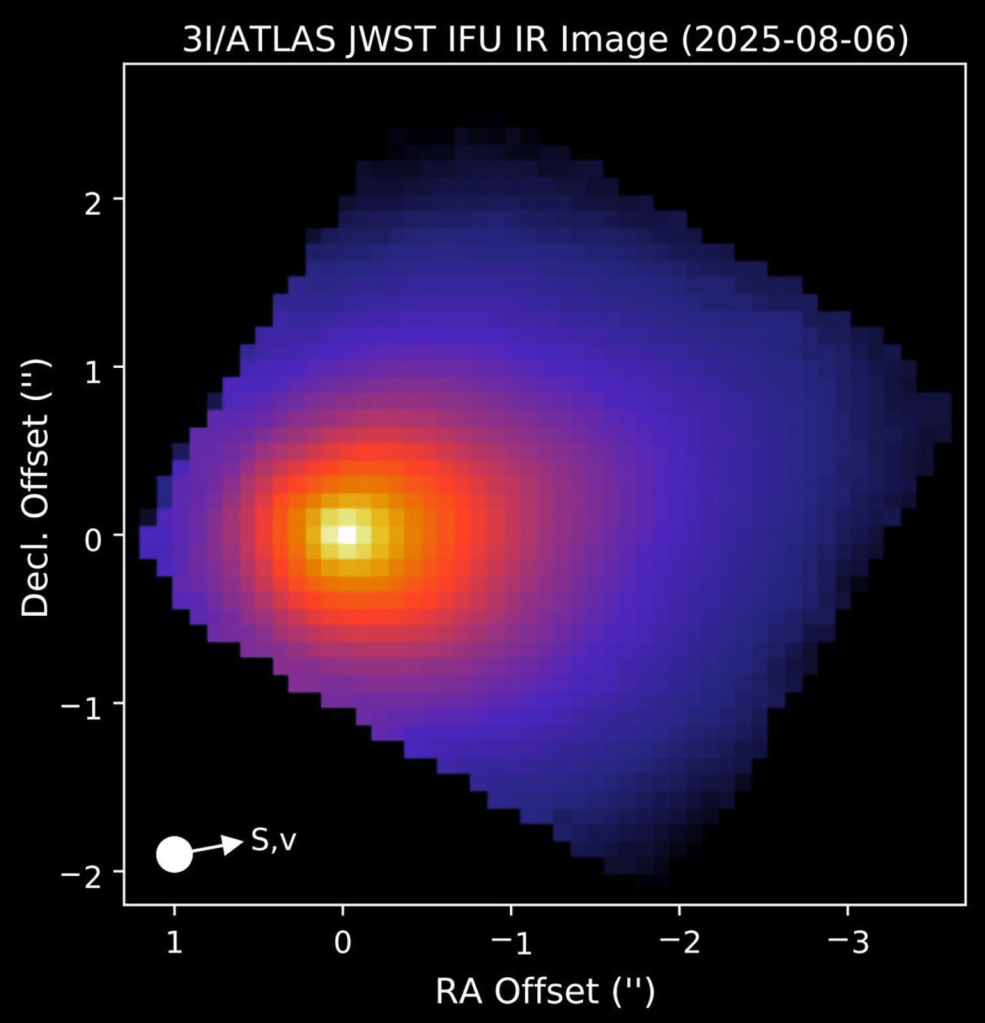
Source: https://science.nasa.gov/image-detail/amf-f316ebff-9e01-4a94-bb04-3364057456bc/
Chat History
You said:
What or where is the most likely origin of comet 3i/Atlas?
ChatGPT said:
Here’s what the current science suggests about where comet 3I/ATLAS most likely came from, along with how certain or speculative each idea is.
What is known about its motion & “birth-region” candidates
- Interstellar origin
- 3I/ATLAS is definitely not gravitationally bound to the Sun — its hyperbolic (eccentric) trajectory and high incoming speed (hyperbolic excess) make that clear. NASA Science
- It was already active (some coma activity) at ~4.5 AU from the Sun (discovery distance) and seems to have been traveling through space for a long time. Wikipedia
- Galactic “disk” membership, thick vs thin disk
- Based on kinematics (its velocity components relative to the Sun, its path through the Galaxy), researchers suggest 3I/ATLAS likely belongs either to the thin disk or thick disk population of the Milky Way. Wikipedia
- Some work (e.g. UniverseToday article) leans toward the thick disk as more probable, which implies that 3I/ATLAS is very old (several billion years), because thick disk stars are generally older than thin disk stars. Universe Today
- Formation environment — beyond volatile “frost lines”
- The chemistry (CO₂ dominance, presence of gases like OCS, etc.) suggests it formed in a cold region around its parent star (where CO₂, CO, water, etc. could freeze) — i.e. far from the star. Wikipedia
- If it formed beyond the CO₂ frost line, that means it was in a “outer-protoplanetary disk” region of its parent system.
- Age estimate
- Some analyses estimate 3I/ATLAS could be between ~7.6 and 14 billion years old (if from thick disk) or more conservatively ~3-11 billion years, depending on assumptions. That range suggests it’s older than the Sun in many models. Wikipedia
What is not known (and what we can’t trace yet)
- We can’t identify a particular star or system from which it came — its path over time through the Galaxy will have been perturbed by many stellar encounters, making a precise “where it came from” nearly impossible with current data. Wikipedia
- The metallicity (chemical “metal‐richness”) of its parent region is uncertain. If it’s from the thick disk, likely lower metallicity than the Sun; but that’s based on motion traits, not direct chemical signature from formation environment. Universe Today
- Whether its current volatiles reflect primordial composition (i.e. what it formed with) vs what has survived / been altered via space weathering, radiation, cosmic rays, etc., is still uncertain.
Most Likely Origin: A Plausible Scenario
Putting together what we do know, the most plausible origin story is something like this:
- Formed in the outer parts of a protoplanetary disk around a star in the Milky Way’s thick disk (or possibly thin disk but thick seems more likely from velocity data).
- In that system, it accreted volatile ices (CO₂, CO, water, etc.), organics, dust, and metal inclusions. Because of its cold formative environment, CO₂ ice was abundant.
- It was gravitationally ejected (or scattered) out of its parent planetary system — likely by interactions with a massive planet or via close encounter with another star — sending it on a long interstellar journey.
- Over billions of years, it drifted through the Galaxy, possibly with its path altered by stellar gravity, until recently entering our solar neighborhood on a hyperbolic trajectory.
You said:
Could you also compare the speed of the three interstellar objects, regular comets, and the planets?
ChatGPT said:
Thought for 35s
Absolutely—here’s a clean speed comparison you can use at a glance. I’ll separate “interstellar v∞” (speed far from the Sun) from “heliocentric speeds” near the Sun, then add planets for context.
Interstellar objects (ISO) — speeds
- 1I/ʻOumuamua
- Hyperbolic excess (v∞): ≈ 26.4 km/s.
- Near Sun: peaked near 88 km/s at perihelion (0.255 AU). Wikipedia
- 2I/Borisov
- Hyperbolic excess (v∞): ≈ 32 km/s (widely cited in early characterizations).
- Near Sun: ~43.9 km/s at perihelion (2.01 AU). ScienceDirect
- 3I/ATLAS (C/2025 N1)
- Hyperbolic excess (v∞): ≈ 58.0 km/s (mission-study orbital solution).
- Near Sun: media reports suggest ~201,000 mph (~90 km/s) as max speed near perihelion; treat as provisional. arXiv
“Regular” comets (for scale)
- 1P/Halley: ~54.6 km/s at perihelion (0.587 AU); ~41.5 km/s at 1 AU; ~0.9 km/s at aphelion. Wikipedia
- Rule of thumb: long-period comets can range from ~10–70+ km/s depending on how close they get to the Sun; speeds spike at perihelion by vis-viva dynamics. Wikipedia
Planet orbital speeds (nearly circular, for context)
- Mercury 47.9, Venus 35.0, Earth 29.8, Mars 24.1, Jupiter 13.1, Saturn 9.7, Uranus 6.8, Neptune 5.4 km/s. Wikipedia
What to take away
- ATLAS is fast even by ISO standards: its v∞ ≈ 58 km/s is ~2× ʻOumuamua’s and well above Borisov’s, so it spends the whole passage moving “hot.” arXiv
- Comet vs planet speeds: at perihelion, active comets frequently outrun planets (Halley at 55 km/s beats Mercury at 48 km/s). Wikipedia
- Why the differences? ISOs carry their interstellar approach speed in; the Sun’s gravity then adds more near perihelion. Typical Solar-system comets start with ~0 v∞ (bound orbits), so their max speed is set mostly by how close they dive.
If you’d like, I can turn this into a one-page cheat sheet (table + two bullets) you can drop into your notes
You said:
My understanding is that the dust and plasma coma surrounding 3I/Atlas is approximately half the size of our sun and that it is expected to grow to match the sun’s size. Are there other notable characteristics of the coma or nucleus in this comet?
ChatGPT said:
What is known / well supported
These are properties of 3I/ATLAS’s coma and nucleus backed by recent observations / preprints:
| Property | Estimate / measurement | Notes / Significance |
|---|---|---|
| Nucleus size (solid core) | Radius < 2.8 km (upper limit), based on Hubble observations. Also a lower bound of ~0.16 km if the coma’s dust is driven by sublimation of very volatile ices like CO. NASA Science | Because the coma is bright and dominates visible light, the nucleus is hard to see directly; these are limits rather than precise values. arXiv |
| Dust / Dust loss rate | Estimated ~6 to 60 kg/s (depending on particle size “a” in microns) for the dust mass loss rate. arXiv | That’s fairly active for an object at ~3.8 AU, so activity is substantial. arXiv |
| Coma composition (gas) | Dominated by CO₂; a very high CO₂/H₂O mixing ratio ~8.0 ± 1.0 at ~3.32 AU. Also detections of smaller amounts of H₂O, CO, OCS (carbonyl sulfide), and water ice and dust. arXiv | The dominance of CO₂ over water is unusual among comets at this distance from the Sun. Suggests either the nucleus is rich in CO₂ ice, or that water sublimation is suppressed (perhaps by insulating layers). arXiv |
| CO₂ coma size | SPHEREx sees a “bright, 3 arcmin radius CO₂ gas coma” in mid-August 2025. arXiv | A radius of 3 arcminutes means a very large angular size; if converted to linear size at the comet’s distance, it is quite large. But “large” doesn’t equal “half the Sun” (more on that below). |
| Surface brightness and color / dust grain size | The dust coma seems to consist of grains from µm to mm sizes. Dust cross-section estimates, colors, spectral slopes etc., show that the coma is redder than some Solar System comets, and that many small particles are involved. arXiv | Grain sizes and colors help in narrowing down the composition and surface processes (dust vs ice vs refractory organics etc.). |
| Sun-facing plume + “anti-tail” / elongated coma features | High-res imaging (Hubble, ground based) show a plume of dust/gas directed toward the Sun (i.e. on the sunlit hemisphere of the nucleus) and a weak tail swept away by solar radiation pressure. An “anti-tail”‐type elongation in the sunward direction has been observed. arXiv | These are interesting features because they tell about the geometry of outgassing, survival/sublimation of grains, dust/gas ejection anisotropy. The anti-tail phenomenon in particular is somewhat unusual. arXiv |
What isn’t (yet) well supported or seems likely overstatements
Some of the claims you saw (or might see) are not consistent with peer-reviewed / preprint observational data. Here are ones to be cautious about:
| Claim | Why questionable / what data says instead |
|---|---|
| Coma size ~ half the diameter (or size) of the Sun, expected to grow to full Sun size | No published peer-review paper supports that. The biggest measured coma sizes are from SPHEREx: ~3 arcminutes radius CO₂ coma. That is large angularly, but at the comet’s distance, that doesn’t correspond to literally half the Sun’s diameter in linear scale. Depending on distances, angular size, etc., “half the Sun” is almost certainly exaggeration or misinterpretation. arXiv |
| Very large nucleus (~20-46 km) | Some speculative articles (or non-peer reviewed media pieces) have suggested large nucleus sizes based on SPHEREx flux assuming the brightness arose from nucleus rather than coma. But the peer-reviewed work (Hubble, etc.) imposes much stricter limits (radius < 2.8 km in many models). So the larger size estimates are likely dominated by coma/dust brightness, not the solid nucleus. arXiv |
Here’s a side-by-side comparison of the three known interstellar objects — 1I/ʻOumuamua, 2I/Borisov, and 3I/ATLAS — focusing on their nucleus / coma composition and activity.
| Feature | 1I/ʻOumuamua (2017) | 2I/Borisov (2019) | 3I/ATLAS (2025) |
|---|---|---|---|
| Type / activity | Asteroid-like; no visible coma or tail | Typical comet with strong coma & tail | Active comet with large, gas-rich coma |
| Nucleus size | 100–400 m (very elongated, extreme light curve) | ~0.4–1 km | Likely < 2.8 km radius (upper limit); possibly as small as a few hundred m |
| Dominant volatiles | None directly detected (no gas lines seen) | H₂O, CO, CN — ratios similar to Solar System comets | CO₂ dominant over H₂O (≈8:1 ratio) |
| Other detected species | None | C₂, CN, HCN, dust with “normal” composition | CO, OCS (sulfur), CN, Ni lines; water ice grains in coma |
| Dust / coma features | None | Dust coma/tail like ordinary comets | Dust coma unusually red, with strong polarization signal; sun-facing plume & “anti-tail” |
| Color / spectrum | Reddish (like outer Solar System bodies) | Slightly bluish (like Solar System comets) | Reddish coma; evolving color (red → greenish with CN/CO₂ emission) |
| Activity distance from Sun | None, even near perihelion (0.25 AU) | Strong water activity at ~2–3 AU | Water & CO₂ activity detected as far as 3.5 AU |
| Coma size | None | Typical (10⁴–10⁵ km scale) | Very large CO₂ coma, ~3 arcmin angular radius (~10⁶ km scale); anisotropic features |
| What’s unusual | Shape, acceleration (possible outgassing or radiation pressure effect) | Looked “ordinary” despite being interstellar | Chemistry exotic: CO₂-rich, high CN & OCS, unusual dust optical properties |
Takeaway
- ʻOumuamua: Unusual because it lacked a coma and had a weird shape/acceleration.
- Borisov: Surprising because it looked so ordinary — basically like a Solar System comet.
- ATLAS: Stands out for its chemistry (CO₂-rich, sulfur/nitrogen species), unusual dust optics, and large early activity far from the Sun.
Would you like me to also plot these three on a timeline chart (2017, 2019, 2025) showing their “most anomalous feature” visually, almost like a one-page infographic for quick reference?
You said:
You didn’t say anything about the metallic composition of the cores.
ChatGPT said:
You’re right — I didn’t address that directly. Here’s a core composition profile comparison of the three known interstellar objects — focusing on what we can reasonably say about their ices, organics, and metals.
🌌 Interstellar Object Core Composition Profiles
| Component | 1I/ʻOumuamua (2017) | 2I/Borisov (2019) | 3I/ATLAS (2025) |
|---|---|---|---|
| Water ice (H₂O) | No coma → not directly detected; models range from very little to hidden under crust | Clearly present, strong OH/H₂O activity | Present, but secondary to CO₂ |
| Carbon dioxide (CO₂) | Not detected (no coma) | Trace/typical levels | Dominant volatile (CO₂:H₂O ≈ 8:1) |
| Carbon monoxide (CO) | No detection | Present, like many comets | Present in addition to CO₂ |
| Sulfur species (e.g., OCS) | Unknown | Minor, typical | OCS detected, above many Solar System comets |
| Nitrogen species (CN, HCN, etc.) | Unknown | CN, HCN detected | Strong CN activity (coma glows greenish at times) |
| Organics (complex hydrocarbons / tholins) | Reddish reflectance suggests organic-rich surface | Dust coma shows organics, similar to Solar System comets | Dust coma redder than average; organic-rich dust inferred |
| Silicates (rocky minerals) | Likely present (reddish spectrum similar to D-type asteroids) | Detected in dust spectra | Detected in dust spectra |
| Metals (Fe, Ni) | No detection | Ni and Fe vapor lines detected in coma at ~2 AU — unusual but confirmed | Ni emission detected; implies Fe/Ni-bearing minerals in nucleus |
| Core size (solid nucleus) | 100–400 m (very elongated, aspect ratio ~6:1) | ~0.4–1 km | Likely < 2.8 km radius (upper bound); possibly smaller (~0.5–2 km) |
| Overall composition | Unknown, no coma; likely porous, organic-rich body | Very similar to Solar System comets (icy-rocky-organic mix with metals) | Chemically exotic: CO₂-rich ices, sulfur & nitrogen volatiles, silicates, Ni-bearing minerals |
Key Takeaways
- ʻOumuamua: We never saw a coma → its core composition is speculative. Probably icy/organic-rich, but no direct proof of metals or volatiles.
- Borisov: Looked like a typical Solar System comet, but proved that metals (Fe/Ni) can sublimate into the coma far from the Sun.
- ATLAS: Shares the Fe/Ni metallic trace signature, but diverges sharply in its volatile chemistry (CO₂-rich, sulfur- and nitrogen-bearing species, unusual dust optics).
 AI Conversations
Leave a comment