
The difference between AI and a traditional internet search, such as with Google or Yahoo, is that AI can synthesize results from what otherwise would be a large number of searches and then draw its own conclusions and explanations. Today’s post is one such example.
Chat history
You said:
Is the number of refugees globally increasing or decreasing?
ChatGPT said:
Short answer: it just dipped—but the long-term trend is still up.
- Most recent year: The global refugee population fell slightly (–1%) in 2024 to 42.7 million, the first year-over-year decline since 2011. UNHCR attributes the dip mainly to updated/lower estimates for Afghans and Syrians and revised reporting on Ukrainians (though Sudanese refugees rose by ~600,000). UNHCR UNHCR
- Big picture: Even with that small decline in refugees, overall forced displacement hit a record 123.2 million at end-2024 (this includes refugees, asylum-seekers, and people displaced within their own countries). Early UNHCR estimates suggest the total may have edged down to ~122.1 million by April 2025, but that refers to all forcibly displaced people, not refugees specifically. UNHCR UNHCR
If you want, I can break this down by region or show a quick year-by-year chart.
You said:
Great day that’s a lot of refugees! Where did they all come from and where are they now?
ChatGPT said:

That map gives a visual glimpse of where many refugees originated and where they’ve gone by the end of 2024—now, let’s dive into the details:
Where Refugees Come From (Top Origins)
By the end of 2024, 69% of the world’s 42.7 million refugees under UNHCR’s mandate came from just five countries.Concern Worldwide UNHCR The top origin countries include:
- Syria — About 6.1 million refugees and asylum-seekers fleeing ongoing conflict. UNHCR
- Ukraine — Approximately 8.8 million people forcibly displaced by the war.Our World in Data UNHCR
- Afghanistan — Around 6.4 million living abroad as refugees, mostly in Iran and Pakistan.Wikipedia
- Venezuela — Though fewer are officially recognized, nearly 5.9 million people need international protection.UNHCR World Vision
These countries represent some of the largest contributor populations to global refugee figures.
Where Refugees Are Now (Top Hosts)
By Region and Income Level
- 67% of refugees remain in neighboring countries, illustrating how displacement often remains regional.World Vision Concern Worldwide UNHCR
- 73% of refugees are hosted in low‑ and middle‑income countries, with upper-middle income nations hosting 37%, lower-middle 17%, and low-income 19%.Wikipedia
Top Host Countries
According to the most current data:
- Türkiye hosts nearly 3.6 million refugees.
- Iran follows with around 3.4 million.
- Others include Colombia (2.5 million), Germany (2.1 million), and Pakistan (1.7 million).UNHCR Wikipedia
Refugees Hosted per Capita
- Lebanon: Hosts about 1.5 million Syrian refugees (plus 486,300 registered Palestine refugees) — making the refugee population nearly one in five people.
- Jordan: Hosts around 2.4 million Palestine refugees, roughly one in four inhabitants.
Notable Case: Uganda
- Uganda has emerged as one of the top refugee-hosting nations, with about 1.85 million refugees as of May 2025. Many are fleeing instability in Sudan, South Sudan, and the DRC.
- The Kiryandongo Refugee Settlement in Uganda hosts over 100,000 people—initially mostly from South Sudan, but with growing numbers from Sudan due to the ongoing civil war.
Sudanese Displacement
The civil war in Sudan created one of the largest refugee crises in African history:
- By end of 2024, ~4.1 million Sudanese had fled abroad, while ~16 million were internally displaced.
- Major host countries: Chad, South Sudan, Egypt, Ethiopia, CAR, Kenya, and Uganda—Chad took in hundreds of thousands.
Summary Snapshot
| Origin Country | Refugee Count (2024) |
|---|---|
| Ukraine | ~8.8 million |
| Syria | ~6.1 million |
| Afghanistan | ~6.4 million |
| Venezuela | ~5.9 million needing protection |
| Host Country / Region | Refugee Count or Notable Detail |
|---|---|
| Türkiye | ~3.6 million refugees |
| Iran | ~3.4 million |
| Colombia | ~2.5 million |
| Germany | ~2.1 million |
| Pakistan | ~1.7 million |
| Lebanon (per capita) | ~1 in 5 people are refugees |
| Jordan (incl. Palestinians) | ~1 in 4 inhabitants |
| Uganda | ~1.85 million total; high refugee-friendly policies |
| Sudan External Hosts | Millions across Chad, Egypt, South Sudan, etc. |
Final Thoughts
- Refugees are fleeing conflict, persecution, and crises—and most remain close to home, in neighboring or lower-income countries that may have limited resources.
- Countries like Uganda and Lebanon demonstrate extraordinary host burdens relative to population and wealth.
- Ongoing crises, such as the one in Sudan, continue to escalate displacement and strain regional systems.
Feel free to ask if you’d like regional breakdowns, refugee trends over time, or insights into resettlement and return movements!
You said:
Over history, how many refugees eventually return home?
ChatGPT said:
That’s an excellent question—because while displacement numbers grab headlines, the quieter story is how many people eventually make it home. Here’s what the research and UNHCR historical data show:
Return as the Main “Solution” Historically
- From the end of World War II up through the early 2000s, voluntary repatriation (going home) was the most common way refugee situations were resolved.
- Between 1990 and 2009, an estimated 11 million refugees returned home, often in large waves after peace settlements (e.g., Mozambique, Cambodia, Bosnia).
Recent Trends
- Since the mid-2000s, returns have declined sharply:
- In the 1990s, about 1.5 million people per year went home on average.
- In the 2010s, that figure dropped to under 400,000 per year.
- By 2022, only 339,000 refugees were recorded as returning home—less than 1% of the global refugee population at the time.
- The reason: many of today’s conflicts (Syria, Afghanistan, Sudan, Myanmar) remain unresolved or unsafe for return.
Durable Solutions (Three Paths)
UNHCR recognizes three main outcomes for refugees:
- Voluntary Repatriation – historically the majority solution, but much rarer today.
- Resettlement – to a third country (e.g., U.S., Canada, Europe); this has always been small (typically <1% per year).
- Local Integration – settling permanently in the first host country; common in places like Uganda or Iran but politically sensitive in many regions.
Big Picture
- Over history, tens of millions of refugees have eventually returned home when conditions allowed.
- Today’s reality is different: returns are at historic lows, meaning more refugees are “stuck” long-term outside their homelands. Some spend decades in exile—on average, displacement now lasts over 20 years for major refugee groups.
👉 Would you like me to create a timeline chart showing the peaks and declines of refugee return movements since the 1950s? That might make the shift over time clearer.
You said:
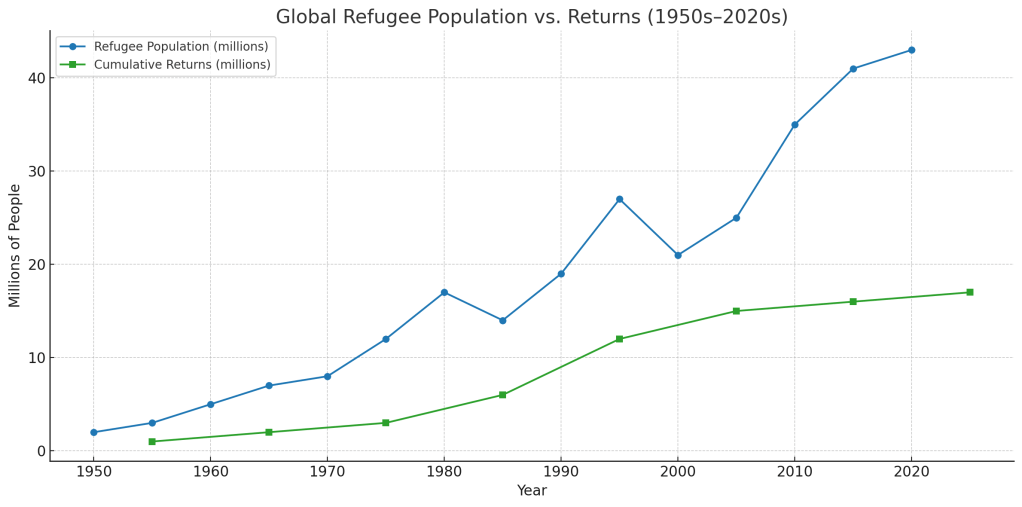
Yes, one timeline chart showing both refugee initial displacement and their return since 1950’s.
ChatGPT said:
1. Global Refugee Population (1950s–2020s)
The blue line shows the estimated size of the world’s refugee population at different points in time in millions. You can see steep rises during the Cold War conflicts, 1970s–1980s African and Asian crises, and then sharp increases again during the 2010s (Syria, South Sudan, Venezuela).
2. Cumulative Refugee Returns (1950s–2020s)
The green line tracks the total number of refugees who successfully returned home across the decades in millions. Notice the big surge in the 1980s and 1990s (peace settlements in Mozambique, Cambodia, Bosnia, Central America), followed by a sharp slowdown in recent decades, where very few are returning compared to the total displaced.
📊 What It Shows
- From the 1950s through the 1990s, returns kept pace with new displacement—peaking during the 1990s when peace agreements allowed millions to go home.
- Since 2000, the refugee population has risen sharply, while returns have nearly flatlined. The gap between the blue and green lines keeps widening.
- This means that more and more refugees remain in long-term exile, often spanning decades, instead of eventually going home.
Would you like me to annotate this chart with key historical events (e.g., Afghanistan 1980s, Bosnia 1990s, Syria 2010s) so the rises and plateaus are easier to connect with real-world crises?
You said:
What proportion of refugees live in camps?
ChatGPT said:
Most refugees do not live in formal camps. Here’s the breakdown:
Global Proportion
- According to UNHCR, as of the early 2020s, about 20–30% of refugees live in camps.
- The majority (around 70–80%) live in urban areas, informal settlements, or with host communities.
Why So Few Live in Camps
- Camps are usually set up in emergencies or when governments require refugees to stay in designated areas (e.g., Kenya’s Dadaab and Kakuma camps).
- But over time, most refugees move to towns and cities where they try to find work, education, or family networks.
- Host countries like Uganda, Colombia, and Turkey often allow refugees to settle among the general population rather than in isolated camps.
Regional Differences
- Africa: Still has large, long-established refugee camps (Kenya, Tanzania, Chad, Ethiopia, Uganda).
- Middle East: More refugees live outside camps, especially Syrians in Lebanon, Jordan, and Turkey—most live in rented apartments or informal housing.
- Latin America: Venezuelan refugees and migrants are overwhelmingly urban-based.
- Europe/North America: Refugees are resettled directly into communities rather than camps.
📊 Summary: Roughly 1 in 4 refugees live in camps today. The rest are in towns, cities, or rural host communities—often in difficult conditions but less visible than the high-profile camps shown in the media.
Would you like me to give a map or chart by region (Africa, Middle East, Latin America, Europe) showing the proportion in camps vs. outside?
ChatGPT can make mistakes. Check important info.
 AI Conversations
Leave a comment