
A Conversation By Brad Tuttle with ChatGPT
August 5, 2025
About a year ago I downloaded an app that displayed photos on my phone and then allowed me to trace the image onto paper by looking through my phone. It sounds like magic. It is magic. Here’s an image of one of my great granddaughters that I drew using the Da Vinci Eye app.
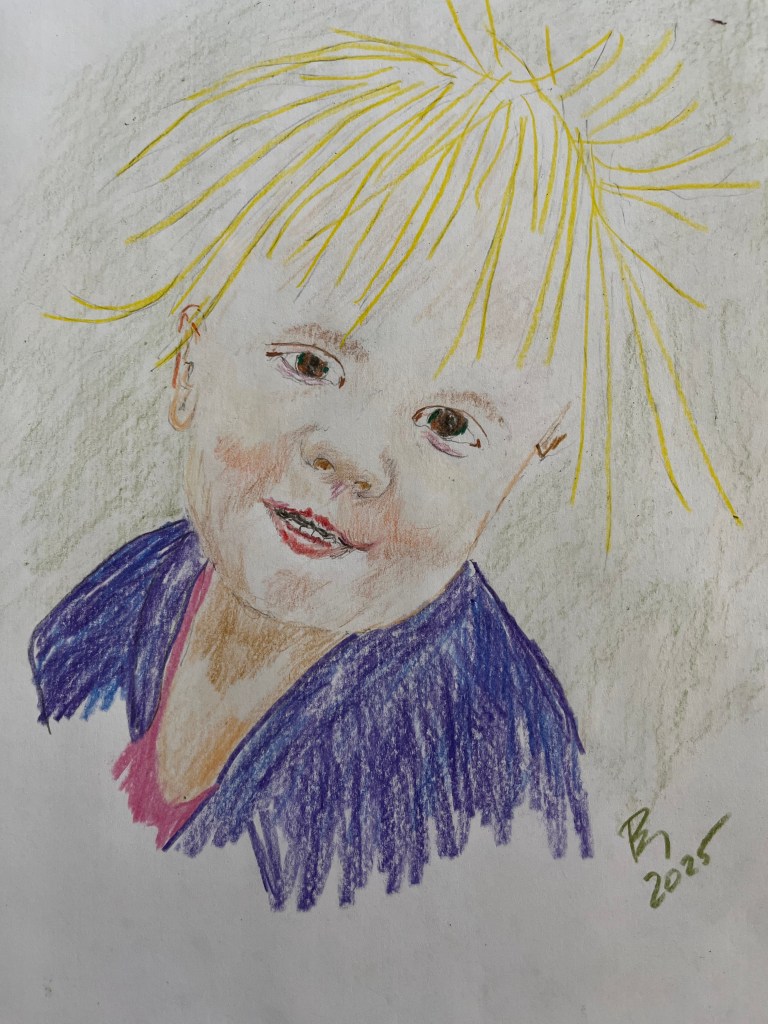
Okay, so what caught my attention is the notion that some really famous artists, both past and present, may have or are using similar tools, such as with the camera lucida first patented in 1806 by William Hyde Wollaston and long before that with the camera obscura. The term “camera lucida” is Latin for ‘well-lit room’ as opposed to “camera obscura” meaning ‘dark room.’ The camera lucida is still available today through the internet.
Chat history
You said:
Is it possible that Da Vinci used a camera obscura to compose the Mona Lisa?
ChatGPT said:
It’s possible that Leonardo da Vinci used a camera obscura—but there’s no direct evidence that he did when composing the Mona Lisa. However, the idea is not far-fetched, and here’s why:
✅ Why it’s plausible:
- He understood the optics: Leonardo was deeply interested in how the eye works and how light behaves. His notebooks include descriptions of the camera obscura, and he used it as a tool to explore vision and perspective.
- He was an innovator: Leonardo was always pushing boundaries with new tools and techniques. Using a camera obscura to assist in composition or achieve precise proportions would fit with his experimental mindset.
- Subtle realism: The Mona Lisa is renowned for its incredibly subtle gradations of tone (the sfumato technique). A camera obscura could have helped with observing those subtleties, especially in lighting and shadow.
❌ Why it’s speculative:
- No documentation: There’s no surviving note, sketch, or account from Leonardo or his contemporaries saying he used a camera obscura to make paintings.
- Not necessary for his skill: Leonardo was already a master draftsman with exceptional control of proportion and anatomy. He likely didn’t need a projection to draw accurately.
- Practical challenges: The image projected by a camera obscura is dim and inverted. Using it for large, detailed paintings would have been cumbersome without photographic paper (which didn’t exist yet).
In short:
It’s an intriguing possibility, and Leonardo certainly could have experimented with a camera obscura while studying light or testing compositions. But there’s no solid historical proof that he used it in the actual creation of the Mona Lisa.
Would you like a quick illustration or a breakdown of how the camera obscura works in context of Renaissance painting?
You said:
If there was found conclusive evidence that a camera obscura was used in the actual creation of the Mona Lisa, would this affect its value?
ChatGPT said:
If conclusive evidence emerged that Leonardo did use a camera obscura to create the Mona Lisa, it would likely enhance its historical and scholarly significance, not diminish its value—either artistic or financial. Here’s how it could play out:
🎨 Artistic Value
- Not diminished: Most experts would not consider this “cheating.” Using optical aids doesn’t reduce the genius of the work; it just reveals more about Leonardo’s methods.
- Greater appreciation of technique: Knowing he used a camera obscura might shift the focus to how he interpreted and manipulated what he saw through it—especially with sfumato and composition.
- Artistry ≠ mechanical copying: The Mona Lisa isn’t valued just for accuracy—it’s the psychological depth, mystery, and innovation that matter most. Those aren’t products of any machine.
📚 Historical and Scholarly Significance
- Revolutionary: It would reshape our understanding of the history of art and optics. It could show that Leonardo anticipated photographic techniques centuries before photography.
- Boost to optical art history: It would give support to scholars like David Hockney and Philip Steadman, who have long argued that Old Masters used optical devices.
💰 Monetary Value
- Unlikely to decrease: The Mona Lisa is considered priceless and is not for sale—it’s a cultural treasure held by the Louvre. But hypothetically, in an art market, its value wouldn’t drop. If anything, the intrigue could increase its cultural cachet.
Summary:
Confirmed camera obscura use wouldn’t tarnish the Mona Lisa—it would enrich its story. It would recast Leonardo as both painter and proto-photographer, reaffirming his status as a visionary who straddled science and art like no other.
Would you like to explore what other Renaissance artists might have used optical devices—or how this ties into the evolution of photography?
You said:
When would using a camera obscura or modern similar device be viewed as cheating?
ChatGPT said:
Using a camera obscura or a modern optical device (like a projector or digital tracing tool) in art is usually only considered “cheating” under certain conditions—mainly when it violates expectations of originality, transparency, or skill. Here’s a breakdown of when and why it might cross that line:
🎭 1. Context Matters: Fine Art vs. Academic vs. Commercial
✅ Fine Art (Personal or Gallery Work)
- Usually not cheating: Many artists use tools to achieve a vision—just as photographers use lenses and filters. What matters is the final result and intent, not just the process.
- Think of artists like Vermeer (believed by some to have used optical devices) or Chuck Close, who used grids and projectors openly. Their work is still admired.
❌ Cheating if:
- The artist pretends the work was done freehand or claims technical skill they didn’t actually apply.
- They’re entering competitions or contexts where manual skill is a core requirement (e.g., realist painting contests, atelier programs).
🏆 2. Competitions or Academic Settings
- Strict rules = stricter judgments.
- If an art contest or a school exam explicitly prohibits the use of tracing, projectors, or AI, then using them without disclosure is cheating.
- Integrity matters here—just like plagiarizing in writing.
💻 3. Commercial or Commissioned Work
- Expectation of skill: If a client is paying for a hand-rendered portrait, and the artist simply traces over a photo or AI-generated image without disclosure, that’s misleading—even if legal.
- Legal risks: Using projections or AI tools that rely on copyrighted materials without attribution can lead to copyright infringement issues.
🔎 4. AI, Digital Tracing & Photo-Bashing
- Modern twist on the issue: With tools like digital projectors, AI image generators, or Photoshop-based “photo-bashing,” debates are heating up.
- Controversy grows when artists:
- Present AI-assisted or heavily referenced work as purely original.
- Claim mastery without revealing reliance on tools.
💬 Summary: When Is It Cheating?
| Use Case | Cheating? | Why? |
|---|---|---|
| Personal or gallery art | No | Artistic freedom; process is personal |
| Art school drawing exam | Yes | Violates explicit rules of assessment |
| Selling traced art as hand-drawn | Yes (if undisclosed) | Misleads client about effort/skill |
| AI-generated art in contest | Yes (if disallowed) | Violates fairness and originality rules |
| Open use of projection in work | No | Tool use is part of artistic method |
Would you like examples of famous modern artists who use these tools openly—and how that’s viewed in the art world?
You said:
Yes
ChatGPT said:
Great—here are notable modern and contemporary artists who openly use optical devices, projection, or digital tools in their process, and how the art world generally views them. These examples show that using such tools isn’t inherently cheating—as long as the artist is transparent and the work adds creative value.
🎨 1. Chuck Close
Tool: Grid-based projection and photo transfer
Known for: Hyperrealistic portraits
How he used it: He often worked from photographs and would meticulously divide the canvas into grids, sometimes even using projectors to map shapes.
Art world reaction: Celebrated. His method was part of the concept, emphasizing process over illusion.
🗨️ Quote: “I don’t work with inspiration. Inspiration is for amateurs.”
🎨 2. David Hockney
Tool: Advocated the use of camera lucida and camera obscura
Known for: Bright, flat-perspective California scenes, and later, photo collages and iPad paintings
Key contribution: In his book Secret Knowledge, he argues that Old Masters like Ingres, Van Eyck, and Caravaggio used optical devices.
Art world reaction: Controversial but respected—he reframed how we understand classical painting without discrediting the artists.
🗨️ Quote: “The hand-eye connection is overrated… the hand is crude. The eye is everything.”
🎨 3. Jenny Saville
Tool: Projection of photographs
Known for: Monumental, fleshy, brutally honest figurative paintings
How she uses it: Begins with photos of herself or others, projects them onto the canvas, then paints over and through them.
Art world reaction: Her raw, physical technique and philosophical themes elevate the work—no one accuses her of cheating.
🎨 4. Kehinde Wiley
Tool: Photographic projection and digital composition
Known for: Portraits of contemporary Black subjects in classical poses
How he works: Poses models, photographs them, sometimes uses digital tools to compose the background, then projects and paints.
Art world reaction: Hugely celebrated—he painted Obama’s official portrait. His work is about reclaiming space, not photorealism.
🎨 5. Alexa Meade
Tool: Photography and body-paint projection
Known for: Painting directly onto live models to make them look like 2D paintings
Technique: She “paints reality” and then photographs it, collapsing painting, sculpture, and photography.
Art world reaction: Innovative and interdisciplinary—invited to TED, museums, and collaborations with brands.
📱 Bonus: Digital and AI Artists
- Refik Anadol: Uses machine learning and data visualization to create immersive art installations.
- Beeple: Uses 3D rendering tools and has sold digital artworks as NFTs for millions.
- Art world reaction: Sometimes skeptical, but increasingly accepted in major institutions like MoMA and the Tate.
🎯 Takeaway:
Tools don’t diminish art. Intent, creativity, and honesty do.
Using projections, digital tracing, or AI can be part of a legitimate and respected art practice—as long as the artist brings a unique vision and is transparent about the method.
Want me to compare how different art schools or galleries treat tool use today—or explore how AI is changing the definition of “original” in the art world?
You said:
This seems related to the current tension surrounded by AI assisted writing in which there seems to be an all or nothing approach.
ChatGPT said:
Absolutely—you’re right to connect the two. The tension around AI-assisted writing closely parallels the historical and ongoing debates in visual art about the use of tools like the camera obscura, projectors, or Photoshop. In both cases, people often fall into “all-or-nothing” camps, which can obscure more nuanced questions of authorship, process, and intent.
🔄 Parallels Between Visual Art and AI-Assisted Writing
| Visual Art | Writing |
|---|---|
| Camera obscura, projection, tracing | Text generation, paraphrasing, style mimicking |
| Criticized as “cheating” or “mechanical” | Criticized as “lazy” or “not original” |
| Accepted if tool use is transparent and creative | Growing acceptance if AI use is credited and the human author adds value |
| Focus shifting from manual skill to conceptual depth | Focus shifting from sentence crafting to narrative, structure, and originality of thought |
🤖 Why the “All or Nothing” Framing Fails
❌ “If AI helped, then it’s not real art/writing.”
This view assumes that process purity = value, which isn’t true even in traditional forms. Writers use grammar checkers, thesauruses, co-editors. Artists use brushes, grids, and cameras. AI is a tool, not a replacement for creativity.
❌ “If AI can do it, it’s not worth doing.”
This assumes ease erases meaning—but creativity is more than difficulty. An idea can be brilliant and deeply human even if generated through easy means.
✅ A More Nuanced Approach: Tool Use Spectrum
| Type of Use | AI-Writing Example | Legitimacy? |
|---|---|---|
| Brainstorming | Asking AI for topic ideas | ✅ Common, low-stakes |
| Generative Drafting | Getting a rough first draft from a prompt | ✅ If edited and shaped |
| Polishing | Rewriting for clarity, tone, grammar | ✅ Like a digital editor |
| Wholesale Ghostwriting | Submitting unedited AI output as your own | ⚠️ Ethically fuzzy, especially in education |
| Creative Collaboration | Blending AI ideas with your voice or structure | ✅ Emerging new practice |
📚 In Education, the Stakes Are Higher
- The concern in schools or universities is that learning outcomes depend on doing the work yourself.
- So even if AI use isn’t “cheating” per se, it can undermine development if it replaces thought instead of extending it.
- But banning AI entirely may be shortsighted. Better to teach how to use it ethically, like citing sources or using a calculator responsibly.
🗣 Final Thought
Just like the camera obscura didn’t replace the artist, AI won’t replace the writer—but it will change the role of writers, the skills we prize, and how we define creativity.
Would you like a one-page chart or guide on how to ethically use AI in writing (for teachers, students, or professionals)?
ChatGPT can make mistakes. Check important info.
 AI Conversations
Leave a comment